

Honda’s light electric scooter works well but isn’t perfect
What’s in a name? Generally, I don’t like it when firms put ‘quirky’ punctuation into a product’s moniker. Partly because it looks bad, but mostly because it’s a faff to type out. Dutch kit maker REV’IT!, we’re looking at you now.
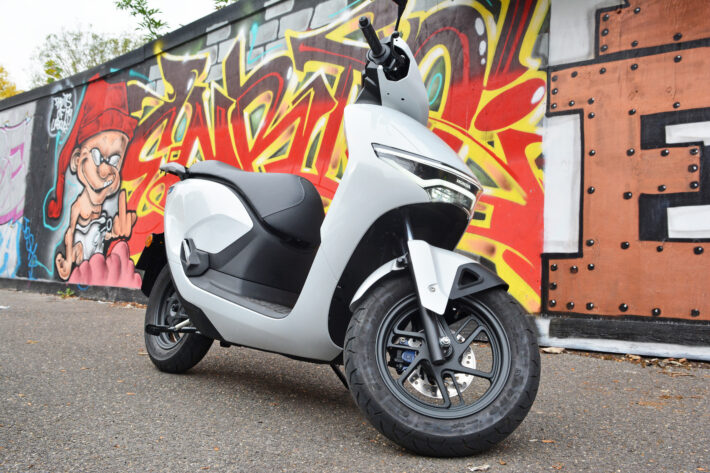
So, I was mildly peeved at Honda from the start when it released the details on its latest battery-powered bike last year – the CUV e: – complete with random capitalisation and superfluous colon (never ideal). It stands for Clean Urban Vehicle, electric, though someone did point out that it pays homage to the original Honda city mover, the 1958 Super Cub 50, which is kinda charming. A ‘leccy Cub with a lisp, nice.
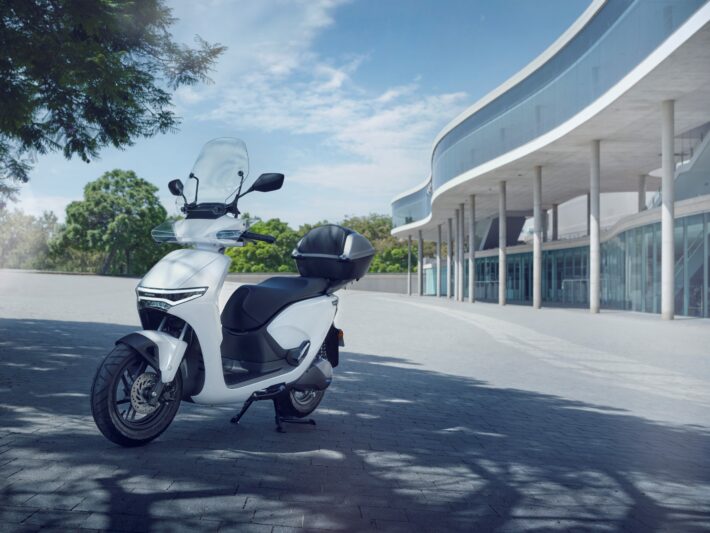
On the face of it though, this could be a solid win for the big H. The lightweight electric bike sector is the only one that’s having much success at the moment, especially in the UK. Full-power machines are struggling to compete, mostly down to worries about range and charging times compared with petrol machinery.
While cars have the room for big batteries under their floor, and can manage the massive weight and cost penalties associated with the likes of a 60kW/h battery pack, bikes are far more limited. If you want the holy grail of a 150-175bhp bike weighing 200-220 kilos with a range of 200 miles and refuelling time of ten minutes, all while costing around £12,000, then it’s simply not possible with battery power.
That’s not to say there’s no path forward for big battery bikes, but that we’ll need to change our approach at the very least. What this all means right now is that big electric bike sales are utterly moribund, despite there being some decent fun options out there.
Back to the lightweight urban sector, and here battery power really shines. Low speeds and shorter journeys means that a 50cc or 125cc equivalent machine is easy to engineer, especially since battery bike range really does scale with speed. Keep your riding around town, at sub-40mph pace, and motors simply sip energy, with zero consumption when sat at lights compared with a hot loud petrol motor idling away.
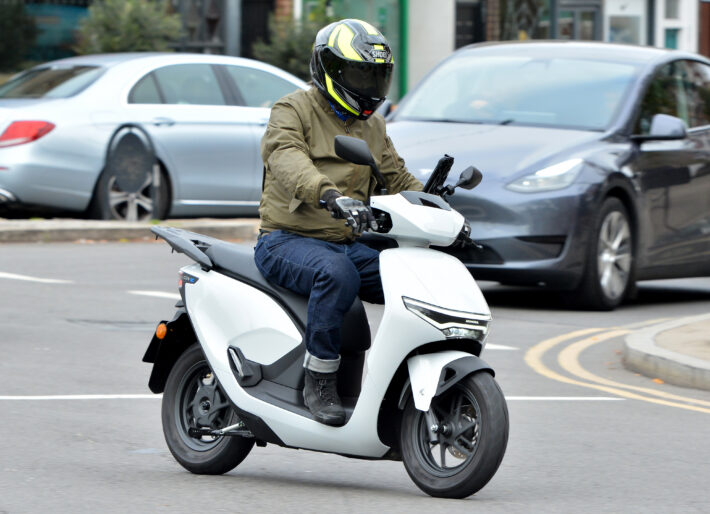
Add in tightening emissions zones in big cities, lower maintenance costs and super-cheap charging if you can do it at home or work, and a battery-powered 50-125cc competitor makes a lot of sense for urban commuters and delivery riders. That’s shown by the relative success of brands like Vmoto with its CPx scooters, as well as (in a different sector) the explosion in use of battery-assisted e-bicycles in town.
And now Honda’s getting in on the act, as part of its new electric two-wheeled lineup. It’s got a series of new battery bikes on the way, including the new WN7 naked which is just dropping this spring.
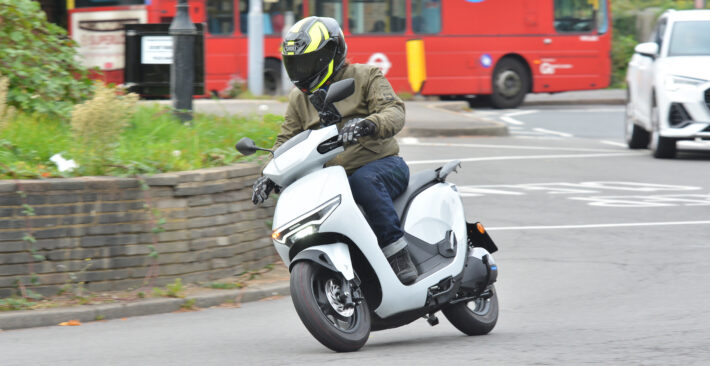
In the meantime, though I’ve got the CUV e: for a couple of weeks, and it’s dropped off by the lovely Honda courier. As usual, they give me a quick once-over with the bike, most of which is pretty simple: keyless ignition, moped-style twist and go operation, options to link your phone, USB charging socket, etc.
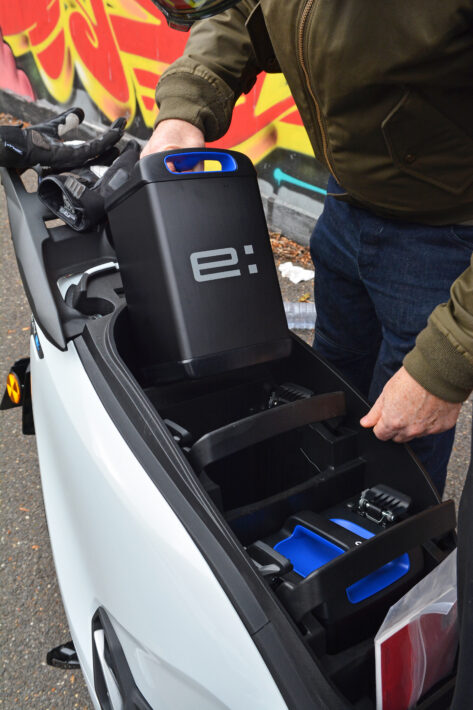
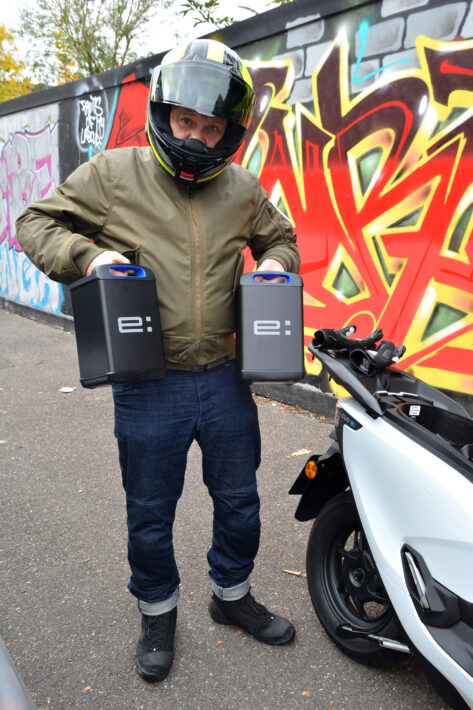
There is a twist here though, the guy goes back into the van and brings out two massive cardboard boxes, each with a battery charger inside. The CUV uses two of the new Honda Mobile Power Pack e: batteries, which sit under the seat. They can’t be charged in the bike though: they need to be taken out and put into the massive chargers, which are about the size of a big breadbin or waste paper basket.
The battery packs themselves slot into the chargers, and indicator lights show the state of charge. It’s a big, bulky setup, and I need to do a bit of reorganising in my garage to make room for ‘em… A quick half-hour topup of charge, and we’re ready to rock.
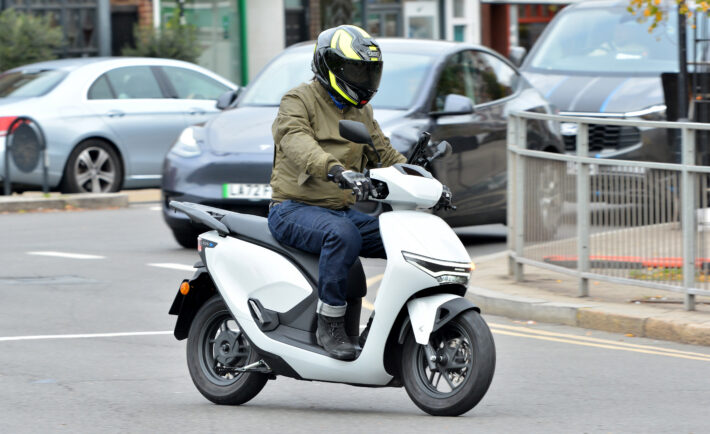
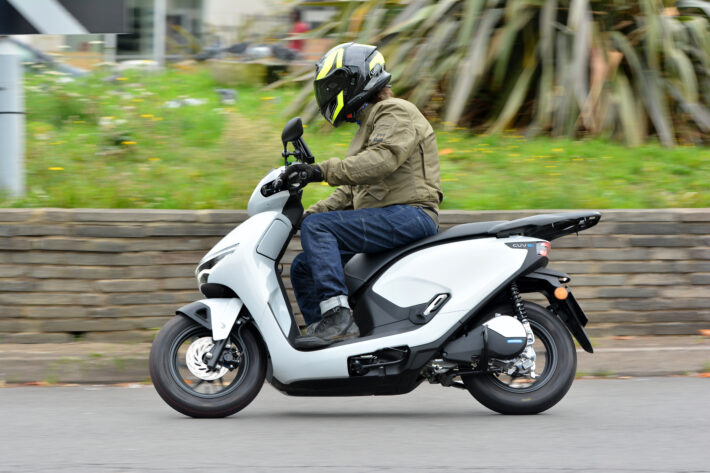
Riding the CUV e: is utterly drama-free. It’s a small, super light (120kg) machine of course, with a real moped feel at rest. Pulling away though, it’s a perky little beastie. Honda says it has the performance of a 110cc scooter, but off the line I’d say it’s sharper than plenty of 125cc learner machines. The physics of electric motors means maximum torque from zero revs, and the little white Honda is more than able to keep up with normal SW London traffic.
It’s suitable silent of course, but the world is getting used to electric cars and even buses, so the lack of exhaust noise is less worrying than it used to be: people are aware of you coming. There are three riding modes: eco which is very slow, standard which is a bit quicker, and sport, which claims to be around a 125cc scooter acceleration level. I’ll be honest: I left it in sport the whole time (though you have to select that each time you stop).
The impact on the range is well worth it in return for the sparky performance boost. Honda claims around a 45 mile range in urban use, which should be more than enough for most users’ daily trips, and top speed is a claimed 83kph/51mph, again, ample for the use case as they say.
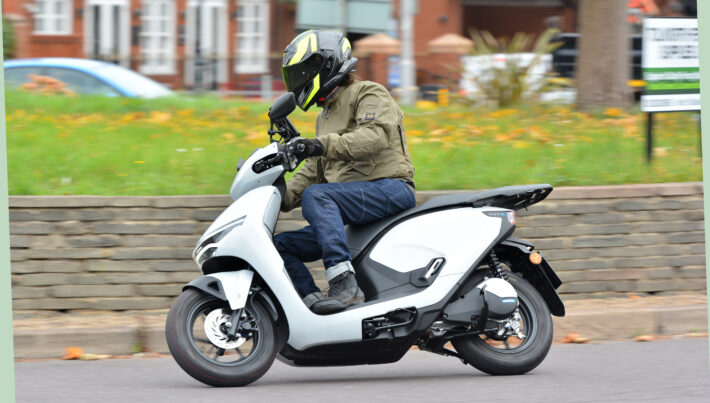
The Honda’s titchy 12-inch wheels mean the handling is a little high-strung compared to a big bike, but the CUV is superbly nimble. You can get through almost any traffic jam on this: it’s in the same sort of scale as a bicycle in terms of length and width, with plenty of steering lock and a low seat, meaning you can thread past buses, trucks, cars and taxis with ease, even on London’s tightest routes, narrowed by cycle lanes and traffic calming measures.
The brakes are strong, with a simple rear drum, and there’s a basic combined braking setup so both ends are activated when you’re stopping. Suspension is basic fare, but again works well enough, only being overwhelmed by the worst of the potholes round my manor.
I take the CUV for a brief run down the A3 dual carriageway near my house, to check that it does max out at around 55mph, which it did, and also to see what it’s like in faster traffic. A bit marginal is the answer of course: I’d not want to go near a motorway or fast A-road too often on the CUV.
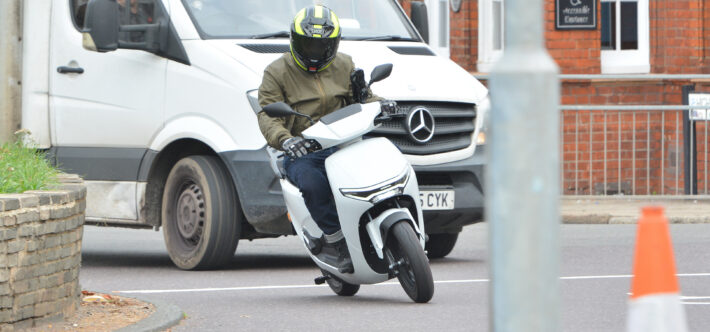
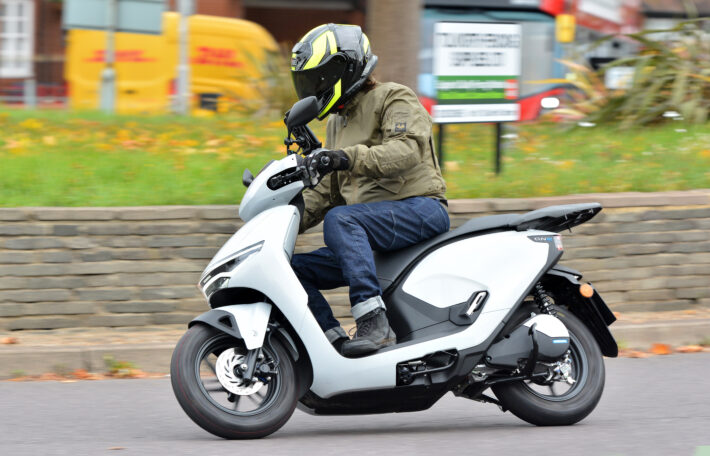
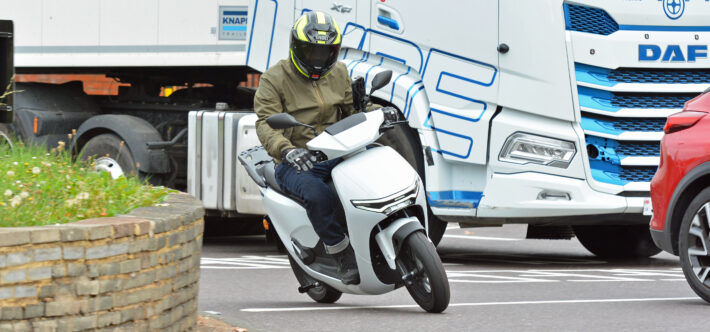
It gets up to speed quickly enough, but the small wheels and diminutive stature leaves you feeling exposed, especially when the big lorries start to overtake you. Looking at the pics of me on a local roundabout dicing with an HGV underlines how small the scoot is.
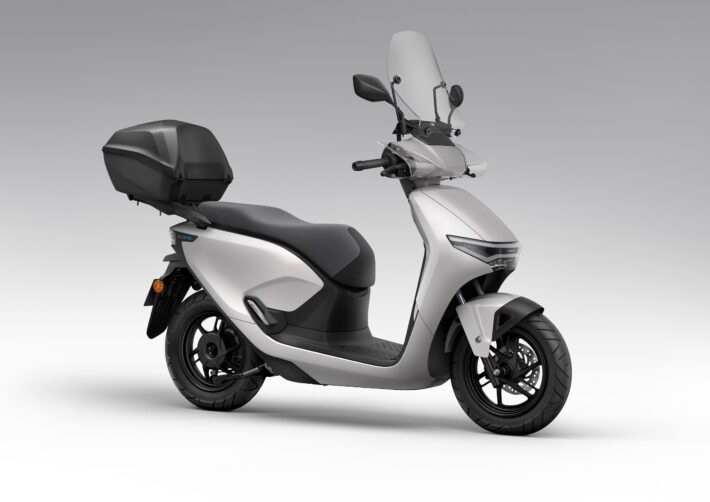
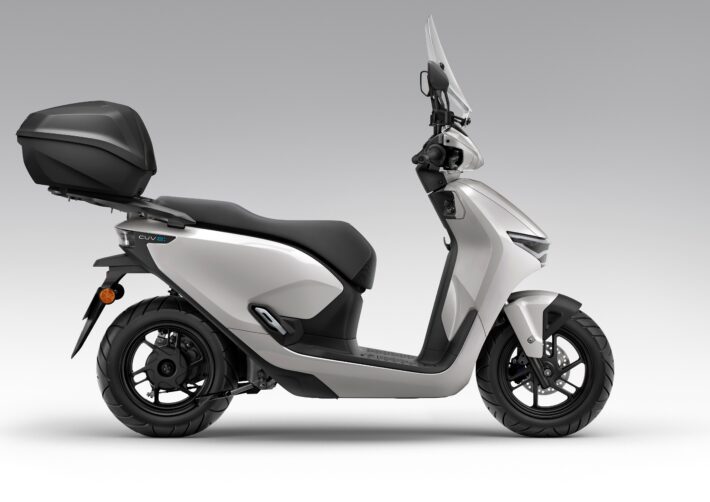
So – few surprises really. The CUV e: is a lightweight electric scooter with Honda backup, solid performance, neat design and useful everyday stuff like the keyless entry and the colour dash. There’s also a reverse function, which seemed largely superfluous on such a lightweight machine, but might be useful when parking up.
Over the course of the test though I found a few basic problems which do handicap the bike for me. Firstly, the two batteries mean there’s no underseat space, apart from a tiny pocket which will just about hold a small disc lock. The batteries themselves are held in with a beautifully engineered clamping system, but one oversight is that the bike won’t run at all with only one battery in place.
So if you wanted to do a short trip, leaving space under the seat for a small bag of shopping or the like, you can’t. On the upside, if you have a battery out, the thing is completely immobilised and thief-proof.
The other issue is the charging. You need to have the (frankly huge) charging base units to top up the cells, and they’re far too big to carry about. You can’t charge the batteries in the bike at all, so if you wanted to ride to work and charge there, you’ll need to take a charger there somehow and leave it.
A simple three-pin connection on the scooter would save a lot of grief, even for very low power top-up charging, but it doesn’t have that option. You also need a lot of space somewhere at home or in your garage to store the chargers, and they have built-in fans which run while charging, meaning background noise during charging.
On the upside, the batteries and chargers are nicely engineered, and feel like quality pieces of kit which will last a long time. As an aside, Honda is developing other uses for the removable battery infrastructure, so these units might appear in cars, lawnmowers, hell you might even have a wall of these in your house in future, storing up solar energy to run your domestic supply as well as your bikes and cars.
As it is though, the CUV e: is certainly an interesting option in the sector. It’s well-priced at just £3,800 for the Connected version, though you’d need to add on an accessory topbox (from £190) to have any storage space at all. That’s around £1500 more than the firm’s lightweight petrol 110cc scooter, the Vision.
You’re guaranteed solid backup in terms of dealer support, spare parts, warranty and the like, which might make the CUV e: a more tempting prospect compared to less well-known brands. Interested? Then get along to your local Honda dealer for a test ride!
www.honda.co.uk/motorcycles/range/scooter/cuv-e/overview.html
Honda CUV E: Specifications
| 25YM CUV e: | STANDARD | CONNECTED |
| MOTOR | ||
| Motor installing location | Rear wheel left side | |
| Max. Power Output | up to 6kW | |
| Max. Torque | 22 Nm | |
| Acceleration | 0→100m 8.3Sec | |
| Max Speed | 83 km/h | |
| Reverse Mode Max Speed | 3km/h | |
| Electric Range | 72 Km | |
| Power Consumption rate | 63Wh/km | |
| ELECTRICAL SYSTEM | ||
| Number of Battery packs | Two | |
| Battery Type | Lithium Ion, removable | |
| Voltage | 50.3V | |
| Capacity | 1.3kWh | |
| Battery Weight (each) | 10.2kg | |
| Battery Dimensions (each) | 298mm x 177.3mm x 156.3mm | |
| Charger | Off-board type – Single-phase AC100-240V 50/60Hz | |
| Charging time 0% to 100% | 6 hours | |
| Charging Time 25% to 75% | 160 minutes | |
| Rated Power | 270W | |
| Lifecycle | >2,500 | |
| FRAME | ||
| Frame Type | Underbone | |
| CHASSIS | ||
| Dimensions (L x W x H) | L:1970mm x W:675mm x H:1100mm | |
| Wheelbase | 1,310 mm | |
| Caster Angle | 26°0’ | |
| Trail | 77 mm | |
| Handlebar Height | 985mm | |
| Seat Height | 760 mm | |
| Ground Clearance | 145 mm | |
| Kerb Weight | 119 kg | 120 kg |
| Turning radius | 1.99m | |
| SUSPENSION | ||
| Suspension Front | Telescopic, 26mm forks, free valve type, 90mm stroke, non-adjustable | |
| Suspension Rear | Monoshock suspension, 75mm travel, non-adjustable | |
| WHEELS | ||
| Wheels Front | 12 x 2.15 aluminium Cast Wheel | |
| Wheels Rear | 12 x 2.50 aluminium Cast Wheel | |
| Tyres Front | 100/90-12 59J | |
| Tyres Rear | 110/90-12 64J | |
| BRAKES | ||
| Brakes Front | 190mm disc, single-piston caliper | |
| Brakes Rear | Drum | |
| INSTRUMENTS & ELECTRICS | ||
| Instruments | 5″ TFT Meter | 7″ Connected Display |
| Headlight | LED | |
| Taillight | LED | |
| Connectivity | No | YES RoadSync Duo® |
| USB | Type-C | |
| Immobiliser | Yes | |
| Drive mode | Three Modes | |
| SMART Key | Yes | |
| Additional Features | Reverse assist | Reverse assist; Navigation System |