

If your motorcycle sits unused for weeks or even months, a trickle charger can help keep the battery topped up during periods of inactivity. This can reduce the risk of a flat battery and help avoid replacing it sooner than expected.
Below, we cover:
- What is a motorcycle trickle charger?
- How does a motorbike trickle charger work?
- Why motorcycles need a trickle charger
- Do car trickle chargers work on motorbikes?
- How much electricity does a motorbike trickle charger use?
- How to use a motorcycle trickle charger safely
- Choosing a suitable motorbike trickle charger
- Can you leave a motorcycle trickle charger connected all winter?
What’s a motorcycle trickle charger?
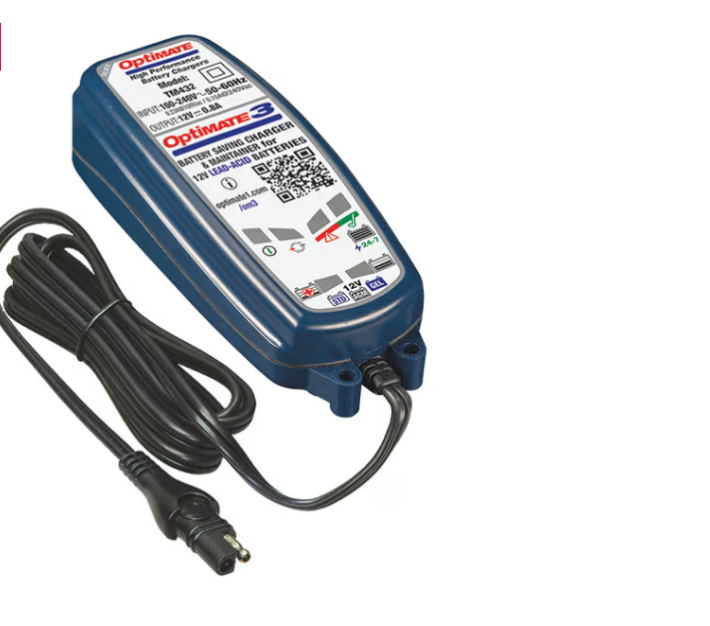
A motorcycle trickle charger is a low-amperage device designed to maintain a 12V motorcycle battery, rather than rapidly recharge it.
Instead of delivering a high burst of current, it provides a slow, steady charge to offset the natural self-discharge that occurs when a battery sits unused.
Many modern devices sold as “trickle chargers” are actually smart battery maintainers.
Unlike a basic trickle charger that continues to deliver current even when the battery is full, a smart maintainer monitors battery voltage and automatically switches to a float (maintenance) mode once charging is complete. This helps prevent overcharging.
For most riders, a smart maintainer may be a more suitable option for long-term use.
How does a motorbike trickle charger work?
A motorcycle trickle charger supplies a low, consistent current to compensate for the natural voltage drop that happens when a battery isn’t in use. Smart chargers also monitor battery voltage throughout the charging process.
Many operate in three main phases:
- Bulk charge: The charger delivers a steady current to bring the battery up from a low state of charge.
• Absorption: As the battery approaches full capacity, the charger reduces the current to avoid overloading the cells.
• Float/maintenance: Once fully charged, the charger switches to a low-level maintenance mode, supplying just enough current to counter natural discharge without overcharging.
This three-stage process is particularly useful for batteries left connected for extended periods, as it helps keep the battery in good condition without the risk of damage from continuous high-current charging.
Why motorcycles need a trickle charger
Motorcycle batteries are generally smaller in capacity than car batteries, which can make them more susceptible to losing charge during periods of inactivity.
Several factors can contribute to battery drain, including:
- Extended winter storage, when many bikes sit unused for weeks or month
- Modern security features, such as alarms, trackers, and keyless ignition systems, which draw a small but continuous current
- Infrequent short rides, which may not give the alternator enough time to fully recharge the battery
- A replacement motorcycle battery can cost anywhere from £21.99 to over £225, depending on the type and specification. A suitable trickle charger may be available for considerably less, potentially making it a cost-effective way to extend battery life over time.
Do car trickle chargers work on motorbikes?
Some car trickle chargers can be used on motorcycle batteries, but there are a few important considerations.
A car charger may be suitable if:
- It has a low amperage setting – ideally around 0.8 to 2 amps
• It’s compatible with the battery type in your motorcycle (AGM, gel, or lithium, as applicable)
• It’s designed for 12V systems, which most modern motorcycles use
Car chargers with high fixed outputs should generally be avoided, as they may deliver more current than a smaller motorcycle battery is designed to handle.
This can increase the risk of overcharging, which may shorten battery lifespan or, in some cases, cause damage.
If you’re unsure whether your existing charger is suitable, checking the manufacturer’s specifications or consulting a specialist is advisable.
In many cases, using a charger designed specifically for motorcycles can be a simpler and safer option.
How much electricity does a motorbike trickle charger use?
Power consumption varies depending on the charger model and the stage of the charging cycle, but most motorcycle trickle chargers draw somewhere between 5 and 50 watts during active charging.
Once a smart charger enters float/maintenance mode, power consumption typically drops considerably – sometimes to just a few watts or less.
As a result, leaving a charger connected throughout the winter is unlikely to make a noticeable difference to your electricity bill. In many cases, the running cost over a full winter storage period may amount to only a few pounds.
Exact figures will depend on your charger’s specifications, so checking the product documentation for wattage information is a useful step if you’d like a more accurate estimate.
How to use a motorcycle trickle charger safely
Following safe charging practices can help to protect both your battery and your bike.
Here is a general guide to using a motorcycle trickle charger:
- Park in a suitable location: Choose a dry, well-ventilated area. Avoid enclosed spaces with poor airflow, particularly if your battery is a lead-acid type, as some charging processes can release small amounts of gas.
• Turn off the ignition: Ensure the bike is switched off before connecting the charger.
• Connect the positive (red) clamp first: Attach to the positive terminal of the battery, then connect the negative (black) clamp to the negative terminal.
• Plug the charger into the mains: Connect to the power supply once both clamps are securely attached.
• Confirm the indicator lights: Most chargers display a light or readout to confirm the connection and charging status. Consult your charger’s manual if you’re unsure what to expect.
Safety reminders:
- Check cables and clamps for any signs of damage before use
• Keep the charger away from flammable materials
• If your motorcycle has a lithium battery, ensure your charger is lithium-compatible
• Many modern chargers include reverse polarity and spark protection as standard – check your product’s features before purchasing
Choosing a suitable trickle charger
With a range of options available, there are several factors worth considering when selecting a motorcycle trickle charger:
- Battery type compatibility: Check whether the charger supports your battery chemistry – options typically include lead-acid, AGM, gel, and lithium. Using an incompatible charger could damage your battery.
- Amperage rating: For most motorcycles, a charger with an output of 0.8A to 1.5A is generally considered suitable for maintenance charging. Higher outputs may be appropriate for larger batteries but should be used with care.
- Automatic shut-off and float mode: A charger that switches to float mode when the battery is full helps to prevent overcharging during long-term storage.
- Weather resistance: If you plan to charge in a garage or outdoor storage area, a charger with some degree of moisture resistance may be worth considering.
- Quick-connect leads: Some chargers include a connector that can be left attached to the battery terminals, making it easier to plug in without removing bodywork or accessing the battery directly each time.
Can you leave a motorcycle trickle charger connected all winter?
Yes, smart battery maintainers are generally designed for long-term connection.
Once the battery reaches full charge, they switch to float mode, delivering only a small current to offset natural self-discharge. This means they can typically remain connected for extended periods without overcharging the battery.
A basic trickle charger, by contrast, may continue to supply a continuous charge regardless of battery state, which could lead to overcharging over time.
If you’re planning to leave a charger connected throughout winter storage, a smart maintainer with automatic float mode would generally be a more suitable choice.
It’s also worth following the manufacturer’s guidance for your specific charger model, as recommended usage can vary.
Help protect your motorbike with specialist insurance from Devitt
Keeping your battery maintained over winter is one way to help look after your bike during storage. Ensuring your motorbike insurance remains in place is another important consideration, whether your bike is in regular use or being stored for the season.
Devitt has over 90 years of specialist experience arranging motorbike insurance and can help you find a policy suitable for your needs. Explore a quote online or contact our UK-based team to find out more.
Disclaimer: the sole purpose of this article is to provide guidance on the issues covered. This article is not intended to give legal advice, and, accordingly, it should not be relied upon. It should not be regarded as a comprehensive statement of the law and/or market practice in this area. We make no claims as to the completeness or accuracy of the information contained herein or in the links which were live at the date of publication.
You should not act upon (or should refrain from acting upon) information in this publication without first seeking specific legal and/or specialist advice. Arthur J. Gallagher Insurance Brokers Limited trading as Devitt accepts no liability for any inaccuracy, omission or mistake in this publication, nor will we be responsible for any loss which may be suffered as a result of any person relying on the information contained herein.