
This is a really odd story to write and, I have to admit, more than a bit emotional because Crooks Suzuki, the T500 production racer from 1970, and Devitt have been with me almost all my motorcycling life – and that’s a long time!
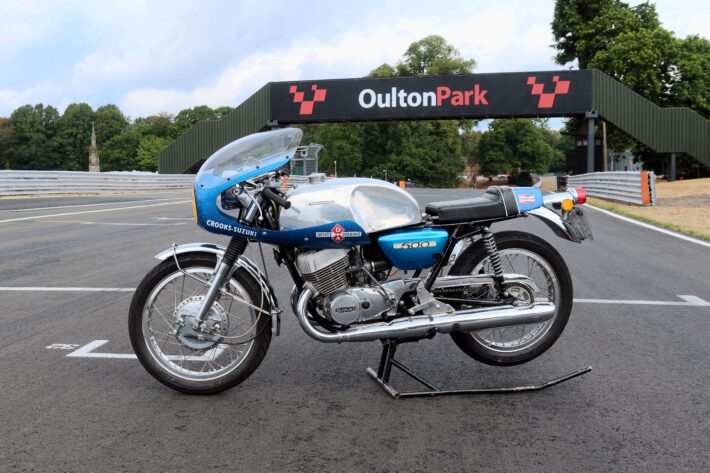
In a world free of internet, which was painted in dull browns and grey, Crooks Suzuki and Devitt were miles past every frontier of being fashionable.
I had a Crooks Suzuki anorak with a yellow stripe on each sleeve. Can you believe that? A yellow stripe on a blue anorak. It was almost obscene!
And there was Devitt. Hugely the market leader in motorcycle insurance with their daring logo and race team association.

Put the two together and this was as high on the bike desirability chart as it was possible to get.
The story starts in 1969. After leaving school aged sixteen I had ricocheted from one job to another and established a fairly consistent record of failure at everything, from a labourer painting shelves to an Executive Officer in the Post Office – and all stops in between.
One rather unproductive avenue I explored was trying to get a job with any of the leading motorcycling magazines of the day. The brutal truth was that none of them would have me – even for free!
I had no “A” levels, and therefore hadn’t completed one of the excellent National Union of Journalists’ training courses, no experience of working with a magazine and no inside contacts. In fact nothing whatsoever to make me worth employing, except that I could write – and I really could write – and I loved motorcycles.
Through a series of incredibly lucky breaks, a lot of effort and some real natural ability I was accepted for teacher training in the Autumn of 1969. At the same time, my Auntie Edie went to America – on an aeroplane! How exotic was that? I asked her to bring an American bike magazine back for me because America was an all-new motorcycling world. Auntie Edie was very fond of me and so brought back not one bike mag but fourteen – and the call of being a journalist began again.
When my mum found out that I still harboured hopes of writing about bikes she went absolutely bonkers. Her dream for me was to come home from work with clean hands. That was the ultimate aspiration all working class mothers had for their kids. Now I had won life’s golden lottery ticket by starting teacher training and she was terrified that I would lose everything for the sake of motorcycling: it was a wholly justifiable fear.
Regardless, I wrote to all fourteen magazines with a fine piece of creative writing in terms of my experience and industry contacts – but not my ability to produce professional quality articles. This bit of my sales pitch was absolutely accurate!
Twelve magazines didn’t reply, one said no and Motorcycle World, of Park Avenue South, New York asked me to send them a piece. I did, they liked it and I was a professional journalist: it really was no more complex than that. You can read the full story in the first part of my autobiography “A Penguin in a Sparrow’s Nest”.
So there I am with the opportunity to continue with teacher training and at the same time get paid for writing about motorcycles. What could possibly be better?
The snag was that my new employers had great ambitions for the magazine – and for me. New York was in the wrong place because all the motorcycling action took place on the West Coast. But they did have a superstar English journalist – I was very creative when I first wrote to them – and this would give them the edge over their Californian opposition.
For my second article they demanded a world exclusive, and I just managed to pull this off by the skin of my teeth by writing an article on the Cheney Suzuki which was doing so well in British motocross.
My editor absolutely loved this and so decided to raise the stakes. He had very little idea of what the Isle of Man TT actually meant, and its status at the time, but he had accepted all that I told him about my industry contacts. He had no problem asking me to come up with another world exclusive – this time, the bike which won one of that year’s TT races.
Although the USA had very little tarmac racing at the time, the TT was still the most important event in the road racing calendar and was therefore known to my American editor. Hence his commissioning of the article.
At the same time, because it was the most important road race in the world, getting a ride on a bike which won a TT was quite simply impossible: not just difficult but simply not achievable.
When I speak to young journalists who want to be freelancers, I try to explain to them that perhaps the single greatest asset you can have is the ability to deliver. Always accede to an editor’s request – and then work out how to do the job later!
This black and white attitude was what I loved most about working for the Americans – and still do. America truly is the most democratic nation in the world. No-one at Motorcycle World asked me about my family background, my “A” levels – or lack of them – or my total absence of professional training. Everything was wonderfully, beautifully simple. Write the story and if we like it we’ll pay you. If we don’t, you’re fired. What could be fairer than that? You could have all the qualifications in the world, but if you couldn’t deliver you weren’t going to get hired and certainly not paid.
I thought that this was great so I did what all good freelancers do – I lied. Yes, I would test a bike which won a TT and yes it would be an exclusive. What could be easier?
The answer was almost anything in the motorcycling world.
For a start, the main classes were simply beyond reach – even with my fevered and desperate imagination. Giacomo Agostini, and the works MVs, looked to be certain winners in the two Premier classes and things weren’t much easier in the 250cc and 125cc divisions. I just was not going to get a ride on any of these bikes.
My only hope was the Production TT. Production Racing is a class for what are, supposedly, standard road machines and at the time there was a huge amount of interest in the idea of racing machines which, in theory at least, the general public could buy.
Production Racing attracted factory entries from Triumph, BSA, BMW, Velocette, Bultaco and Norton all striving for race results which would help sell bikes so, in theory at least, I was in with a chance.
By this time, I was very serious about college. I had settled well into the academic work and professional training and so had to fit being a top international journalist in between lectures, seminars and tutorials. It was a busy time and the current obsession with work/life balance really does make me smile. I lived to work – and loved it!
Fortunately, there was a pay phone at the bottom of the stairs leading from the English department and, with a pocketful of coins, I started to haunt this place. The first pitch was to BSA. “Hello, I’m Frank Melling and I’m a journalist writing for Motorcycle World…”
I didn’t get much further until the much loved “Dear Sir or Madam” response kicked in and I was asked to send my CV in to the Press Department for consideration.
The lady on reception at Triumph was a little less brusque – but not much.
Two down and no scores so far.
Norton was no better and the British BMW office had no idea what the parent factory were doing and no interest in me whatsoever.
Geoff Dodkin, who ran the works Velocettes, was polite but Velocette were on their last legs as a motorcycle factory – he doubted if there would be any bikes at the 1970 TT.
I had run out of ammunition and the enemy was swarming over the hill with fixed bayonets. This was the end. My two article journalism career had been a wonderful experience but thank goodness I had taken college seriously. At least I wasn’t going back to scrap metal burning or humping potatoes into farm trailers!
Then I read an article in Motorcycle News. Eddie Crooks, the owner of Crooks-Suzuki, was going to enter the Production TT with a 500cc Suzuki. Here were the final dregs in the almost empty bottle of the terminal order in the Last Chance Saloon. This was it. One last bet – and then I would be thrown out on to the street as a failure.
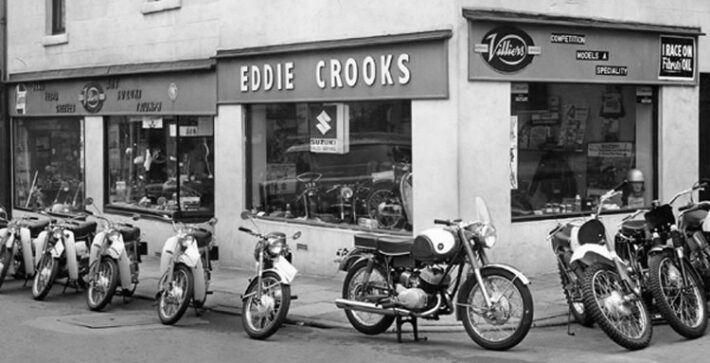
I loaded up with loose change, headed for the phone booth again and dialled the Crooks’ shop in Barrow-in-Furness.
“I’m Frank Melling. I’m a journalist. May I speak to Mr Crooks, please?”
“Yes, this is Eddie. What’s up?”
I was in shock. Instead of a distant secretary or receptionist I was talking to the man who could, just possibly, save my head from the noose.
I need to digress at this point to explain about Eddie. He had no training or experience in marketing or PR but intuitively knew more about the subject than anyone in the motorcycling business, and probably any other profession for that matter. I am sure that he left his mother’s womb looking for a photo opportunity because he was – quite simply – a natural, and gifted, marketing genius.
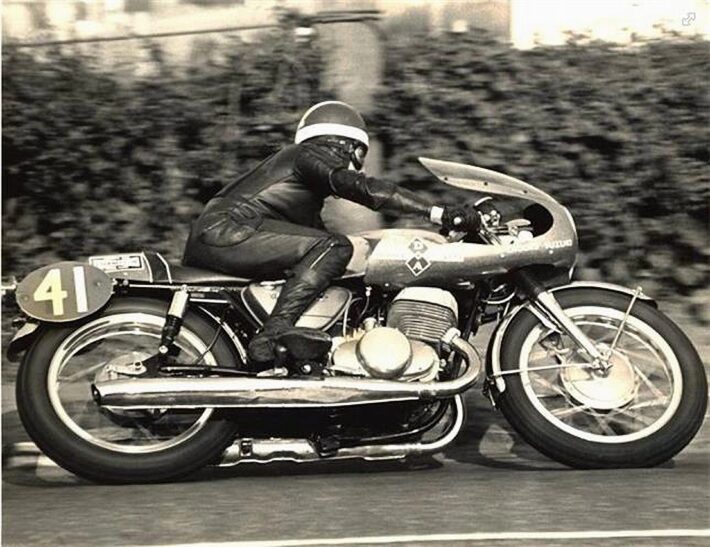
He was years ahead of the industry and had formed a firm relationship with Devitt Insurance, really the only player in bike insurance at the time. Devitt were the gold standard and Eddie knew that relationships like this were the mother lode.
He also took to me immediately and we were instantly on the same wave length. In some respects, Ed was not always a paragon of virtue but with me he was wonderful and, as the years passed, we were to become ever closer.
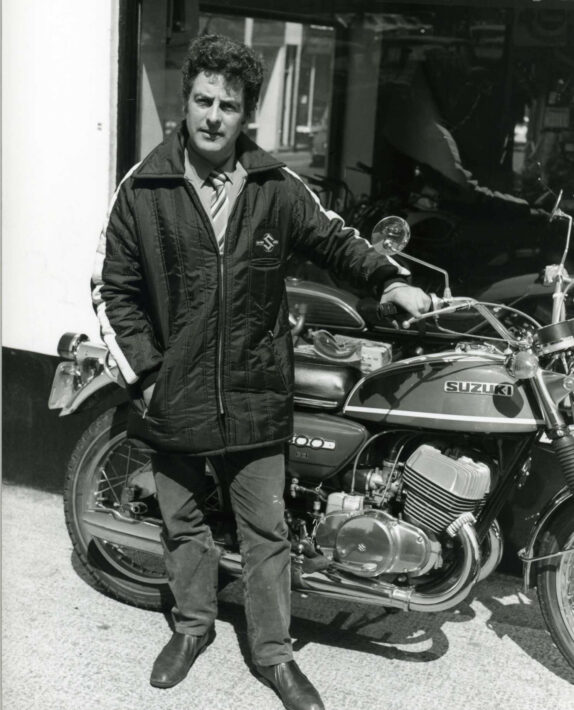
Ed’s aim was to make Crooks-Suzuki, located right at the end of the deeply unfashionable Furness Peninsula in the far north-west of England, into one of the biggest Suzuki dealers in the world. To do this, he needed publicity and here was what at least sounded like a journalist offering him five pages of it.
Yes, I could ride the T500. Yes, I would be the only journalist allowed to ride the bike regardless of whether it finished first or last.
For my part, I promised that I would write the story regardless of the results and we shook hands over the phone.
I wrote another letter to America with an interesting interpretation of the facts. I had got a bike and for 101% certain it was going to win the TT – I skated over which TT – so all was good. Trust me, I will deliver.
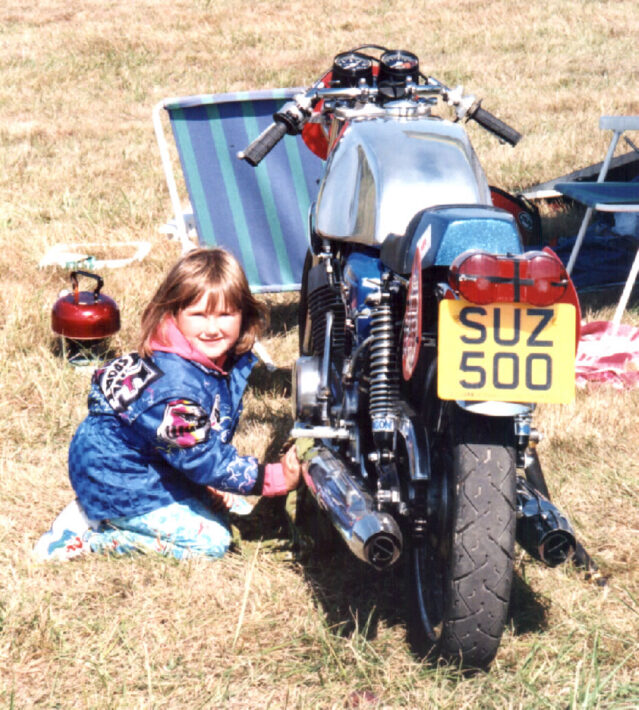
To be honest I didn’t know that much about the Suzuki T500. At the time I was more interested in dirt bike sport although, like a lot of sporting riders of my generation, I did ride road racing machines whenever the opportunity came about.
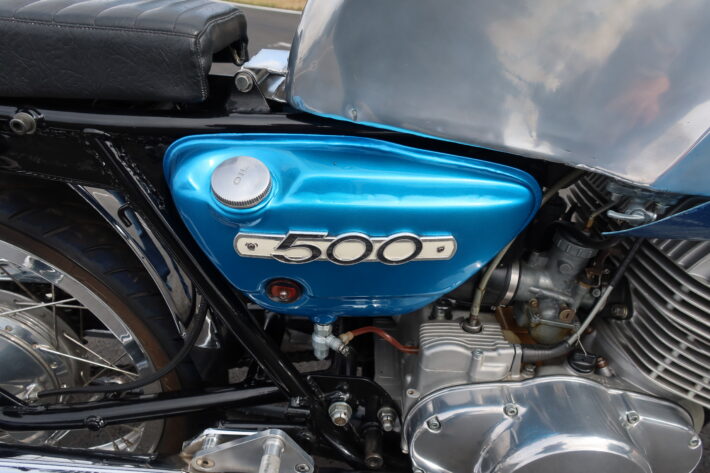
Suzuki began production of the T500 in 1967 – not 1968 as is widely reported. Martin Crooks, Eddie’s son, has a newspaper cutting of Ed sat on the T500 production line in 1967 and that’s fact. At launch, everyone was universally sceptical over the practicalities of a 500cc two-stroke twin.
It’s not that there had never been a 500cc two-stroke engine before – the British Excelsior company had a three cylinder unit in production as early as 1953. Somewhat ironically, the Excelsior engine, which was designed for microcars, proved how unsuitable big two strokes were in the real motorcycling world!
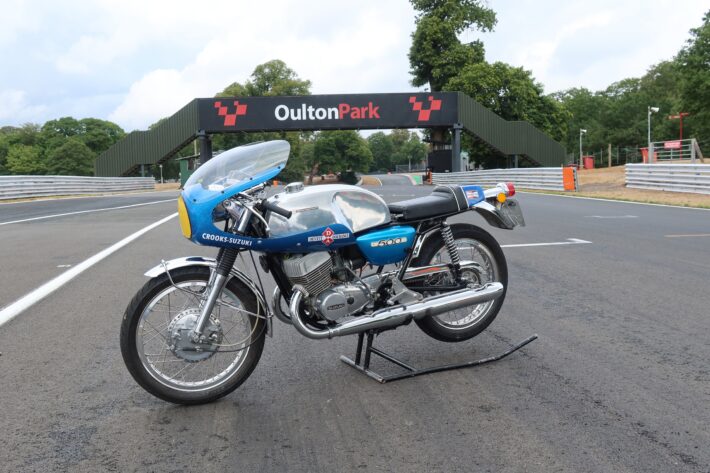
This is why the T500 was so radical. Despite their GP winning heritage Suzuki didn’t have in mind a highly strung, rev happy race replica which required endless meticulous maintenance. Rather, the concept was for a high-speed tourer which would run faultlessly for thousands of miles and be easy to ride.
A central part of the big idea was to make a bike which was completely and totally unbreakable. The crank from the T500 is so big and strong that it deserves a place in motorcycling history just for its durability. The downside is that the T500 is a heavy bike – heavier than a 650cc, British four-stroke of the day.
In 1968 a Triumph Bonneville, the best British bike of its era, weighed in at 363 pounds (165kg) whilst the over-engineered T500 tipped the scales at a substantial 410lbs (186kg). This was one unbreakable motorcycle!
Obviously, the bike had automatic lubrication because Suzuki had pioneered this idea on mass produced motorcycles. Less obvious was the very low first gear in the five-speed gearbox. I guess that this was to help a fully loaded, touring T500 pull away in challenging conditions. Later on, racers got very upset with this low first ratio.
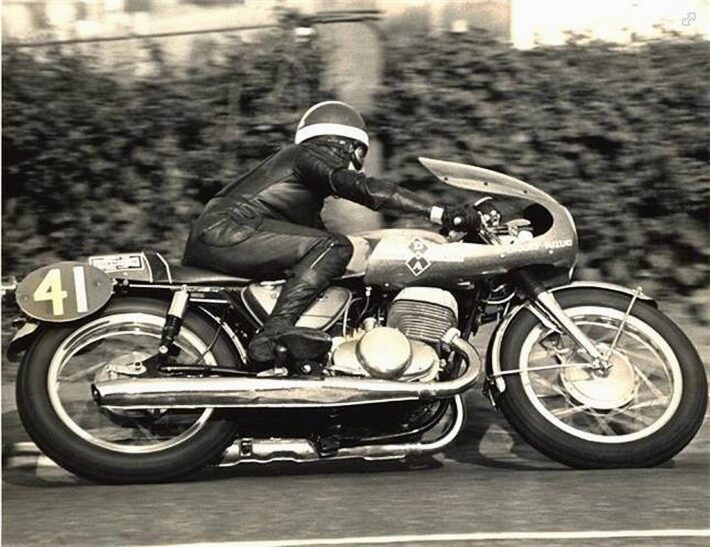
The Crooks Suzuki production racer was the result of being in the right place at the right time. Eddie had been a fine all-round motorcycle racer in his own right, winning the 1959 Manx Grand Prix and also racing a 250cc T20 in the 1967 Production TT. He was a world class enduro rider too, winning three Gold Medals in the International Six Days Trial.
Inside the terraced houses in Crellin Street, Barrow in Furness, which Eddie had knocked together to make a rambling shop, there was a lot of race knowledge and experience. Eddie’s workshop foreman was Frank Whiteway. He was also an excellent rider who had won the 1968 Manx Grand Prix. Frank was talented with the spanners too and knew how to put a winning race bike together. For the 1970 TT, it was decided to enter a T500 in the Production Race with Frank as the rider.
The bike Crooks Suzuki produced was stunning – absolutely gorgeous – and, like all the successful production racers of the day, stretched the rules as far as they would go without incurring a ban for cheating. Although Proddie racers were supposed to be lightly tuned, standard road machines which anyone could buy there wasn’t a winning bike which didn’t indulge in some serious rule bending.
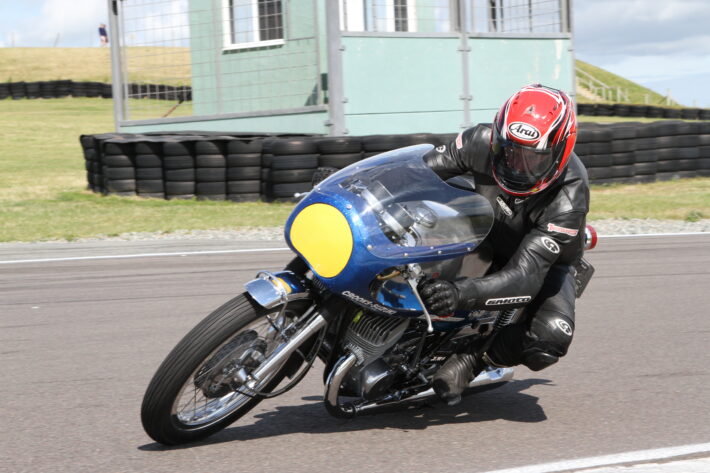
The first T500 had a ludicrously short wheelbase of 52 inches (1320mm) and this made the bike distinctly frisky – unpleasantly so. Suzuki wanted a high-speed tourer and so added another 5 inches (127mm) to the wheelbase which gave relaxed, rock solid handling. The problem was that 57 inches (1447mm) was far too long for a race bike and the steering head angle, designed for straight-line stability, was far too shallow.
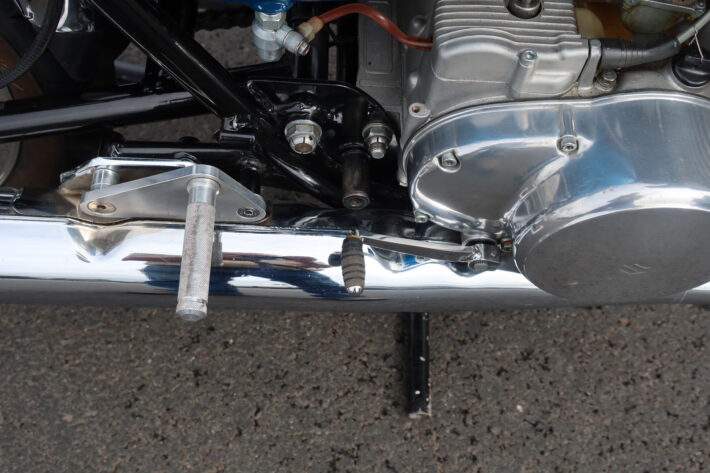
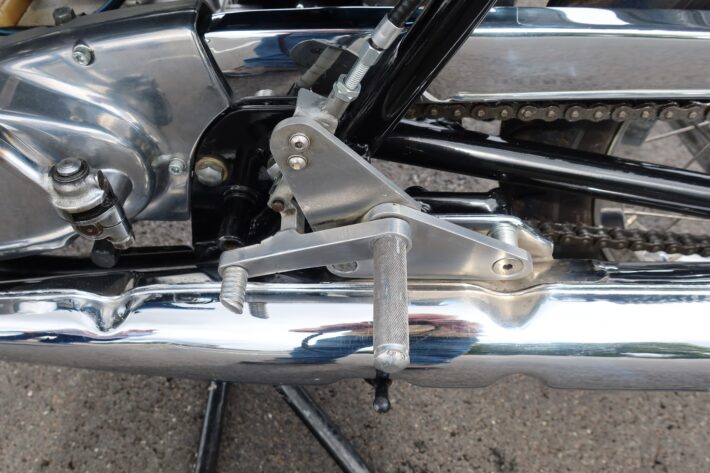
Eddie and Frank helped matters along by fitting a non-standard 19” rear wheel and 3½” (89mm) longer Girling race suspension units. This jacked up the rear of the bike and made it turn much better whilst giving a little more ground clearance – and dragging the huge Suzuki silencers on the floor was, and is, always a problem with T500 production racers.
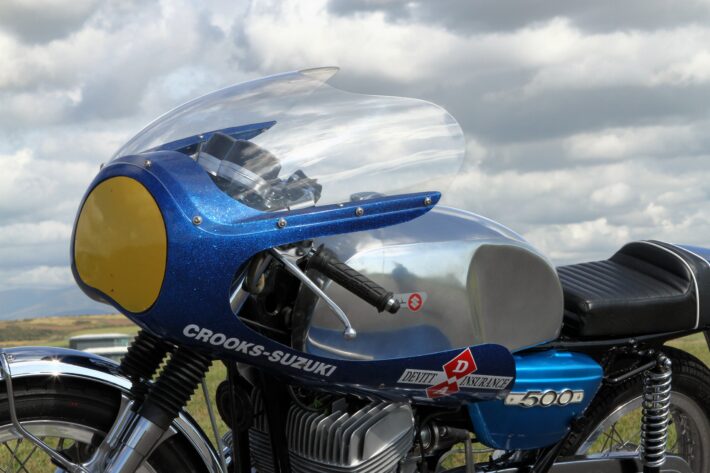
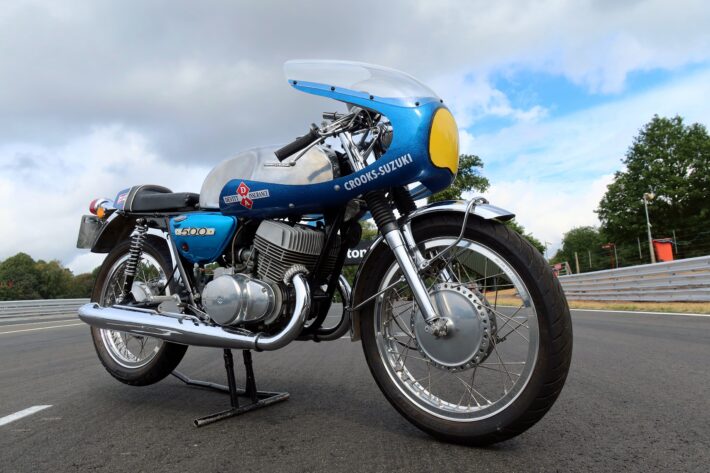
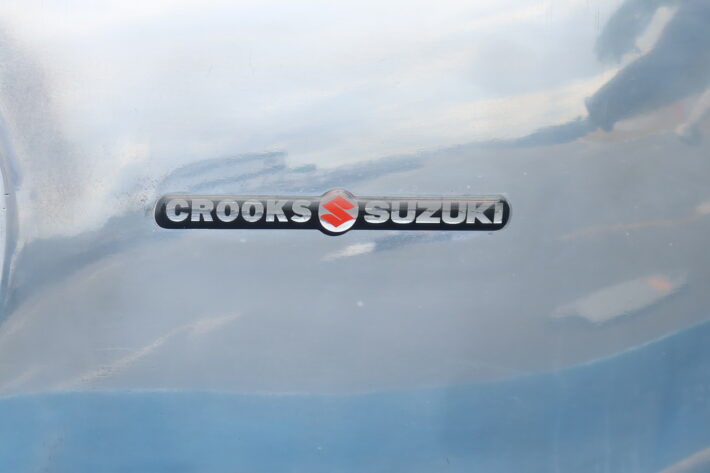
The rest of the race conversion was pure British backyard engineering at its best. The Crooks Suzuki had a wonderful 5½ gallon (25 litres) alloy fuel tank made by Jim Lee in Birstall, Yorkshire, who also supplied the rear set footrests and “Ace” handlebars. Setting the bike off cosmetically was a super-duper, psychedelic, metal flake blue bikini fairing straight from the Beatles’ LSD inspired Magical Mystery Tour. There were state-of-the-art stickers from Devitt and Champion and the bike could have appeared on ‘Top of the Pops’: right on man, indeed.
The bike went wonderfully well, Frank won the TT and I had my article. This is what Frank remembers of his winning ride.
“I managed to slip past Bill Smith on the short run to Braddan Bridge and then got my head down on the 7-mile blast to Ballacraine.
“I was astonished to find the road behind completely empty when I took a quick glance over my shoulder as I approached the right-hander. For one awful moment I thought there must have been a big pile-up behind me and I was expecting to see a red flag any minute! Thankfully all was well, and I had a trouble-free 5 laps and took my TT win by just over a minute.”
At the time, I had my own concerns. I had attended the final lecture of the week at college and then headed down to the Pier Head in Liverpool to catch the midnight boat. It was cheap, and in those days I could manage sleeping on the ship’s deck without any problem.
I walked the two miles to Braddan Bridge, saw Frank win the race and, afterwards, sat on the grass with my head in my hands. Somewhere in Multiverse, a deity loved me!
The next morning I presented myself, as instructed, at Eddie’s mum’s house in Marathon Avenue which was quite near to the TT paddock. The race winning T500 was leaning against a low wall with the ignition key still in the lock. This was not a mainstream PR exercise by any stretch of the imagination!
I nervously knocked on the door and, after a long pause, Eddie opened it just a crack.
Eddie clearly had other, more pressing matters to deal with and was not very interested in me. He waved me towards the bike and just said: “Go on. Take it and I’ll see you after.” With that, the door was firmly closed and Eddie returned to whatever was primarily on his mind.
I’ve never quite bought into the idea of love at first sight when it comes to personal relationships but I have to admit that, by the time I had pushed the T500 the few feet on to Marathon Avenue, I really was deeply smitten.
Even in production racing trim the T500 is a big lump of bike – nothing like a svelte race thoroughbred – but it looked so right. I opened the two petrol taps, dropped the choke lever, turned the ignition key and gave the left hand kick-start a long prod with my right foot. The big twin burst instantly into life with a lovely two-stroke crackle coming from the silencers which had been tweaked to be less restrictive.
I swung my leg over the saddle and snicked in first gear with the right hand mounted shift lever. The clutch bit gently and progressively and we pulled away, heading for the Glencrutchery Road and the TT circuit. In 30 seconds, I felt as if I’d been riding the bike all my life.
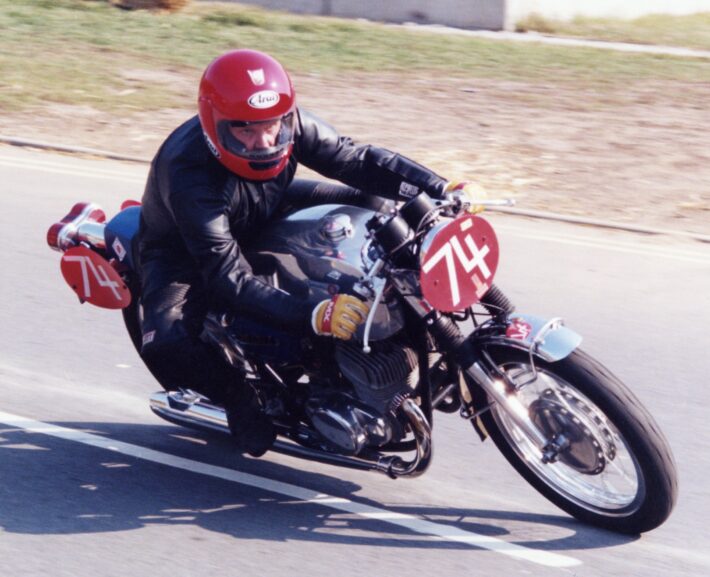
There is a vast amount of room inside the T500’s cockpit and it was such a comfortable, relaxing place to be. Eddie and Frank had set the bike up to perfection. The motor pulled like a diesel engine and yet was free revving and the handling was rock steady. Truly, I was in love.
First gear was of very little use except for standing starts but the other four ratios were perfect for fast riding. Only the weedy, 8” front brake was really marginal, even when fitted with race linings. I must have been doing well over 100mph down Sulby Straight when I tried to stop for the bridge at the end – and the front brake simply gave up and abandoned the job. Most of the T500 was heavily over-engineered but not the brakes!
I was having a great time until I arrived at Parliament Square in Ramsey. The Sunday of TT week is always known as “Mad Sunday” because spectators go bonkers riding the TT course which, when it is not being used for racing, is a normal public road. “Mad Sunday” really is a crazy period – and I have always been very cautious of it.
So there we are, with the roads knee deep in wannabee TT stars, and I rock up in Ramsey on a bike carrying race numbers and looking as if it has just finished a TT – which it had!
The white helmeted constable holds up a hand vertically and pulls me over. The next bit is absolutely verbatim: “Okay Son, what do you think you are doing? Riding in the TT?”
A calm response was needed. “Actually no, Officer. I am the official test rider for the Crooks Suzuki team and this is the bike which won yesterday’s Production TT.”
And then, looking as cool and nonchalant as I could: “I’m just doing some carburettor testing before the Senior” – which was the week’s premier race.
The reaction was instant and the whole of the Ramsey Constabulary gathered round as I talked them through the finer points of the bike, some of which were accurate – and many more a product of my desperate imagination!
“Well, you’d better get on with the testing then, Sir.” And, with that, the lovely officer strode boldly out into the road, stopped all the traffic and waved me regally on my way.
The more I did of this journalism job the more I liked it.
I actually wrote the story long hand, sitting behind the grandstand, and then typed it up when I got back to England. Having spent another night on the deck, I wasn’t exactly in pristine condition when I arrived back at St Kath’s for lectures on Monday morning but the job was done. By Wednesday the photographs had been printed and the package was on its way, by airmail, to New York.
My new American boss was delighted. He had a freelancer who could be trusted to deliver and for any editor this is the key criterion in hiring a writer. Being only 99% sure that the journalist you have hired will do the job is no good.
With Eddie and Devitt by my side, the job was done!
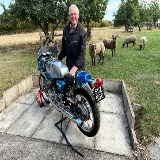
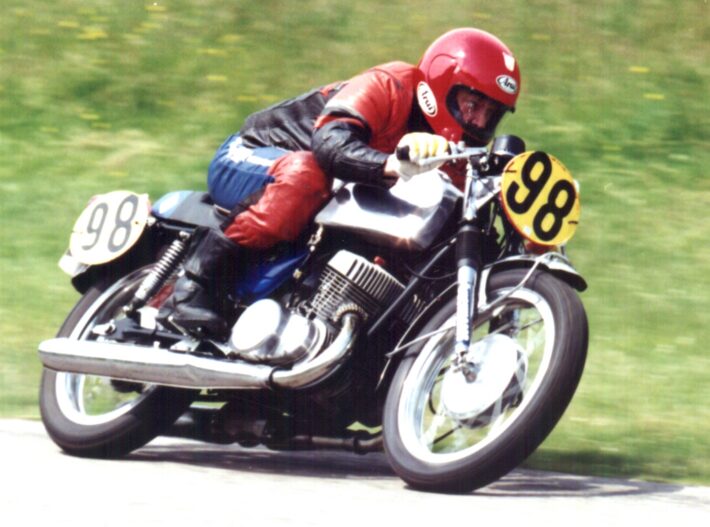
Later, I raced the T500 which won the TT and made me as a journalist. Martin Crooks also built me a T500 Proddie Racer of my own and this too was wonderful – although still with a very marginal front brake! Mark Newsome, one of Martin’s customers, constructed the superb Proddie racer we used for this photoshoot.
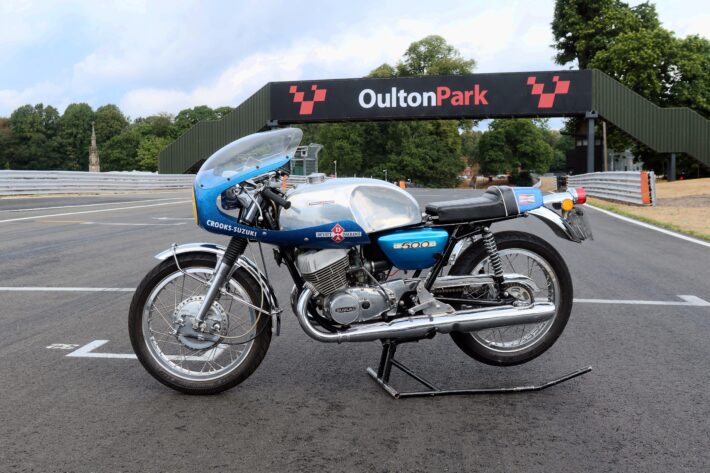
Now, T500s are still available at bargain prices and, with a bit of effort and some care, you could build a close replica of a bike which really did win a TT – and saved a baby journalist’s nascent career.
Disclaimer: the sole purpose of this article is to provide guidance on the issues covered. This article is not intended to give legal advice, and, accordingly, it should not be relied upon. It should not be regarded as a comprehensive statement of the law and/or market practice in this area. We make no claims as to the completeness or accuracy of the information contained herein or in the links which were live at the date of publication.
You should not act upon (or should refrain from acting upon) information in this publication without first seeking specific legal and/or specialist advice. Arthur J. Gallagher Insurance Brokers Limited trading as Devitt accepts no liability for any inaccuracy, omission or mistake in this publication, nor will we be responsible for any loss which may be suffered as a result of any person relying on the information contained herein.