

Goodwood is a place where magical things happen – as our man Dowds found out on the first Thursday of the 2025 Festival of Speed.
I’m a very lucky man. I like motorbikes (a lot), and I like writing about them (a lot). And I’ve had a fair few ‘bucket list’ gigs down the years. I’ve flown to the Sepang GP track in Malaysia to ride Nicky Hayden’s Honda V5 MotoGP bike (and Dani Pedrosa’s RSW250 factory two-stroke 250GP machine).
I’ve ridden with Kevin Schwantz at his track school in Atlanta, toured the MV Agusta factory with Claudio Castiglioni, been on sunny trackdays in Mugello, and ridden round Qatar at night. MotoE bikes, BSB machines, 1000bhp drag racing Hayabusas, £75k custom Harleys – I’ve cocked a leg over them all in the past few decades.
But as I’m riding home from the 2025 Goodwood Festival of Speed on a baking-hot Thursday evening, I still can’t quite believe what just happened. Because the bike I rode earlier that afternoon wasn’t just a ‘bucket list’ experience: it was well beyond the bucket list.
The story started just two days earlier, when a good friend who helps with the motorcycle side of Goodwood texted to ask if I was coming to the Festival. ‘I wasn’t going to…’ was my answer – and they suggested a ride up the hill on the Saturday on a Livewire electric bike.
I was already booked for the weekend though – Thursday was the only day I could go. A general admission ticket for Thursday was booked, with the plan that I’d just pop down from London, wander round for a few hours, and soak up that ineffable Goodwood atmosphere.
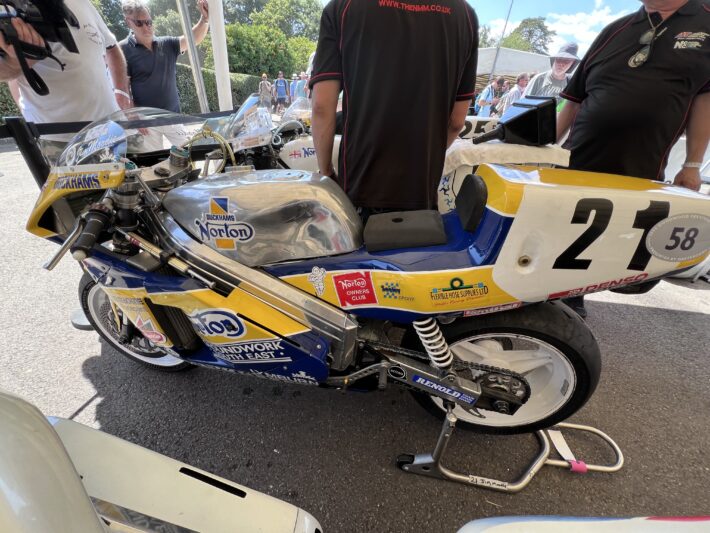
A couple of hours later though, I got another message: would I like to ride a bike on Thursday for the National Motorcycle Museum? A Duckhams QXR-sponsored Norton/Crighton rotary race bike, ridden by Robert Dunlop and Jim Moodie to be precise? I was packing my race leathers and Arai lid before you could say ‘Wankel’: not only was the 1990s Norton race program one of the most interesting efforts around, I’ve never ridden any of the British rotary-engined bikes either.
So it was a most definite ‘yes’ from the Scottish rider, and I suddenly had a lot more to look forward to in West Sussex.
Two days later, and I’m on the road, leathers in a bag on the back of my Yamaha Tracer 9 GT, trundling down an already-stifling A3 from my manor in south London to Goodwood. I whizz past the five-mile traffic jams outside the Estate, and before I know it I’m in the Drivers’ Club area, signing on as a demonstration rider for the course.
I’ve done this event a few times before, so I know where to go. Leathers and helmet are quickly scrutineered, and I head to the paddock to meet James Hewing, the head of the National Motorcycle Museum (NMM). James is in charge of the NMM presence here today, and he’s got some amazing machines including the aforementioned Duckhams Nortons, and the mighty Norton Nemesis V8.
There’s also a plain white bike tucked into the corner of the paddock, which I don’t pay too much attention to at first – more on that in a moment…

I help out the techs Wes and Chris with some fuelling (the rotary engines have a bit of two-stroke oil in their racing fuel – it’s a 30:1 premix, just to lubricate the rotor tip seals). They take me through the Duckhams bike – though to be fair there’s not much to do.
Race bikes from more than thirty years ago don’t have the rows of buttons like a modern machine: there’s no engine brake control, fuelling maps, pitlane limiters or traction setups here. Throttle, brakes, clutch and a race gearchange is the sum total of the controls, alongside a simple kill switch plus coolant temperature gauge and a basic tachometer. Then, I head off to get into my leathers in the (thankfully) air-conditioned changing rooms.
The heat is building, metaphorically and literally, when I come back to the paddock. The NMM techs are trying to start ‘my’ bike, but the blue/yellow machine isn’t firing. There’s some muttering about a coil, but James Hewing quickly points to the white bike. “Take that instead,” he says, in the matter-of-fact fashion of an instructor at the Ron Haslam school pointing a student at a rough CB500.
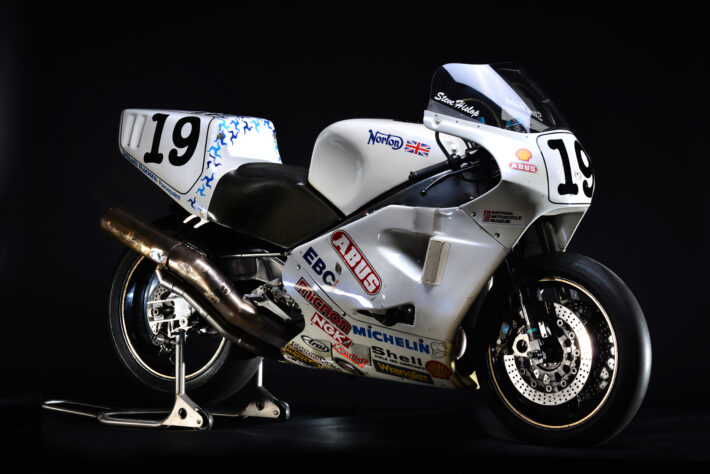
The white bike. Yes, that white bike – the legendary ‘White Charger’ NRS588, with the ABUS and EBC logos, ridden by the late great Steve Hislop to an incredible TT Senior race victory in 1992. It’s here, it starts, and as the marshals direct everyone down to the holding area, I jump on.
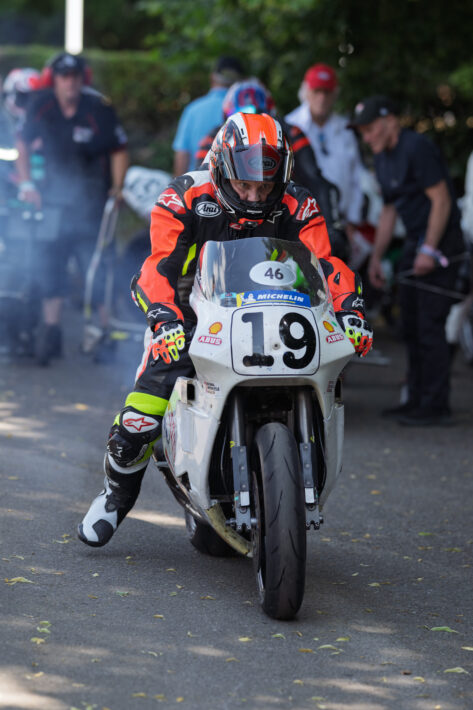
The NMM tech lifts me off the stand, and I’m revving the nuts off this angry, buzzing, hot, smoking race bike. It’s low-slung for a race bike, though the seat is wide, and I can get both feet on the deck. It’s very light and manageable, even just paddling out of the paddock tent and rolling down to parc-ferme, you can feel the lack of mass (the spec sheet from the NMM claims 143kg, which is the same as a Honda CB300R).
There’s a pause, then the group of bikes head down to the start line. There’s a lot of waiting around at the Festival of Speed while things move into place. We’re held until all the cars in our group make their way down too – a mad selection of drift cars, one-off specials and wacky electric sportscars.
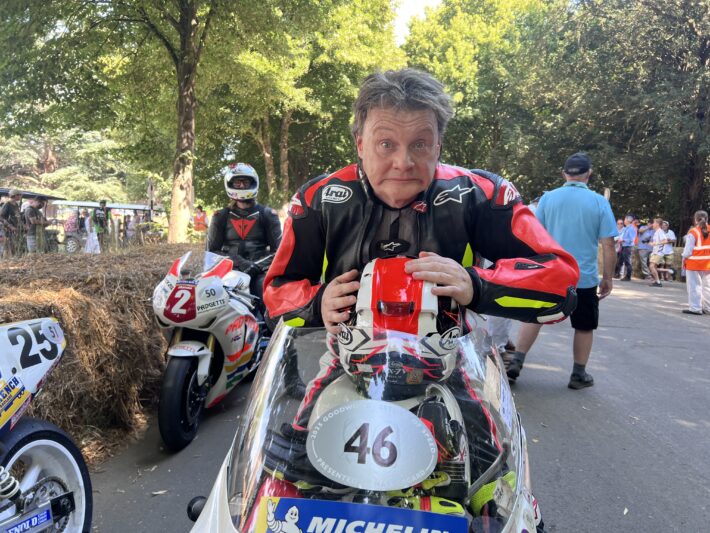
Another long pause – then a flurry of activity, and I need to get my bike started. There’s no starter on an old racebike like this of course – neither electric nor kick, so we need the petrol-powered starter trolley and a paddock stand.
The NMM guys are rushing to start the other two Nortons, then they come to me. I’ve done this twice now, so am used to checking the kill switch, clunking up into second gear, then dumping the clutch when the rear wheel is spinning.
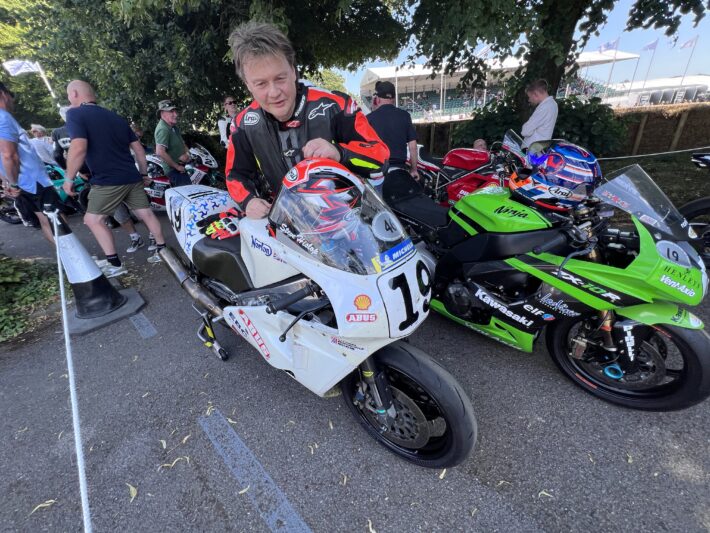
We’re all set – lots of noise, smoke and heat from under the white fuel tank, and I pull forward to the start line, revving away like a kid on a Fizzy in the 1970s. I’m fairly tense here: if I stall the Norton, not only will the world watching on the live video feed mock my failure, there’ll be no chance to get it started again with the starter trolley and paddock stands already being taken to the top of the climb.
The cold race-tuned engine and old-school flat-slide carbs mean it doesn’t idle without revving it, and it won’t go into neutral when the engine is running either. So, clutch in, lots of revs, and a silent prayer to the gods of unconventional internal combustion…
There’s no stalling today though. The nice man on the start line gives me the wave, I give it a big handful of gas, feed in the dry clutch, and we’re away cleanly. The Goodwood climb is a short 1.17 mile run, and shouldn’t be any problem at all. But there are a few issues: firstly, you don’t get any sighting ‘laps’.
I’ve been here three times so I’ve ridden that mile-and-a-bit three times (four now!), in eight years, which isn’t great for learning which way to go… You have no tyre warmers, so the rubber is cold, as are the brakes and the suspension. Finally, there are thousands of spectators, who want to see cool stuff, so the pressure is on to have a go…
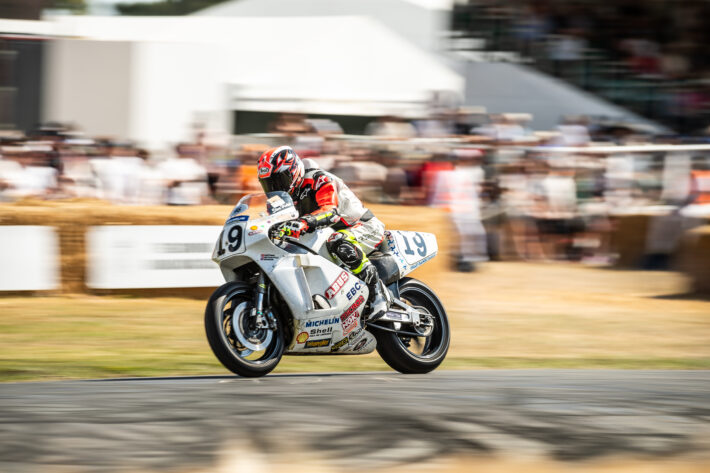
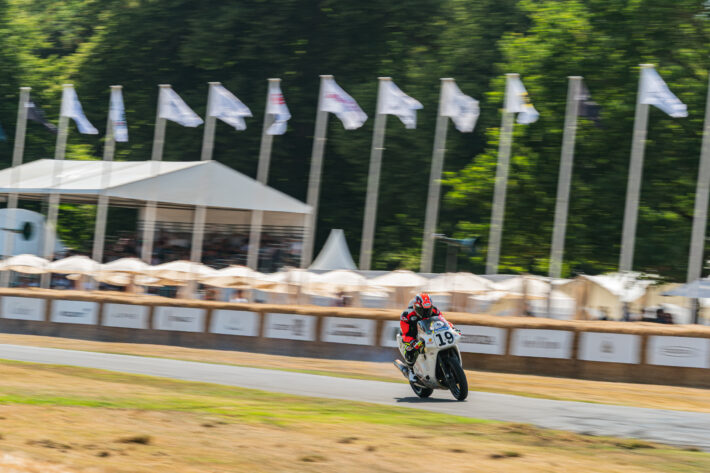
Which I duly do. I’m not risking a big wheelie on a priceless bike powered by a one-off race version of an engine I’ve never ridden, but I give it the proverbial handful down the short start straight, and am rewarded instantly. There’s a clean, strong burst of power through first gear, and I click up into second, then do it again.
Slow down a bit for the first right-hander, then on the gas again in front of the big Goodwood house. The Norton definitely feels a lot like a big two-stroke, but a weirdly smooth one. The rotors whizz around in a much less vibey way than a load of pistons flailing up and down, and there’s a broad spread of torque too. I can see even now why this was such a solid race performer.
Suddenly I have a lot to think about though. I’m heading into the sort-of chicane section at the grandstands a bit too quick for my liking. There’s minimal engine braking on a rotary – another parallel with two-strokes – so cutting the gas hasn’t made any difference.
I grab the front brake lever hard – too hard, and the elderly AP Racing four-piston calipers deliver a short sharp shock of deceleration. Luckily, the tyres are not at all elderly, and the front Michelin Power GP2 hoop protests with a loud, heart-stopping squeal, before gripping hard, and turning into the kink nicely. Phew – that could have been nasty.
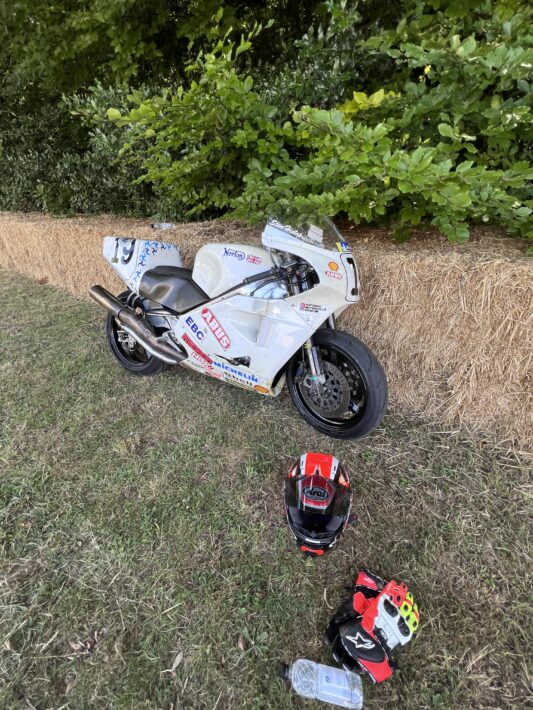
We’re tramping up the hill now, and the motor is strong and keen, though it is missing a little at the top of the rev range. There’s a bit of a misfire, like a cold two-stroke, then I change up, it clears, and blasts through for the rest of the run. I park up against a hay bale in the baking heat, take off my lid, and soak in the amazing atmosphere.
The Norton is smoking away, with a bead of two-stroke oil dribbling down the battered exhaust silencer, but it still looks incredible. The scrutineering stickers of past race events, the missing front mudguard taken off for the TT, when the bike kept overheating, the small fork protectors and white-taped spoilers on the cooling vents – it’s all there, just as it was when this bike parked up in the Douglas paddock after the 1992 Senior race. I’m most certainly no Steve Hislop, but I am, again, a very lucky man…
Norton 1992 NRS588 SPECS
Engine: 588cc water-cooled twin-chamber rotary, 9.2:1 compression ratio. Based on F1 roadbike engine
Power: 140bhp
Fuelling: twin 37mm Keihin flat-slide carburettors
Electronics: electronic ignition
Transmission: Belt primary drive, dry multi-plate clutch, Yamaha six-speed gearbox, chain final drive
Frame: aluminium twin spar frame and braced monoshock swingarm. Designed by Ron Williams of Maxton Engineering, made by Harris Performance.
Suspension: WP Racing fully adjustable USD telescopic forks (front) WP Racing fully adjustable monoshock (rear), tuned by Maxton Engineering
Brakes: twin 320mm discs (front), AP Racing four-piston calipers, Nissin rear caliper
Wheels/tyres: 17” cast magnesium race wheels, Michelin Power GP2 120/70 17 (front) 190/55 17 (rear)
Weight: 315lb (143kg)
Top speed: 190mph
The Norton rotary story
Norton made its name in the first two-thirds of the 20th century with its conventional engines: single and twin-cylinder four-strokes. These are the bikes which won the first ever TT in 1907, powered the British Army in WW2, and helped make the firm a household name alongside Triumph and BSA.
But in the late 1970s, the firm – like all the British manufacturers – needed something new. An OHV air-cooled twin was stone-age tech compared with the best from Japan, so Norton experimented with two-strokes, and even a Cosworth-designed water-cooled DOHC high-performance race-ready 750 twin. The real left-field option though came from an old Triumph/BSA project to develop a Wankel, or rotary engine.
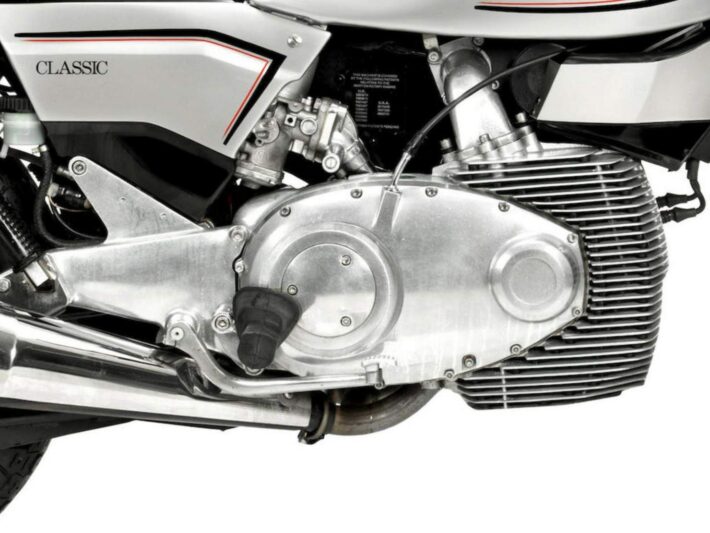
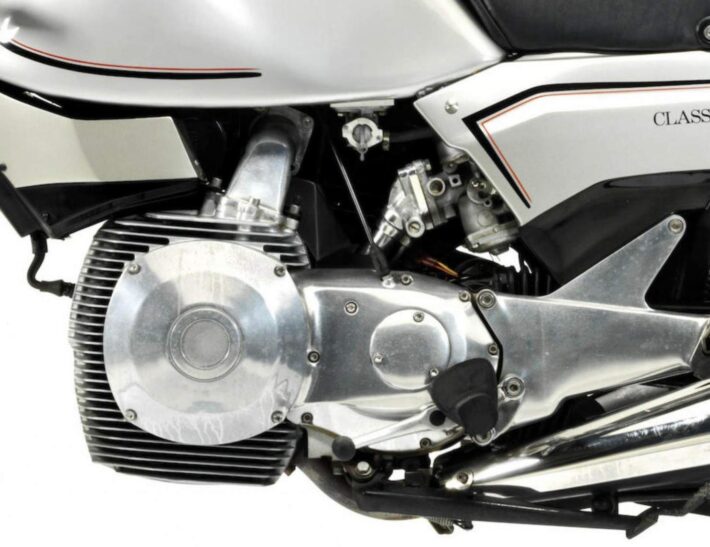
These motors – which have also appeared in Mazda cars – use a triangular-ish rotor, which spins in a specially shaped ‘bore’ that includes intake and exhaust ports, and a combustion chamber. They’re sort of similar to a two-stroke, but with some of the benefits of a four-stroke, they have smooth running with less vibration compared with a reciprocating piston engine, no valve gear, meaning fewer moving parts, and low weight for the power.
They were fleetingly popular in the bike world: German firm Hercules sold them, as did Suzuki with its RE-5, while Yamaha and Kawasaki both produced prototypes.
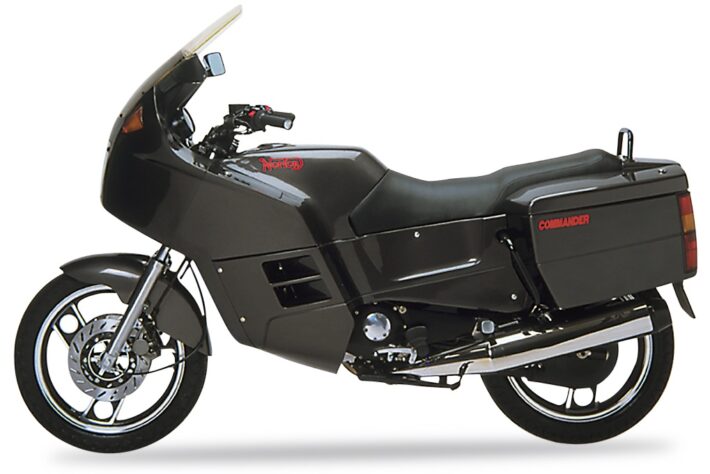
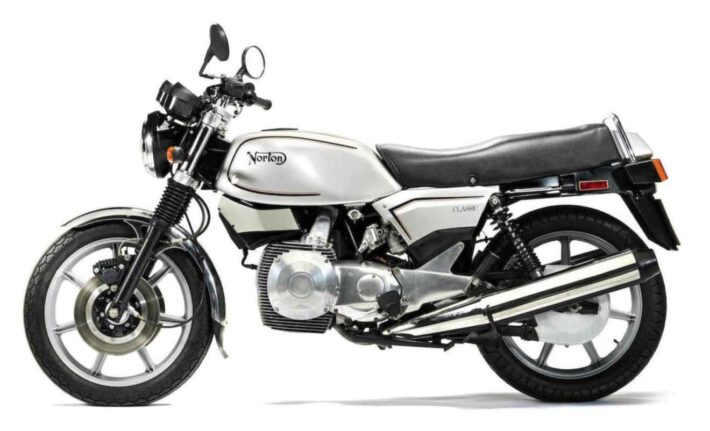
Norton arguably made the biggest go at a rotary range though, in spite of the parlous state of the company in the 1970s and 80s. The first rotary was a 79bhp air-cooled design, and made its debut in 1973 powering the Interpol police bike, later also appearing in the Classic road bike. Water-cooling was added, and the more powerful 85bhp motor appeared in the Commander roadbike, as well as an updated Interpol police bike.
Norton then launched a small race programme using the engines, with a road-going sportsbike, the F1. The Nortons were light and powerful against the competition, and as a result, they had some strong results: Scottish rider Ian Simpson won the British superbike title in 1994.
The NRS588 White Charger was a bit of a one-off compared with the other bikes. Ex-Honda race guru Barry Symmons had become Norton’s team manager in 1990, and he oversaw the JPS race team. Ron Haslam joined as development rider and Norton’s new NRS588 Rotary racer appeared in mid-1991.
It differed from the RCW in having a frame designed by Ron Williams of Maxton Engineering and made in aluminium by Harris Performance Products. Where the Roton/Crighton bikes used a twin-shock rear swingarm, the NRS has a monoshock rear. The Norton F1 road bike-based liquid-cooled engine ran ‘backwards’, primary drive was now by belt instead of troublesome chain to the dry clutch and the transmission used a Yamaha-based six-speed gear cluster.
Ron Haslam broke several circuit records in the MCN TT Superbike championship, but had to settle for second place in the series after several poor starts. Trevor Nation, who did not like the NRS, left the team at the end of 1991.
But the ultimate glory was to come in 1992 when Steve Hislop won an epic Senior TT beating Carl Fogarty on a Yamaha OW01 to give Norton its first Senior TT race victory since Mike Hailwood’s 1961 victory. The legendary Scots rider won the six-lap epic by just 4.4 seconds after a 226-mile battle.
Hislop averaged a record 121.28mph to take the win, and while struggling to beat Hislop, Fogarty set an outright lap record at 123.61mph, which stood until 1999. ‘Hizzy’ was new to rotarys: the deal was a last minute affair, and only happened thanks to sponsorship from his friend Michael Brandon from Hawick, who was the ABUS locks importer, and Andy Freeman of EBC Brakes
It was all too late though: the oil-burning rotary design couldn’t be cleaned up enough for road use, and the main Norton company collapsed, the name living on with a number of different successor outfits.
Image Credit – Oli Tennent, Rob Cooper and Joseph Harding
Words – Alan Dowds
Disclaimer: the sole purpose of this article is to provide guidance on the issues covered. This article is not intended to give legal advice, and, accordingly, it should not be relied upon. It should not be regarded as a comprehensive statement of the law and/or market practice in this area. We make no claims as to the completeness or accuracy of the information contained herein or in the links which were live at the date of publication.
You should not act upon (or should refrain from acting upon) information in this publication without first seeking specific legal and/or specialist advice. Arthur J. Gallagher Insurance Brokers Limited trading as Devitt accepts no liability for any inaccuracy, omission or mistake in this publication, nor will we be responsible for any loss which may be suffered as a result of any person relying on the information contained herein.