

If you’re thinking about getting behind the handlebars, you may be wondering how much CBT and licence test costs and what the process actually involves.
Below, we take you through everything you need to consider, from the cost of CBT and how much training is involved, to passing your theory test and getting your full motorbike licence.
Who needs to complete CBT?
Compulsory Basic Training (CBT) is a course that new riders typically need to complete before riding a moped or motorcycle on UK public roads.
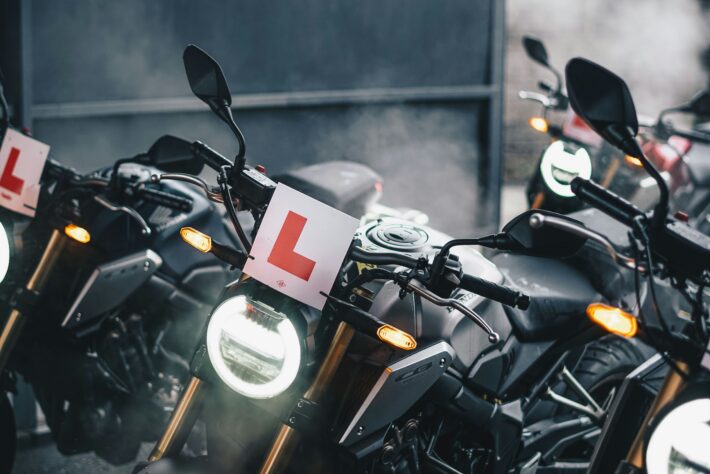
CBT is designed to make sure you can ride safely on your own while you practise for your full moped or motorcycle test. Because CBT is a training course rather than an exam, there’s no formal pass or fail.
Once it’s completed, your CBT is valid for two years.
How much does CBT cost in the UK?
The price of CBT training in the UK can vary depending on the provider you choose and where you complete your training. On average, you can expect to pay between £130 and £170. In many cases, you can reduce the cost by bringing your own bike and helmet.
The cost of CBT training typically includes:
- Bike hire (unless stated otherwise) for the full training day
- Use of safety equipment such as a helmet, jacket, gloves, and waterproof clothing
- Fuel for the bike
- Insurance covering any bikes hired
How does CBT training work?
CBT training usually lasts a full day, although it can take longer if you need additional time to reach a safe basic riding standard.
CBT is split into five structured elements, covering everything from basic safety checks to riding on public roads:
- Element A: Introduction covering the aims of CBT, choosing suitable equipment and clothing, and meeting the eyesight requirements.
- Element B: Practical on-site training, including how the motorcycle or moped works, required maintenance checks, and getting a feel for the weight and balance of the vehicle.
- Element C: Practical on-site riding, focusing on manoeuvres under full control, braking, changing gear, and carrying out observations.
- Element D: Practical on-road training preparation, covering legal requirements, road positioning, speed, separation distances, anticipating hazards, and understanding other road users.
- Element E: Practical on-road riding in typical traffic conditions, including U-turns and emergency stops.
You’ll move on from one element to the next when your instructor is satisfied that you’ve:
- Learned the required theory
- Demonstrated the practical skills to a safe basic level
You can learn more about the CBT syllabus by following official Government guidance.
What happens after you’ve completed your CBT?
Once you’ve completed your CBT, you’ll receive a certificate of completion, often referred to as a DL196. This allows you to ride a moped or motorcycle up to 125cc with a power output of up to 11kW on public roads. You must display L plates (or D plates in Wales).
Within a two-year window, you’ll need to pass your theory test and full moped or motorcycle test. If you don’t, you’ll need to complete your CBT again or stop riding.
Motorcycle theory tests
Before you can take your practical motorcycle tests, you’ll need to pass your motorbike theory test and hold a provisional motorcycle licence.
The theory test is straightforward to book online or over the phone and costs £23. It has two parts:
- Multiple-choice questions
- Hazard perception (a video-based test on spotting potential hazards)
The test covers every aspect of riding, so it’s a good idea to practise as much as possible beforehand. You can practise both parts online for free, and there are also apps, videos, and online resources available to help you prepare.
Motorcycle practical test
The motorbike practical test is split into two modules. They’re booked and paid for separately.
Module 1
Module 1 is an off-road riding test that examines your handling skills. The examiner will be looking for any faults that could put you or others at risk. The test lasts around 20 minutes.
Module 1 includes:
- Wheeling the motorcycle or moped and using the stand
- Riding a slalom and a figure of eight
- A slow ride
- A U-turn
- Controlled stops, emergency stops, and hazard avoidance exercises
For the hazard avoidance and emergency stop exercises, you must ride at a minimum speed of:
- 19 mph on a moped
- 31 mph on a motorcycle
Once you’ve finished Module 1, you’ll be told whether you’ve passed. You’ll usually pass if you make no serious or dangerous faults (known as majors) and no more than five minor faults (known as minors).
If you pass, the examiner will explain any faults you made and give you a pass certificate, which you’ll need for Module 2.
If you don’t pass, you’ll need to book and pay for another Module 1 test, choosing a date at least three working days away.
Module 2
Module 2 normally takes about 40 minutes. It includes:
- An eyesight check
- “Show me, tell me” vehicle safety questions
- Road riding
- Independent riding
- You must bring your Module 1 pass certificate and the same documents you needed for Module 1.
If you pass, the examiner will:
- Explain any faults you made
- Give you a pass certificate
- Ask if you want your full licence sent to you automatically (you’ll need to provide your provisional licence)
If you didn’t pass, you’ll have to book another Module 2 test and pay again. You’ll also need to choose a date at least 10 working days away.
If you pass, congratulations! You can start riding immediately without L plates—there’s no need to wait for your full licence to arrive.
How much do motorcycle tests cost?
Here’s what you can expect to pay for your theory and practical tests:
- Theory test: £23
- Module 1 (off-road practical test): £15.50
- Module 2 (on-road practical test): £75 on weekdays, £88.50 for evenings, weekends, and bank holidays
Overall, the total cost for both tests typically ranges from £113 to £127, depending on when you book Module 2.
Get on the road with dedicated motorbike insurance from Devitt
Once you’re road-ready, the next legal must-have is motorbike insurance. And that’s where we can help.
With over 90 years’ experience, we can help to find cover that suits riders at every stage, whether you’re newly qualified or more experienced.
Backed by a 5-star Defaqto rating, you’ll also be supported by our dedicated, UK-based team, ready to answer questions and support you through a claim if something goes wrong.
Request a motorbike insurance quote online or speak to one of our specialists on 0345 872 3614.
Disclaimer: The sole purpose of this article is to provide guidance on the issues covered. This article is not intended to give legal advice, and, accordingly, it should not be relied upon. It should not be regarded as a comprehensive statement of the law and/or market practice in this area. We make no claims as to the completeness or accuracy of the information contained herein or in the links which were live at the date of publication.
You should not act upon (or should refrain from acting upon) information in this publication without first seeking specific legal and/or specialist advice. Arthur J. Gallagher Insurance Brokers Limited trading as Devitt accepts no liability for any inaccuracy, omission or mistake in this publication, nor will we be responsible for any loss which may be suffered as a result of any person relying on the information contained herein.
Disclaimer: the sole purpose of this article is to provide guidance on the issues covered. This article is not intended to give legal advice, and, accordingly, it should not be relied upon. It should not be regarded as a comprehensive statement of the law and/or market practice in this area. We make no claims as to the completeness or accuracy of the information contained herein or in the links which were live at the date of publication.
You should not act upon (or should refrain from acting upon) information in this publication without first seeking specific legal and/or specialist advice. Arthur J. Gallagher Insurance Brokers Limited trading as Devitt accepts no liability for any inaccuracy, omission or mistake in this publication, nor will we be responsible for any loss which may be suffered as a result of any person relying on the information contained herein.