
Indian brand finally releases a bigger capacity version of its 650 twin-cylinder engine – and puts it in a full-sized Himalayan adventure bike.
It’s eight years since we first rode the new-generation Royal Enfield 650 parallel twins. Back in 2018, we loved the Continental and GT 650 models launched in California – they were a really great balance of power, torque and handling, and looked the part too.
That new engine looked like the beginning of a process though. The stripped-down powerplant on show at the launch revealed a beefy, super-strong crankshaft and cases, and cylinders with hugely thick walls – there was plenty of room for expansion here it seemed.
And so there is – although we’d hoped it would appear in less than eight years. But for 2027, Enfield has put together a 750 version of the 650 twin motor, with a massive 5.5mm big-bore job.
The 743cc oil/air cooled eight-valve twin has an 83.5mm bore and the same 67.8mm stroke as before, keeps the same 9.5:1 compression ratio, and now makes 54bhp peak power, up from 47bhp on the 650, while torque hits 63Nm from 52Nm.
Interestingly, despite the bigger bore, both peak figures come in lower than before, suggesting this is an even lower-tuned version of the motor (expect more revs and higher power on other variants of the new 750 we reckon).
Insiders tell us that despite the very similar looks and spec of the 750, almost all the internals have been revised compared with the 650.
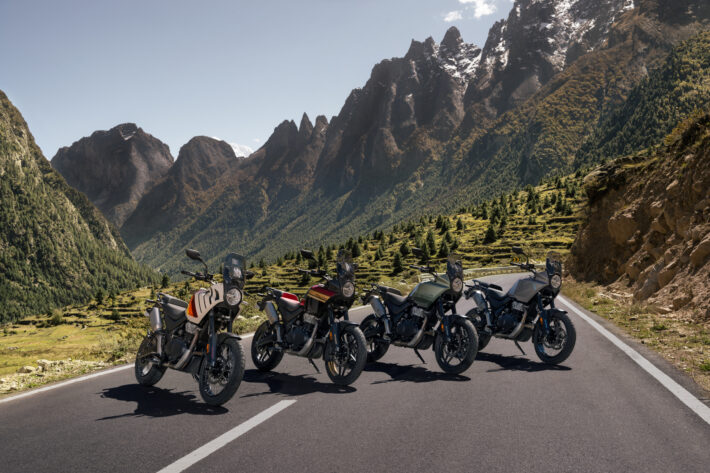
So – the bigger new engine we all wanted to see – and it’s in the current box-office class of motorcycle, a middleweight adventure bike. Okay, a 750 would usually be an upper-middleweight machine, but with that power output, you’re more in the class of a Honda NX500.
Indeed, that power puts it in a sort of uncanny valley: too much for A2 so not in the NX500 sector really, but still a way behind even the Kawasaki Versys 650 with its 67bhp.
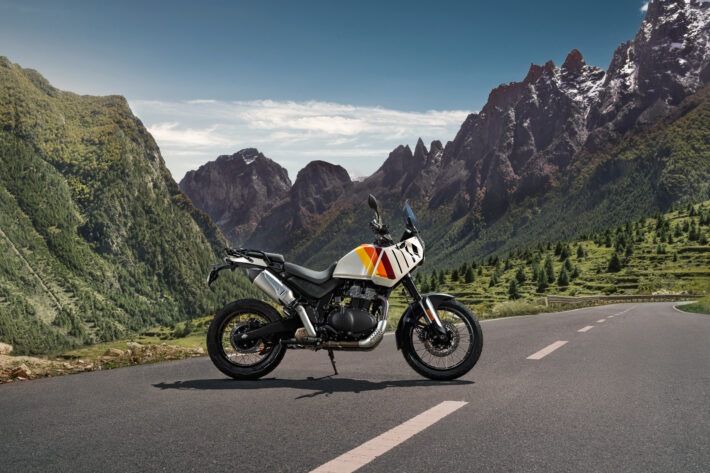
This is Royal Enfield though, and it’s not purely defined by the number of ponies in the stable, rather it’s about the style and the attitude as much as the spec.
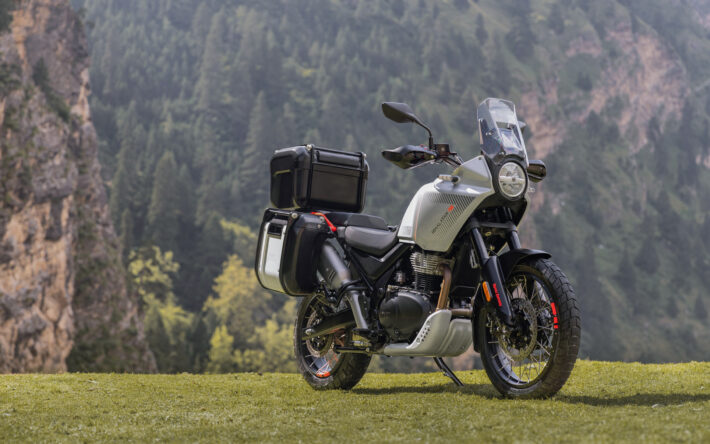
Nevertheless, the Himalayan 750 comes with the most advanced chassis spec we’ve ever seen on an Enfield – with dual 280mm front brake discs and twin piston ByBre calipers, Showa suspension with a fully-adjustable 43mm USD fork and preload/rebound adjust rear monoshock.
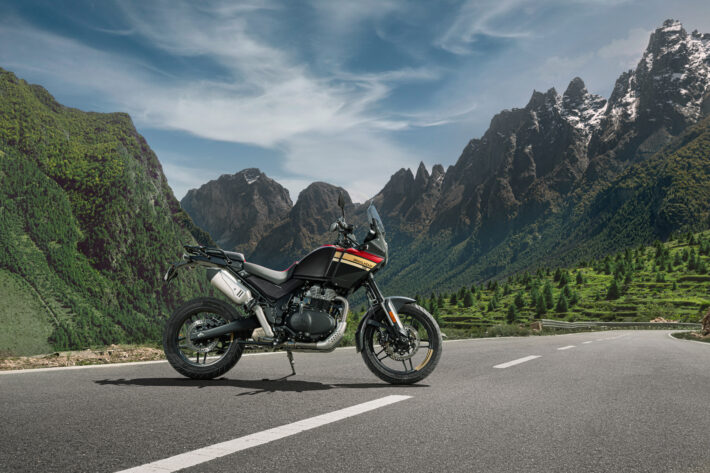
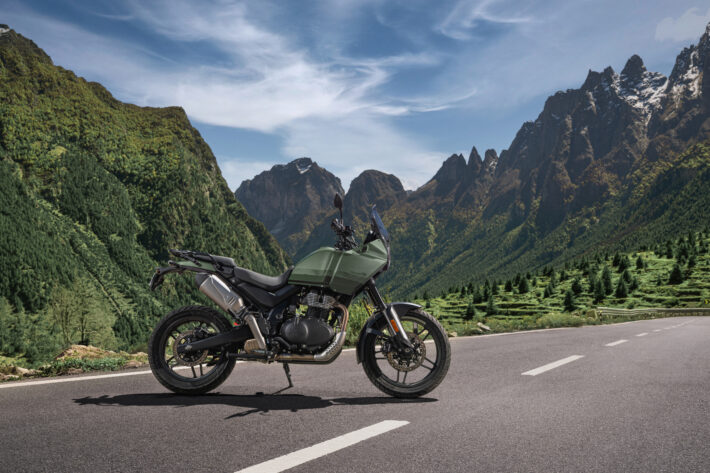
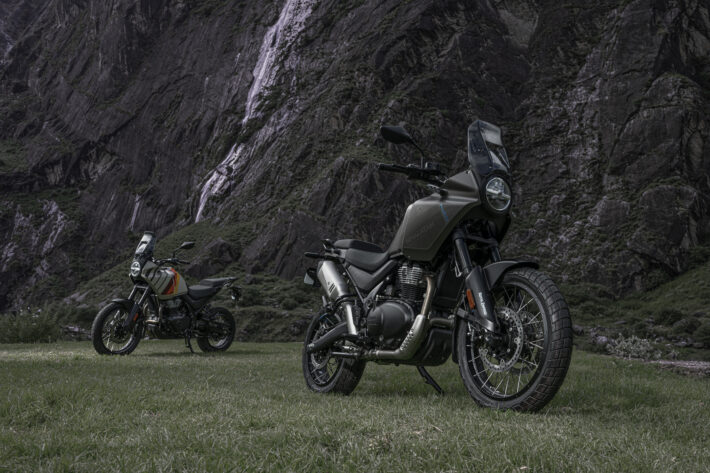
Wheel travel is 190mm front/175mm rear, there’s a 19” front rim and the choice of cast or wire-spoked wheels with tubeless tyres. It’s all held together with a tough steel main frame, and aluminium dual-sided swingarm, and clad in stylish bodywork that’s very much got the Himalayan look and feel.
There’s the highest levels of tech on this bike too, with five bespoke ride modes augmented with a proper six-axis Inertial Measurement Unit (IMU).
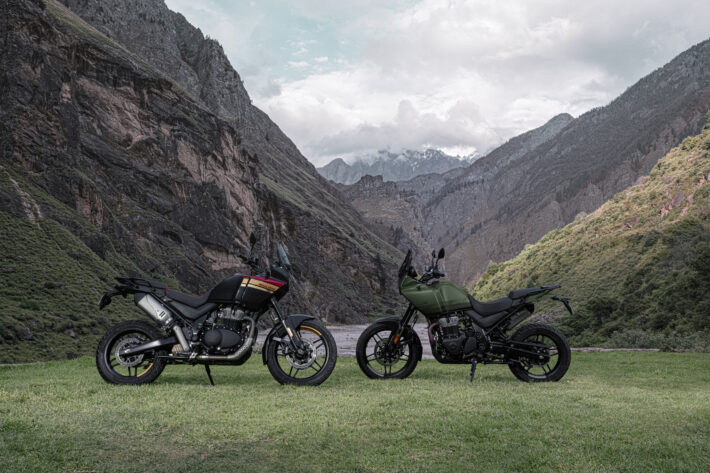
That also means cornering ABS and lean-sensitive traction control, plus cruise control and optional tyre pressure monitoring setup, all controlled with a smart new round LCD display.
There’s plenty of useful touring features too, like the five-way adjustable windscreen and full navigation/media connectivity, LED lighting, and Enfield has a wide range of handy accessories too.
The Himalayan 750 will be available at an introductory price of from £6,999 for the cast wheel option in Aztec Green, while the spoked wheel option in Viking Bronze and Siberia White comes in at £7299.
Finally, the top-line flagship version comes in Antarctic Silver fully loaded with bespoke luggage created in collaboration with GIVI at £8,699. More info: www.royalenfield.com.
Royal Enfield Himalayan 750 Specifications
ENGINE
Type: Air-oil cooled inline twin cylinder, 4 stroke, SOHC
Bore x Stroke: 83.5 x 67.8 mm
Displacement: 743cc
Compression Ratio: 9.5:1
Maximum Power: 55PS(40.5kW)@7,000rpm
Maximum Torque: 63Nm@5,000rpm
Gearbox: six-speed
CHASSIS & SUSPENSION
Frame Type: Box section spine frame with pressed steel outriggers, engine as stressed member
Front Suspension: Showa USD Ø 43 mm. Cartridge-type, adjustable for damping, compression and rebound
Front Wheel Travel: 190mm
Rear Suspension: Showa monoshock with linkage, adjustable preload and rebound
Rear Wheel Travel: 175mm
DIMENSIONS & WEIGHTS
Wheelbase: 1522mm
Rake: 27.9°
Trail: 121.5mm
Ground Clearance: 205mm
Seat Height: 840mm
Kerb Weight (90% fuel): 223kg (With Center Stand)
Fuel capacity: 17.8l
BRAKES & TYRES
Front wheel/tyre: 19” x 2.5” (cast-alloy wheel / tubeless rim) 110/80 R19
Rear wheel/tyre: 17” x 4.25″ (Cast-alloy wheel / tubeless rim) 150/70 R17
Front brake: Twin 280mm floating discs, dual-piston floating caliper 28X28 mm
Rear brake: single 255mm disc, dual-piston floating caliper 28×28 mm
ABS: Dual Channel (switchable at rear), cornering ABS
Dash: 4.0 ” TFT cluster with Wi-Fi, Bluetooth connectivity.
Navigation, phone and music control:
- Five configurable riding modes
a) Road
b) Road sport
c) Rain
d) Trail
e) Custom ride modes with different throttle maps and ABS settings
- Traction levels settings in each ride mode
a) Low
b) Medium
c) High
d) Off
Cruise control
Key based Immobilizer
a) Dual Type-C USB Ports: 1 Fast-Charging (27W) and 1 Standard (10W)
b) TPMS
c) Turn signal Self cancellation d) Emergency brake lamp
Wingman 2.0 with 4G connectivity and GPS A3 – 4.44 l/100 Km