
Honda’s Fireblade-powered Hornet 1000 looks good, has great spec-sheet numbers and has a very tempting price tag. What’s the catch? Our man Alan Dowds spent a couple of weeks on one to try and find out…
It’s nearly 25 years since I first rode a FireBlade-based Honda Hornet. That was back in 2002, when Honda released the CB900 F Hornet: a naked roadster sold at a great price using a detuned 100bhp version of the 1996 CBR900RR engine: the second generation 919. I had one on long-term test for a whole year, and did thousands of miles, hundreds of wheelies, a couple of trackdays, one crash, the lot. Good times…
That first big-bore Hornet was released to build on the massive success of previous Hornets: the main one being the CBR600-powered Hornet 600 sold in Europe from 1998-2013, which itself followed up on the Japanese-market Hornet 250, based on the CBR250 four-cylinder four-stroke engine.
That 900 Hornet was a solid design, with neat twin underseat silencers, a good price, and solid-if-steady performance. It never hit the sales heights of its 600 sibling, partly down to limitations like no fairing option, and an engine which was very hard to tune for more power.
Competition like the 140bhp faired Yamaha Fazer 1000 soundly trounced it at the time, and Honda discontinued that first ‘litre Hornet’ in 2007 after just five years.
But now the big-bore vespid has returned, again on the back of a stellar sales performance from its smaller sibling: this time the parallel twin 750 Hornet launched a few years ago. Sporty naked bikes are strong sellers in most major markets these days, the firm’s CB1000R was getting a bit long in the tooth, and Honda’s also been cutting prices where it can, so a new budget naked, with good power and wide appeal made a lot of sense.
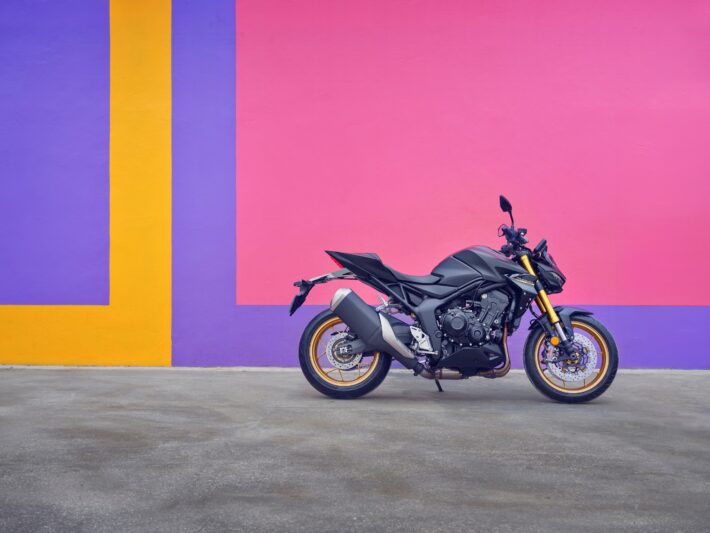
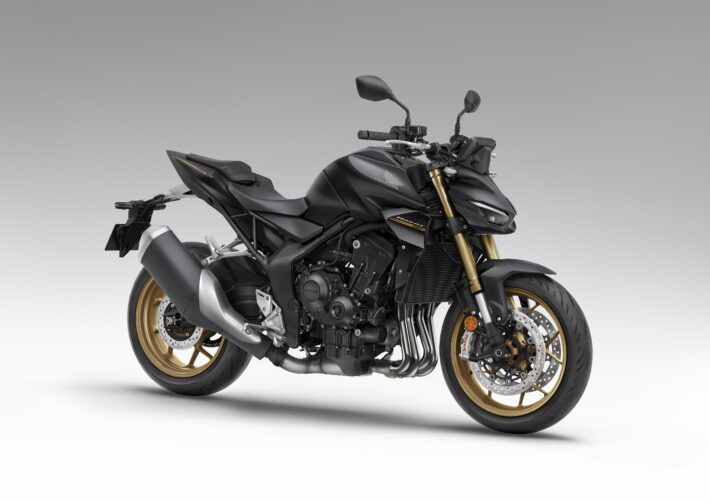
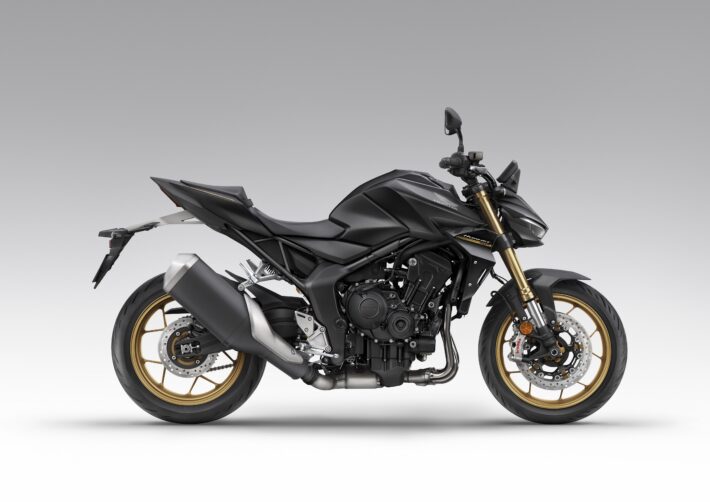
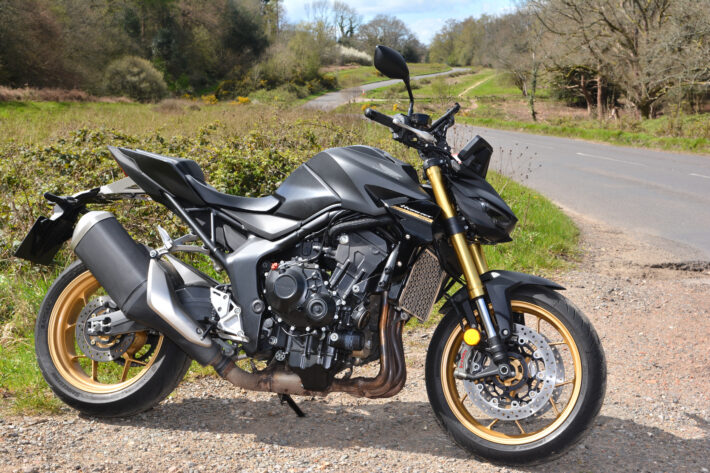
And here it is, parked up outside my house after the very nice Honda man has dropped it off. It’s an SP variant, in black and gold, and looks pretty classy I think. It’s a nice day, so I pop on some riding kit, switch on my out-of-office, and head out for a quick spin on the slick Honda.
The bike is cold, and takes a little bit of a press on the starter button before it barks into life (it’s never a great starter during the time I have it tbh, perhaps down to the battery being on its way out). Once it fires up though, there’s a sharp, race-style bark, followed by a gruff fast-idle roar from the single exhaust pipe.
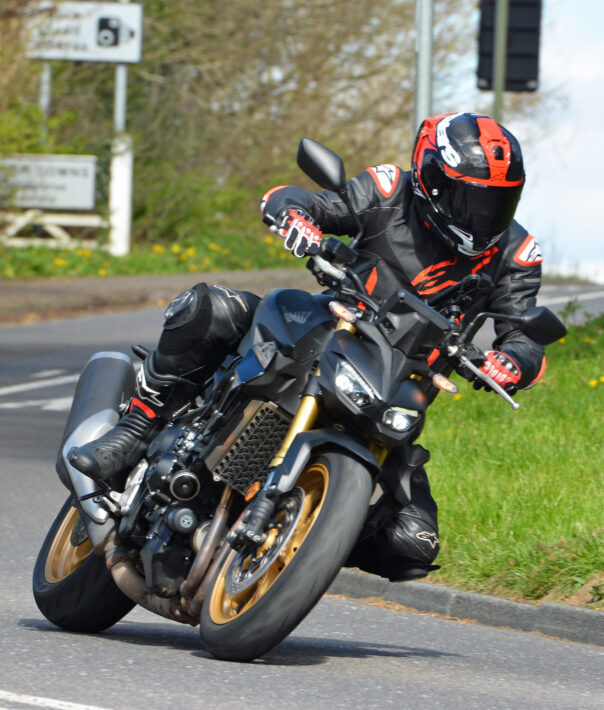
It sounds great, perhaps down to some clever work from the exhaust valve exclusive to the SP version. Honda says that what it calls a ‘Revolutionary Controlled (RC) valve’ in the 7.1L exhaust muffler setup adds 5bhp to peak power. It’s basically an EXUP valve de nos jours, and while Honda says it’s closed until 5,700rpm in all gears, I reckon the ECU is cracking it open a little on start-up for the vibes/lolz. My poor neighbours.
I’m off on a little local loop I use when testing bikes – nothing too strenuous, and since I’m in London it majors on urban miles at first. This is All Perfectly Fine mind: the Hornet’s riding position is comfy, though the seat is pretty hard from the off (one of several areas where you can perhaps see costs have been kept down).
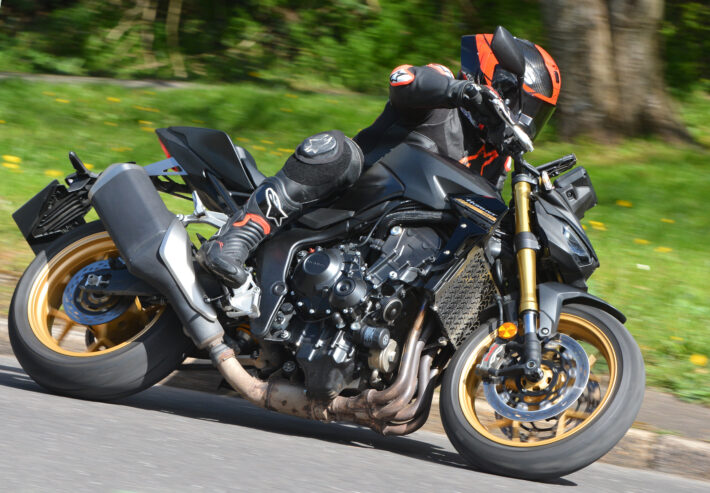
You grab onto a sweet set of posh tapered fat aluminium bars, there’s an adjustable brake lever (but not on the clutch), clean switchgear and simple mirrors with a great view behind. The LCD dash is compact and clear enough, though I think the menu navigation isn’t the most intuitive out there, and I spend a bit of time flicking through to find the essentials (firstly ‘range remaining’ since the fuel light is on).
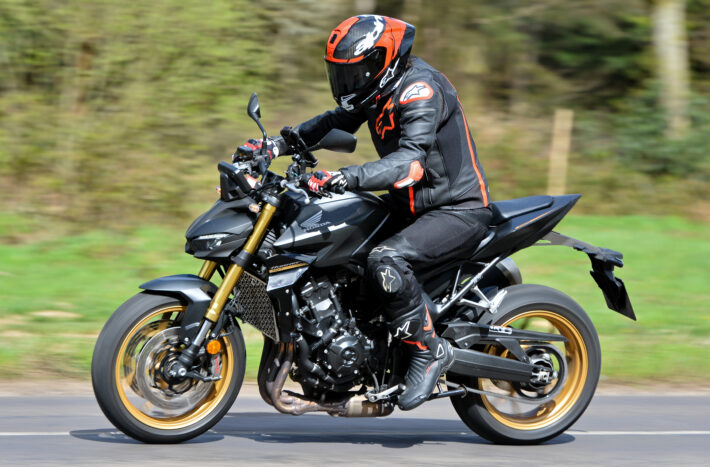
I am enjoying the handling of the Honda straight away though. It feels really agile around town, which is a great start for urban riders like me. Compared with some of the other litre nakeds, it has the nimble feel of a smaller bike, which surprises considering its not-inconsiderable 212kg wet bulk.
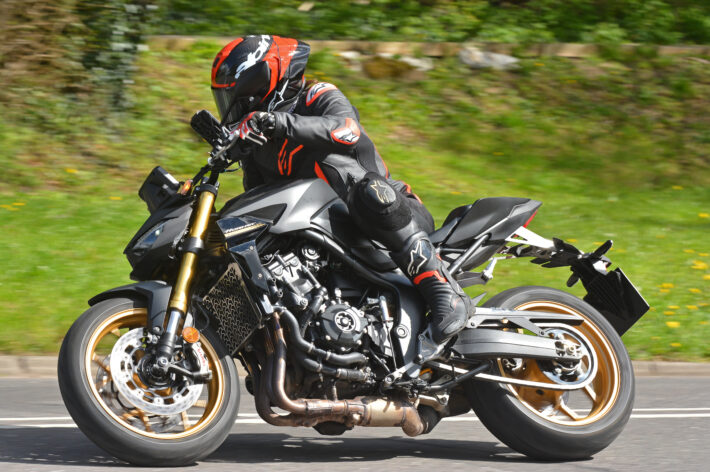
The steering is light, with good feedback from the front, and I can make my way through the fabled ‘urban hellscape’ of south west London with aplomb.
I’m on a big dual carriageway now though, and can dig into the fat reserves of power from that Fireblade engine. I’ve been trundling through 20 and 30mph zones up till now, so have been barely troubling the throttle at all, but now I can give it a bit of a handful, as it were.
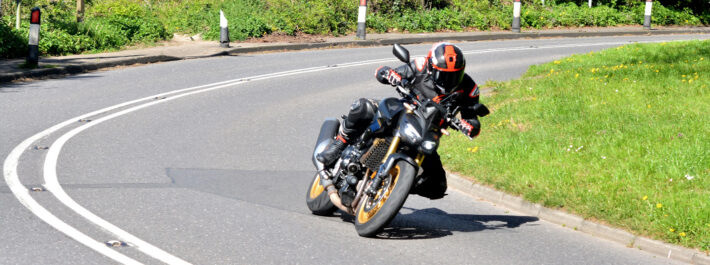
The cheery easy-going Honda below me transforms into a bit of a monster with a flick of the wrist: there’s decent urge through the bottom end, and a definite litre-bike rush once you get over 6,500rpm on the rev range.
It’s smooth, classy Honda power of course, but with a bit of an edge, and a pleasing howl from the end can. The gearshift is clean and snappy, and the Honda up/down quickshifter is also really well executed, with smooth predictable gearchanges. Lovely stuff.
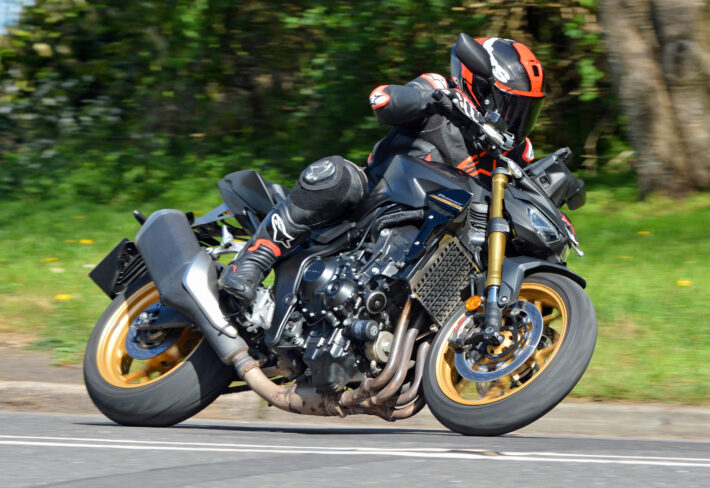
I’m out on some of my favourite local twisty roads now, and giving the Hornet chassis a bit more attention. The front brake is a teeny bit disappointing considering the posh Brembo Stylema calipers on this SP variant. They’re a little soft in terms of initial bite, though there’s plenty of power once you give them a handful.
The 310mm discs are a little smaller than the 320 or 330mm fitments on current superbikes, the master cylinder is a standard axial roadbike design, and the extra weight on the Hornet over a sportsbike is perhaps worth considering.
Performance-obsessed owners who fancy the odd trackday might want to look at some sportier pads, with bigger discs and spacers for the calipers as a more involved upgrade option. Braided steel hoses and an upgraded radial master cylinder? Well I admire your chutzpah sirrah and carry on if you will!
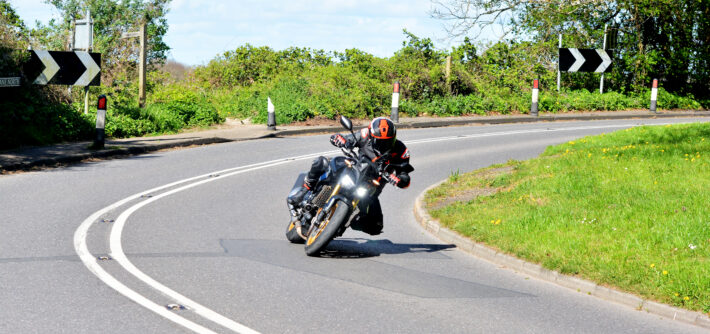
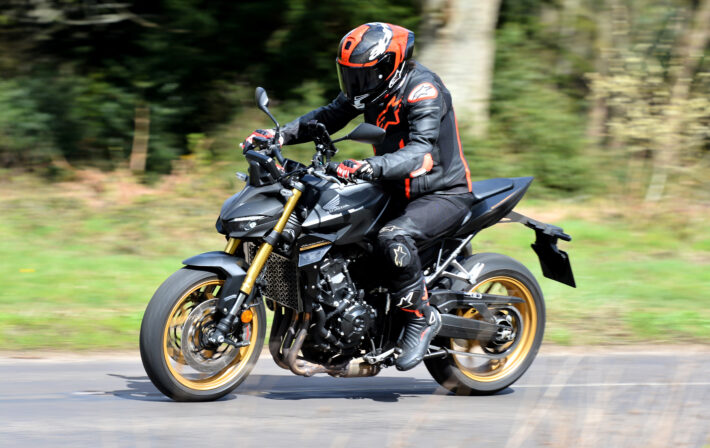
What’s very much not a disappointment is the stock rubber: Honda’s done a good job here, with Bridgestone S22 sporty road tyres performing very nicely indeed thanks. On my usual photo corner, they give plenty of proverbial confidence all the way through the bend, and there’s ample feedback. The front fork is impressive too, but the back end is a little bit firm I reckon.
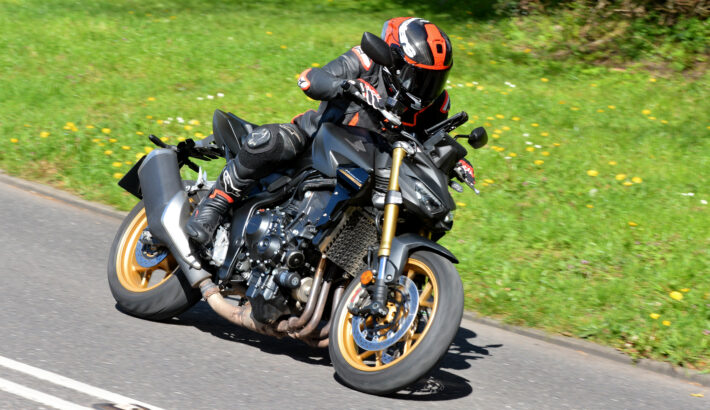
The Öhlins shock is beautiful on smoother sections of road, with a plush controlled feel. Hit a nasty pothole or a speed bump though, and you’re shot out of the saddle. A bit of fettling on the fully adjustable monoshock would pay dividends no doubt – or just steer clear of them bumps and bomb craters…
I spend the next week or so using the Hornet as my daily wheels, and it’s a really impressive bit of kit. That engine impresses more and more as I use it: unlike my old 900 Hornet it’s got more than enough power, especially once you start to use the revs higher up, and the quickshifter is great. I have a little grumble about the electronics package though: Honda’s gone for a fairly basic setup in terms of ABS and traction control, without any IMU assistance.
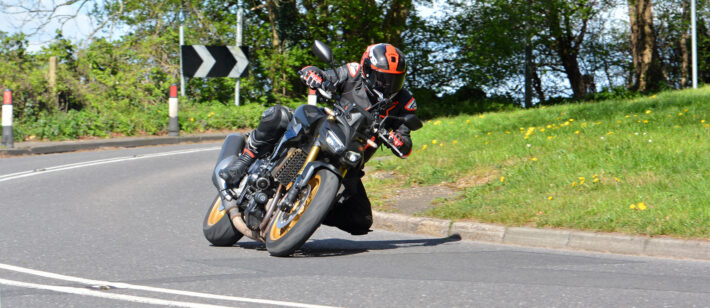
That’s understandable when you consider the price tag, but if you’ve become used to more advanced setups, you will notice the difference. On the standard settings the anti-wheelie comes in quite sharp, so that even just accelerating hard down a motorway slip road will have the motor cutting as the electronics step in.
That’s bad enough, but the power then takes a fraction of a second to come back in, rather like early ABS systems would take some time to cycle the brake pressure off and on.
Once you get used to it, it’s much less intrusive, but I ended up switching the traction off when riding a bit harder. That’s also a bit of a faff, since every time you turn the ignition off, it comes back on again. You then need to go into one of the customisable ‘User’ rider modes and turn off the TC, before selecting that user mode.
This is actually a decent setup in the end, since it does mean you can turn traction on and off as you go along, but you do have to remember to reset it each time you turn the bike on.
While I’m having a moan, there’s no cruise control, which seems a shame on a bike like this these days, and there was also some nasty rust showing on the clamp between the silencer and link pipe. Again, to be expected on a budget bike perhaps, but along with the obvious ‘MADE IN CHINA’ stamp on the rear wheel hub, maybe something that you’d have expected Honda to tidy up a bit better.
At the end of the day though, for the £10,099 price tag, Honda has to be applauded for the new Hornet 1000 SP. If you want a full-on superbike with all the bells and whistles then your dealer will gladly sign you up for a Fireblade at more than double the price. As it is, the Hornet is a great bike at a great price, and a very worthy holder of the ‘Hornet’ moniker.
TECH HIGHLIGHTS
Engine
Honda’s chosen to revamp an old engine here to save cash: the previous generation motor from 2017, retuned to suit its new role and current emissions regulations. Using a previous design saves cash: you can probably use existing tooling and processes, and it’s a proven design that won’t need a lot of testing.
Having said that, Honda has suffered from some oil consumption problems with this new engine – perhaps down to choosing lower-cost internals like the cast pistons instead of forged, though there’s been no official comment on the reasons.
The Hornet gets a ride-by-wire fuel injection system rather than the old-school cable setup on the 2017 ‘Blade, plus different cam timing and vale lift to move torque/power down the rev range. It’s down around 35bhp on the old Blade, making 155bhp instead of 189bhp.
Lower revs means it can use those cheaper cast aluminium pistons instead of forged parts, as well as steel valves rather than titanium. Compression is also down to a lowly 11.7:1 from 13:1, again this lowers the state of tune, and broadens out the power. Gear ratios are also lower in second-fifth gears, with a taller sixth gear for cruising.
Frame
Nothing radical here: a cheapo steel twin-spar design does the job with no fuss, at a lower cost than posh aluminium kit. The downside is mass: the Hornet weighs 212kg wet, which is okay, but reflects this design choice.
Suspension
This SP version has been primped-up with an Öhlins TTX36 rear shock, which is a nice touch, matched to a cast aluminium swingarm. Up front you get Showa 41mm USD forks, which are fully-adjustable for spring preload and compression/rebound damping.
Brakes
Again, the SP variant excels, with Brembo Stylema four-piston radial-mount superbike brake calipers up front and 310mm discs.
Electronics
One area where the cost cutting is most obvious: the traction control and ABS are non-cornering units, so the intervention is quite basic compared with higher-tech versions. Five-inch colour LCD dash is well-laid out and has smartphone integration, with simple switchgear control, and there are five rider modes including two user-customisable ones.
Standard Hornet spec
The non-SP version loses the exhaust power valve used on the SP, which costs 5bhp peak power. Brakes are radial-mount Nissin calipers instead of the Brembos, the rear shock is a preload/rebound adjustable Showa rather than Öhlins, and the up/down quickshifter is an optional £188 extra rather than fitted as stock.
2026 Honda CB1000 Hornet SP Technical specifications
Price: £10,099
| ENGINE | |
| Type | Liquid-cooled, 4-stroke DOHC inline four |
| Displacement | 1000cc |
| Bore and stroke | 76mm x 55.1mm |
| Compression Ratio | 11.7:1 |
| Max. Power Output | 155bhp (115.6kW)@11,000rpm |
| Max. Torque | 107Nm@9,000rpm |
| Noise Level | L urban 74.1dB L wot 78.9dB |
| Oil Capacity | Upper 3.5L/ Lower 3.0L |
| FUEL SYSTEM | |
| Carburation | PGM FI electronic fuel injection |
| Fuel Tank Capacity | 17L (inc reserve) |
| CO2 Emissions (WMTC) | 136g/km |
| Fuel Consumption (WMTC) | 5.9L/100km / 16.9km/L |
| ELECTRICAL SYSTEM | |
| Battery Type | AGM |
| Battery Capacity | 12V 6.3AH |
| DRIVETRAIN | |
| Clutch Type | Wet multiplate, Assisted slipper clutch |
| Transmission Type | Six-speed Manual |
| Final Drive | Chain |
| FRAME | |
| Type | Twin Spar |
| CHASSIS | |
| Dimensions (L´W´H) | 2,140mm x 790mm x 1,085mm |
| Wheelbase | 1,455mm |
| Caster Angle | 25° |
| Trail | 98mm |
| Seat Height | 809mm |
| Ground Clearance | 135mm |
| Kerb Weight | 212kg |
| Turning radius | 2.8m |
| SUSPENSION | |
| Type Front | Showa 41mm SFF-BP USD forks 118mm travel |
| Type Rear | Ohlins Monoshock damper, Prolink swingarm, 139mm travel |
| WHEELS | |
| Type Front | Multi-spoke cast aluminium |
| Type Rear | Multi-spoke cast aluminium |
| Rim Size Front | 17M/C X MT3.50 |
| Rim Size Rear | 17M/C X MT5.50 |
| BRAKES | |
| ABS System Type | Dual-channel |
| Type Front | Dual 310mm floating disc with Brembo Stylema radial mounted four piston calipers |
| Type Rear | Single 240mm disc with single piston caliper |
| INSTRUMENTS & ELECTRICS | |
| Instruments | Five-inch TFT Meter with customisable layout, including speedometer, tachometer, clock, gear position, upshift indicator |
| Headlight | LED |
| Taillight | LED |
| Connectivity | Honda RoadSync |
| USB | Yes |
| Quickshifter | Yes |
| Security System | HISS (Honda Intelligent Security System) |
| Riding Mode | Standard, Rain, Sport, 2x User |
| HSTC | Yes |
| Wheelie Control | Yes |
| Additional Features | ESS |
Image Credit: John Goodman/Honda
Disclaimer: the sole purpose of this article is to provide guidance on the issues covered. This article is not intended to give legal advice, and, accordingly, it should not be relied upon. It should not be regarded as a comprehensive statement of the law and/or market practice in this area. We make no claims as to the completeness or accuracy of the information contained herein or in the links which were live at the date of publication.
You should not act upon (or should refrain from acting upon) information in this publication without first seeking specific legal and/or specialist advice. Arthur J. Gallagher Insurance Brokers Limited trading as Devitt accepts no liability for any inaccuracy, omission or mistake in this publication, nor will we be responsible for any loss which may be suffered as a result of any person relying on the information contained herein.