
Ducati updates its Hypermotard, with most powerful version ever. Let’s explore the 2026 Ducati Hypermotard V2 and V2 SP…
When it was first shown as a concept 20 years ago (that makes us feel old, we won’t lie), the Ducati Hypermotard was a super-light, V-twin powered piece of nonsense. Based on the old ‘supermotard’ concept of a full-power big-bore dirtbike with road-racing wheels and brakes, the 2007 production Hypermotard used the firm’s air-cooled desmodromic V-twin in a 1,078cc capacity, with a skinny bare-bones chassis weighing in at a svelte 179kg dry.
Sporty running gear – Marzocchi forks and Sachs shock plus Brembo brakes – gave sharp handling, but it was the tall stance and snappy performance that made it. Stunts, wheelies, stoppies and burnouts were de rigeur, and Ducati launched the bike with iconic imagery of its ex-MotoGP and then-WSBK racer Ruben Xaus, knee-down, one-handed, thumb up, sliding the Hypermotard round a race track. Lovely stuff.

Since then, the Hypermotard has been a staple of the Ducati lineup: it’s probably not a bike you’d have in your garage as your only set of wheels (though we’re sure there are folk out there doing just that). But as a piece of skinny madness for sunny funny days, it’s been hard to beat.
Ducati’s built a few versions, with various V-twin motors, as well as the new 698 single which came out a couple of years ago. And now, for 2026, the nutty motard gets the latest Ducati V-twin motor, in a 120bhp tune.
That 890cc engine has gradually been replacing all the old-school Ducati V-twins in the Multistrada, Monster, Streetfighter and Panigale, and is now doing a job in this, the fourth generation Hypermotard.
It’s a light engine, and that helps the new bike to beat the weight goal of the original. It tips the scales at 180kg wet with no fuel, which is 1kg more than the 2007 bike’s DRY weight, so there’s a clear advantage there. It also has a chunky 30bhp more peak power, so will definitely be a lot quicker.
The new V-twin engine is familiar by now: it’s dropped the desmodromic valve gear, and majors on compactness and mass reduction, as well as Euro 5+ emissions compliance and efficiency. Ducati’s matched it here to a new monocoque frame, specially developed for the Hypermotard. It’s not as stylish as the old-school steel tube trellis units previously used, but will no doubt be lighter and more efficient all round.
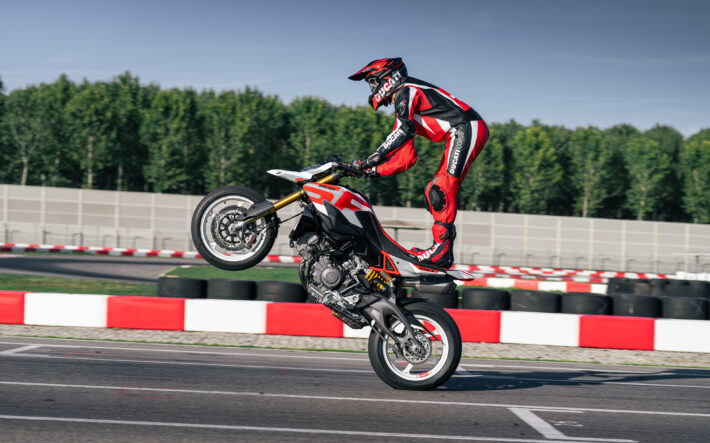
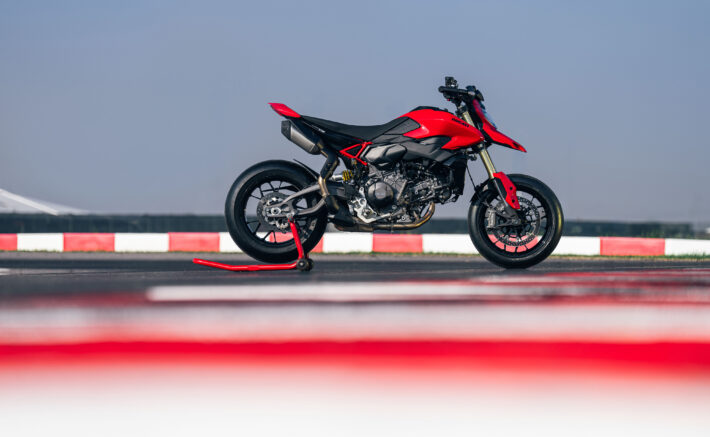
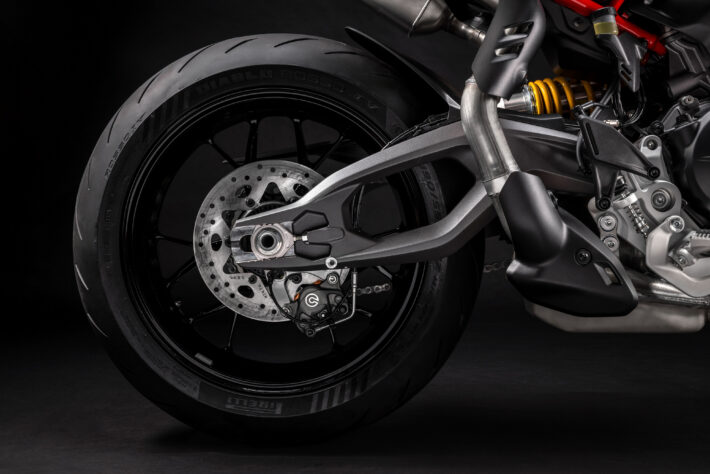
Standard suspension fitment is adjustable Kayaba kit front and rear – 46mm USD fully adjustable forks and a preload/rebound adjust rear monoshock, operated by a new dual-sided swingarm. Brakes are from Brembo, predictably enough, with PR 18/19 radial master cylinder, M4.32 front calipers and dual 320mm discs.
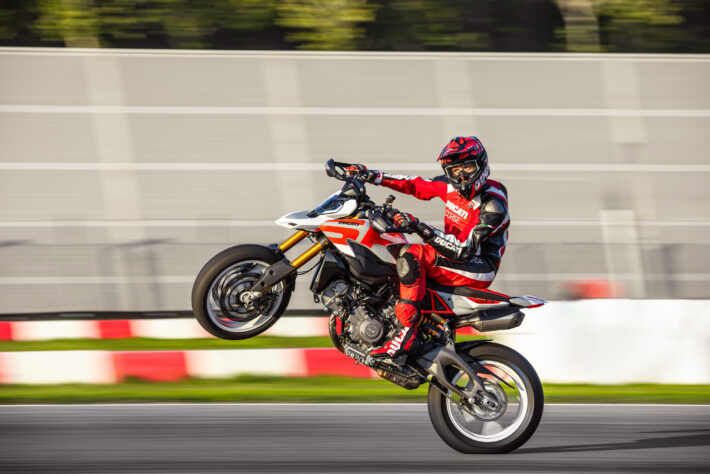
Ducati’s electronics are amongst the best in the business, and the Hypermotard doesn’t miss out. Standard setup includes a Ducati Quick Shift (DQS) up/down 2.0, Riding Modes, Power Modes, Ducati Traction Control (DTC), Ducati Wheelie Control (DWC), Engine Brake Control (EBC), Bosch Cornering ABS and the Ducati Brake Light (DBL) setup.
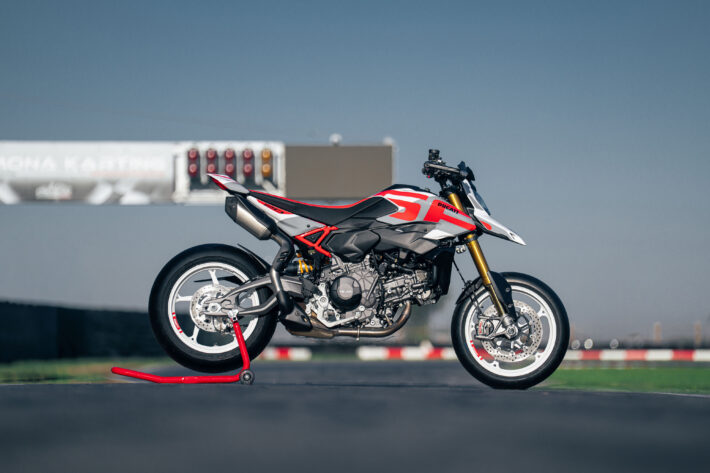
Other tech includes quick adjustment buttons, ‘Coming Home’ lighting, TFT colour display, Full LED lighting system, Daytime Running Light (DRL), Sachs steering damper, Dynamic turn indicators, self-cancelling turn indicators and lap timer. Nice.
Ducati’s also offering an SP version, for nearly four grand more, which has a much saucier spec. That starts with the suspension: the SP has fully adjustable Öhlins suspension front and rear: 48mm USD NIX30 forks and an STX 46 shock absorber, for ‘more refined, racing-like handling’.
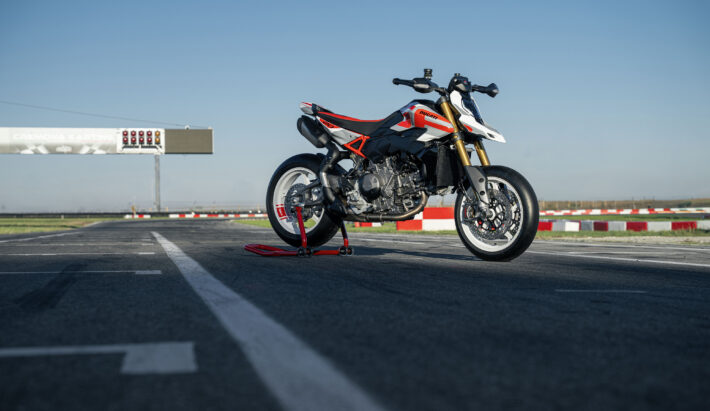
The brakes are upgraded to M50 calipers and PR16/21 master cylinder, and the wheels are forged aluminium instead of the cast parts on the base bike. You also get sportier Pirelli Diablo Rosso IV Corsa rubber instead of standard Diablo Rosso IV fitings. The SP spec further adds launch control and pitlane speed limiter, a carbon fibre front mudguard, lithium battery instead of lead acid, and the bike is a total of three kg slimmer overall. Lightness costs, as we all know by now…
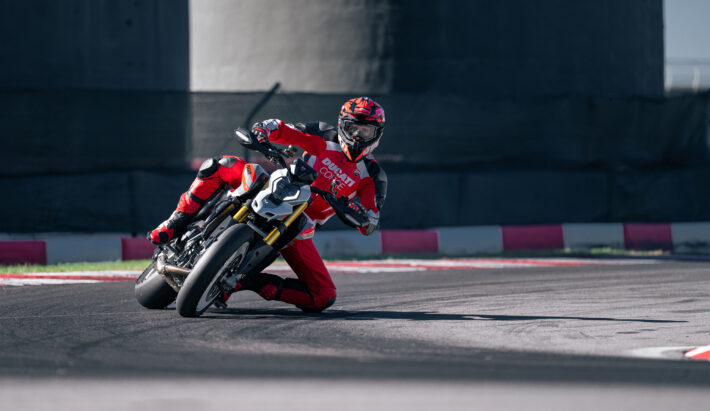
A tempting package then – though as with the Monster, we reckon the new Hypermotard is lacking a little in that essential Ducati character. Dropping the desmo valves, steel trellis frame and single-sided swingarm all makes sense in engineering and cost terms we’re sure.
But while the Hypermotard keeps the Ducati style, it’s becoming a little more like mainstream models from competitor brands. Will Ducati fans care? Probably not, in the short term, at least…
2026 Ducati Hypermotard V2 and V2 SP Tech Highlights
Hypermotard V2 SP – £17,295
V-twin engine, 890 cc
Maximum power: 120 hp at 10,750 rpm
Maximum torque: 94 Nm at 8,250 rpm
Kerb weight without fuel: 177 kg
Dedicated monocoque frame
Öhlins NIX30 48 mm upside-down forks, fully adjustable
Öhlins STX46 monoshock, fully adjustable
Forged aluminium wheels, 3.50 x 17″ at the front and 5.50 x 17″ at the rear
Braking system with Brembo M50 calipers
Pirelli Diablo Rosso IV Corsa tyres 120/70 and 190/55
Latest-generation electronics package with 6-axis Inertial Measurement Unit (6D IMU): Four-stages
ABS with cornering functionality; Ducati Traction Control (DTC); Ducati Wheelie Control (DWC);
Ducati Quick Shift (DQS) 2.0; Engine Brake Control (EBC).
New petal joystick
New 5″ full-TFT dashboard with 16:9 aspect ratio
Riding Modes (Race, Sport, Road, Wet)
Full-LED headlights with DRL and dynamic turn indicators
Ready for Ducati Multimedia System (DMS), Turn-by-Turn Navigation o Lithium battery
Carbon Fiber front fender
Ducati Power Launch
Ducati Pit Limiter
Hypermotard V2 – £13,495
Main standard features as Hypermotard V2 SP with the exception of:
46mm upside-down Kayaba forks, fully adjustable
Kayaba monoshock, adjustable for preload and rebound
Cast light-alloy wheels, 3.50 x 17″ at the front and 5.50 x 17″ at the rear
Pirelli Diablo Rosso IV tyres, 120/70 and 190/55
Braking system with Brembo M4.32 calipers
Kerb weight without fuel: 180 kg
Lead-acid battery
SPECS
2026 Ducati Hypermotard V2 specs (SP)
Engine: Ducati V2 engine: 90° V2, 4 valves per cylinder, intake variable valves timing system, liquid cooled, 890cc
Bore x stroke 96mm x 61.5mm
Compression ratio: 13.1:1
Fuel injection: electronic fuel injection system, one injector per cylinder, ride-by-wire
Peak power: 120.4bhp (88.5kW)@10,750 rpm
Peak torque: 94Nm@8,250rpm
Clutch: Hydraulically-controlled slipper wet clutch.
Frame: Aluminium monocoque frame
Front suspension: Fully adjustable 46mm USD Kayaba fork (48mm USD fully adjustable Öhlins fork)
Rear suspension: Preload/rebound adjustable Kayaba rear shock (fully adjustable Öhlins STX46 shock absorber) dual-sided aluminium swingarm
Wheels: cast aluminium (forged aluminium), 3.50 x 17 5.50 x 17
Tyres: Pirelli Diablo Rosso IV (Rosso IV Corsa) 120/70 17 189/55 17
Brakes: Dual 320mm semi-floating discs, radially mounted Brembo Monobloc M4.32 (M50) four-piston calipers (front), single 245mm disc, Brembo dual-piston caliper (rear). Cornering ABS.
Dash: Digital unit with 5″ TFT display
Kerb weight: 180kg (177kg), wet with no fuel
Seat height: 880mm standard, with high/low seat accessories can be 850mm
Wheelbase: 1,514mm
Rake/Trail: 26°/110mm
Fuel capacity: 12.5 litres
Rider aids: Riding Modes, Power Modes, Ducati Traction Control (DTC), Ducati Wheelie Control (DWC), Engine Brake Control (EBC), Bosch Cornering ABS, Ducati Brake Light (DBL)
Warranty: 24 months, unlimited mileage
Service intervals: 12 months 15,000 km (9,000 mi), valve check 45,000 km (28,000 mi)