
When I started riding, more than 35 years ago, Bimota was my dream bike brand. Back then, in the late 1980s, Ducati was a weird, near-moribund financial basket case of a firm – massive WSBK racing success was still to come, and its range of bikes was a curious mix of late-60s air-cooled motors in slick chassis with dated styling.
Like BMW at the time, it wasn’t a realistic choice for the typical UK biker at the time: Japanese machinery was by far the best option. Owned by Cagiva, Ducati’s future was uncertain, and things came pretty close to going out altogether for the ‘D’ brand.
Bimota though – there was a bike brand you could fantasise about. It made nutter sportsbikes in tiny numbers, had a unique style, didn’t mess about when it came to tech, and offered stunning big-bhp performance.
Hipster appeal, plus real-world reputation: it even won the odd WSBK race (fun fact: Bimota won the VERY FIRST world superbike race back in 1988, with Davide Tardozzi riding a Yamaha FZ750-powered YB4…)
A very special firm then – but Bimota has hit hard times in recent years. Now, though, it’s back on the UK market, with a new range of Kawasaki-powered machines, and is now owned by Kawasaki too.
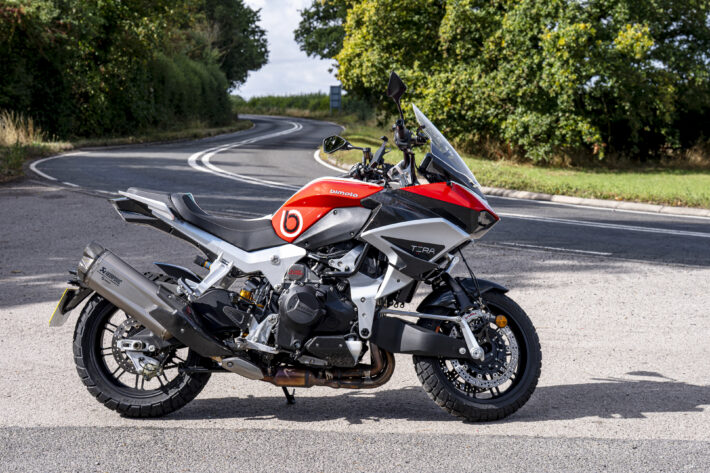
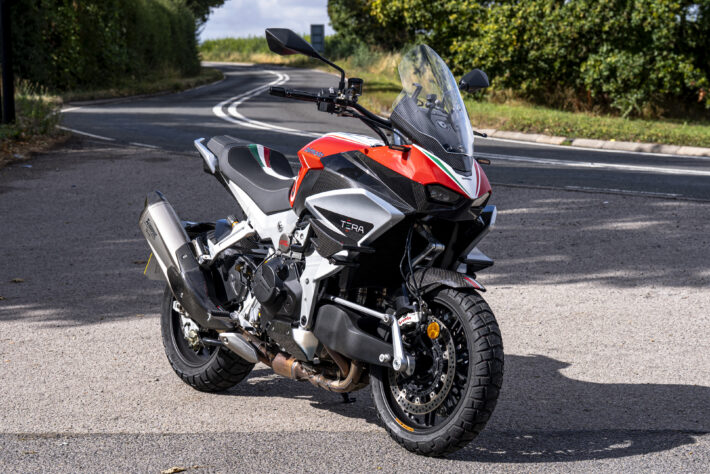
Leading the charge is this piece of madness: the Tera. It’s a ‘crossover’ design, with hints of adventure-touring design, Kawasaki’s 200bhp supercharged H2 engine, and Bimota’s legendary Tesi front suspension system.
It first appeared at the Milan show a few years back, and now it’s here, parked up in front of me at the goods entrance of Kawasaki UK in Bourne End. I’ve snaffled half a day on the bike, the sun’s out, and Berkshire is my oyster, as it were.
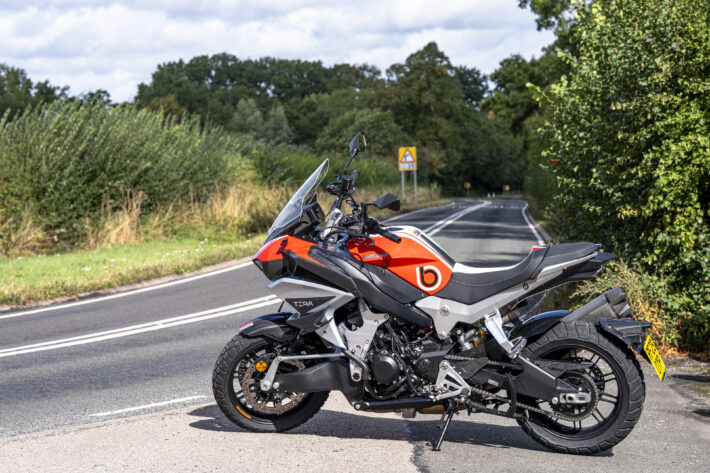
First impressions are actually quite intimidating. This is a big piece of kit, and looks both heavy, tall and slightly ungainly at first glance. The mad chunky Anlas tyres and weird front end, plus the knowledge that the thing has 200bhp, and costs £35k also weighs on the mind a little, I’m not going to lie. I steel myself for an intense ride, slip on my Arai, and jump aboard.
I needn’t have worried – the Tera is really civilised, and puts me at ease instantly. Part of that is down to the familiar Kawasaki tech: the dash and switchgear are familiar from my time on the Z H2 and H2 SX, and the engine is pure modern Japanese fare: smooth, predictable and beautifully fuelled.
The other pleasant surprise is the slow-speed handling. Looking at all the steering linkages, front swingarm, suspension rods and hub-centred steering, you could expect a stiff, distant, cranky response to the handlebars. But there’s none of that at all: even just paddling around the car park reveals simple, easy handling, with plenty of steering lock. Even the seat height is accommodating, the 830mm saddle not too imposing at all.
Bourne End is a classic English chocolate-box village, so there’s not too much call for a 200bhp powerplant as I trundle out towards the M40 and Oxfordshire. I have an old photo corner in mind which is about 25 miles away, and am meeting the snapper there.
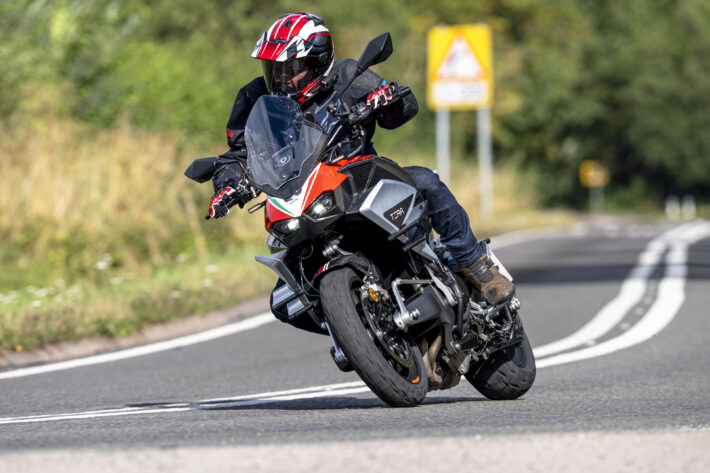
The Tera burbles away below me as I filter through the mid-morning weekday traffic, by far the most exotic vehicle on the roads here today, though the riding position is natural and comfy, helped by the tall wide handlebars.
I’m out of the village, and onto the local bypass up to the motorway. The slip road gives me the first taste of the Tera’s pure performance, and it does not disappoint. The H2 supercharged engine now has a long distinguished history of total madness, and it continues that here.
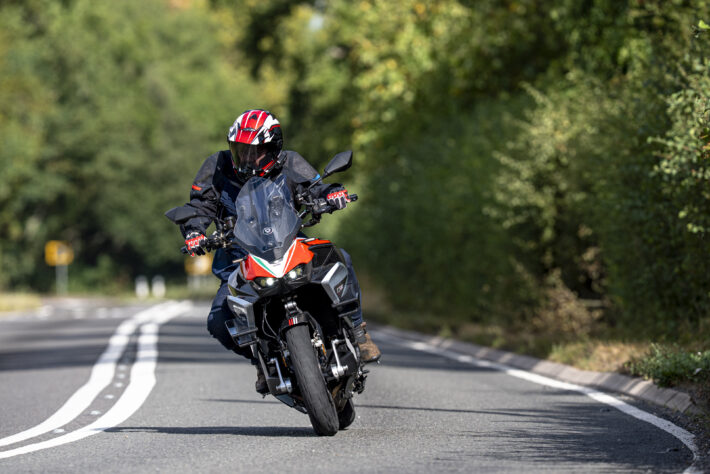
It’s a very, very strong engine, with that 200bhp peak output matched to a bulging midrange. The supercharger boosts the torque right from low-down in the rev range, and just keeps piling on the ponies. That forced induction gives the feel of a bigger-capacity motor, and the Tera has the heart of something like the ZZR1400 rather than a screaming litre four like the ZX-10R.
Onto the M40 and heading west, the Tera has me chuckling in my lid at the sheer acceleration available, punctuated by the high-pitched chirruping of the blow-off valve whenever you roll off the throttle. It’s beguiling stuff, and more than lives up to the Bimota performance reputation.
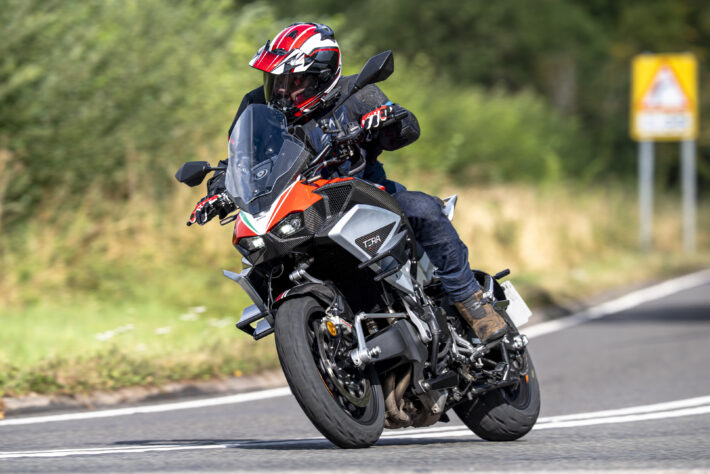
Off the motorway and onto some twistier roads to meet the snapper, and I get an idea of how the chassis performs in ‘normal’ conditions. Pretty well is the answer: it takes a bit of time to get used to the total absence of any front suspension dive when braking, but once you do, it’s all remarkably conventional.
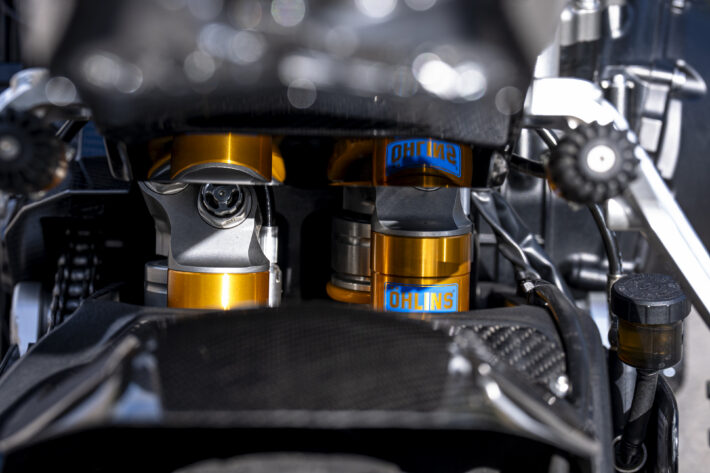
The Tesi setup offers theoretical advantages for a big, heavy long-suspension bike like this, in the same way as BMW’s Telelever and Duolever front ends. Not having the whole front end sitting on two spindly long tubes with springs inside makes sense, and the Tera chassis works really well. The front end is communicative and plush, with the Öhlins shock giving slick damping, and the back end is just as good.
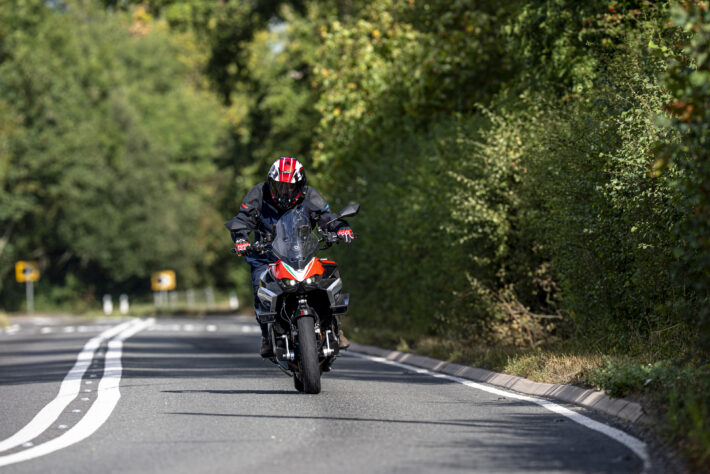
A critic might wonder why there’s no electronic semi-active suspension setup here, and I can see some customers wanting that. But on the road today, I’ve got no issues with the suspension at all. Ditto the brakes: the Brembo Stylema front calipers felt a little bit flat at the start of my ride, as if the pads had a little bit of a glaze on them, but as they’ve warmed up and bedded in, the performance sharpens up nicely.
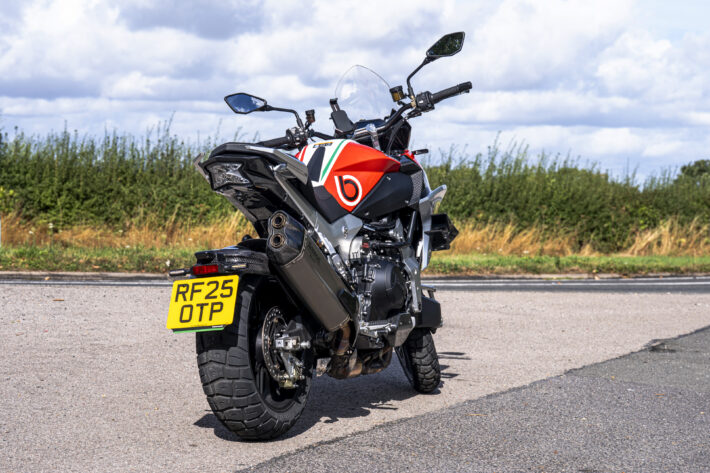
I’m not so sure about the tyres though. Bimota has chosen the Turkish tyre maker Anlas to supply a bespoke variant of its chunkily-trod Capra adventure tyre, and they do look the part. They work okay too, on the warm, dry asphalt we’re enjoying today. But I didn’t feel like I was getting as much communication from the front end in particular as I’d like on a bike like this.
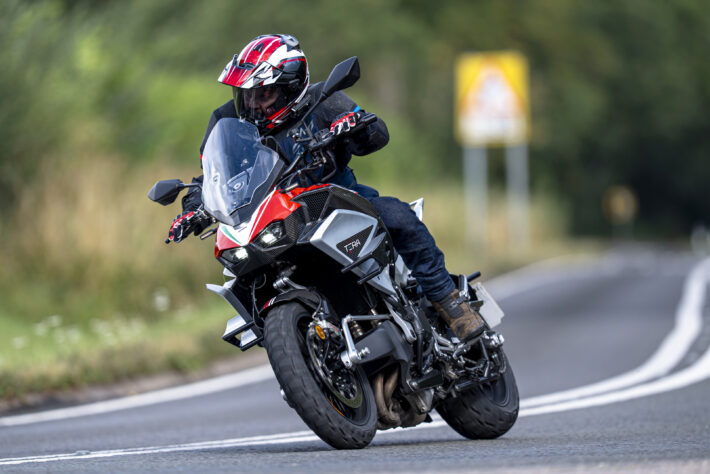
The Tera has no serious dirt pretentions, so a knobbly tyre is a style choice, nothing more. I’d really like to try it with some conventional sporting road tyres from a big ‘legacy’ brand instead, with none of the compromises of the semi-knobbly design.
I spend 45 minutes riding up and down the same stretch of road for photos, and really settle into the Tera experience. I’m still impressed by the slow-speed handling: foot-up U-turns in a narrow B-road are a breeze considering the size and mass of the bike, and it’s a joy to throw into and through a bend.
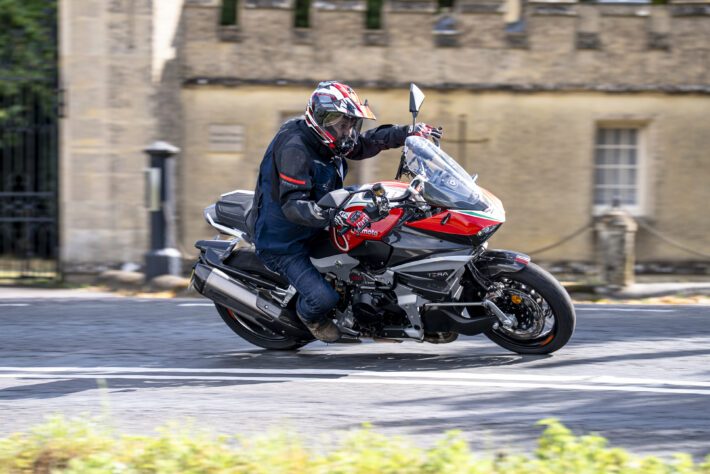
It has very much a road touring bike feel rather than an adventure bike, partly because of the lack of dive off the front end, with only the tall riding position marking it out as a crossover design. The steering is natural and easy at speed too, and while I’m not pushing too hard today, there’s loads of ground clearance too.
Pics over, I go for a run around the county. I pop into Wokingham to see my chums at Big CC Racing, just 40 miles down the road from the photo stop, and take in some more urban routes. The Tera’s great manners continue when the pace drops again, and it’s easy to manage through traffic.
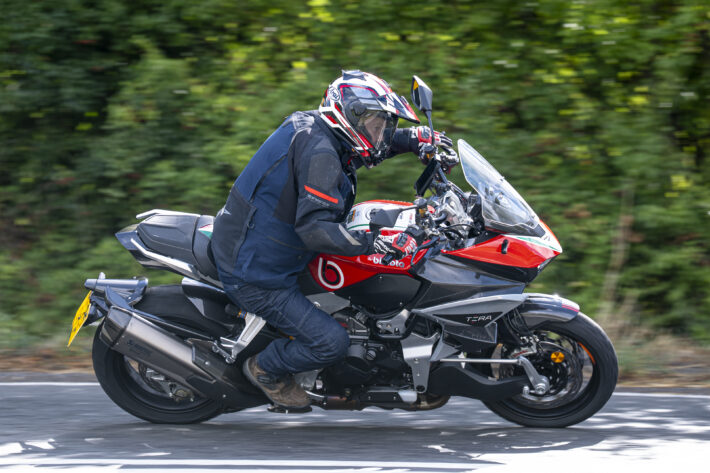
At Big CC, the Tera’s looks are thoroughly deconstructed: the verdict is it looks wild, with some nice design cues, lovely carbon fibre and billet aluminium, but it’s also a bit messy. There’s a heap of hoses, wires and cables, added to the various steering and suspension linkages, which makes for a rather fussy feel around the engine and front end.
Questions are also raised about the aerodynamic winglets up front and multi-layered fairing panels. It’s a long way from the traditional Bimota design, especially when we compare it with the classic GSX-R1100 powered SB6R which Big CC has in the back of the showroom.
On my way back to base, I decide I’m a firm fan of the Tera experience though. It’s effing fast everywhere of course, and the only worry there is the usual one on a big bike – the enforcement cameras and tight speed limits of 2025 Britain. The handling is superb, and a genuine treat for fast road use, though I’d have zero interest in trying to wrestle this 215kg beastie along even the gentlest of green lanes.
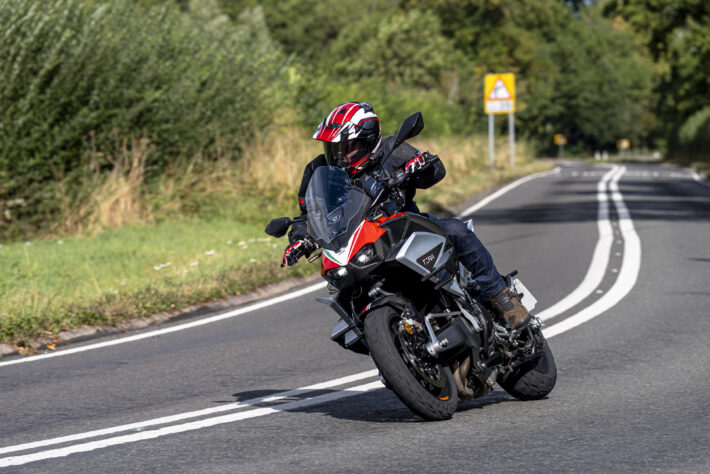
The electronics suite is decent enough, with cornering ABS and traction, quickshifter, launch control and cruise (which seemed to be broken on my bike), though it’s a little behind the very extreme cutting edge of 2025. Things like keyless ignition, electronic suspension, radar cruise and an electric windscreen are all absent, and the nice Kawasaki-sourced dash is a little on the skimpy side in terms of size.
BMW and Ducati are a little ahead of Kawasaki on all those fronts still it seems. And the overall touring package is also missing some useful elements. The manually-adjustable windscreen is a bit small for serious touring use, and there’s no facility for hard luggage at the moment (though that is on the way as an option according to the firm). You do get a massive centrestand though, and the 19 litre tank should give a decent range.
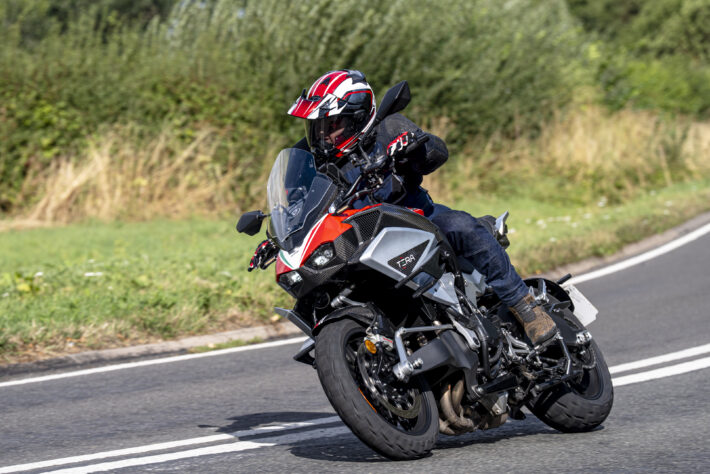
All of that seems like mere quibbling when you park the Tera up though. It looks like nothing else, is beautifully made, and will stand out at any bike meet. It’s an expensive luxury at nearly £35k – though you can pay that for a top-end Ducati Multistrada V4 RS these days – but for that money you get a proper ‘dream bike’ exotic Italian experience. And the fact it now comes with Japanese reliability and backup makes it a fantasy well worth living…
BIMOTA – A history
Bimota was set up in Rimini in the early 1970s by a trio of talented Italian engineers and bike nuts (Valerio BIanchi, Giuseppe MOrri, and Massimo Tamburini – hence the name), and it was the answer to a common conundrum at the time.
At the start of the 1970s, Japan was able to make extremely good engines: big, powerful, reliable high-tech beasties like the Honda CB750 and Kawasaki Z1. But its chassis tech was lagging behind a little. That came partly from cost concerns – these were mass-produced bikes, and had to make profits for their firms, so stuff like shocks, forks, brakes and frames were fairly basic in their design and construction.
It was good kit – don’t get the wrong idea – but there was definitely scope for improvement. As an aside, if you look at something like a Z1 these days, the *36mm* fork stanchions, skinny triple clamps/yokes and rear swingarm tubes look almost comically insubstantial.
To compare, Kawasaki’s current Z125 actually comes with 37mm diameter forks… The disc brakes didn’t work in the wet, tyres were skinny and grip-lite, and frame technology wasn’t up to the job either.
The Japanese were learning fast: by the 1980s we were seeing aluminium frames, monoshock suspension and much better running gear all coming in. But there was a definite gap in the market for bespoke hand-made chassis from specialist firms.
Complex steel-tube trellis and aluminum beam frames, braced swingarms, premium Italian suspension and brake components – they could all be combined with standard Japanese powertrains to make super-handling bikes, at a price.
Bimota soon emerged as one of the best at this, and it released a series of bikes, powered by Honda CB750, Kawasaki Z900, Suzuki GSX and Yamaha FZ motors. It even produced a couple of Ducati-powered superbikes in the 1980s. None of these models were built in big numbers: these were super-exotic hand-built pieces of moto-art which you almost never saw on the street.
By the 1990s, Bimota was at its peak: models like the Suzuki GSX-R1100-powered SB6 and SB6R, and TL1000R powered SB8R, plus the various Yamaha FZR1000-engined YB6, YB8 and YB10, were almost mainstream. By the turn of the century though, the firm was in big trouble.
It had tried to develop its own fuel-injected two-stroke 500 V-twin engine, which never really worked, and it limped from financial crisis to financial crisis until a few years ago. The brand was saved when it was taken over by Kawasaki back in 2021 after the Japanese firm took an initial 49% share in 2019. Now, as a fully-owned subsidiary, the marque’s future is brighter than it’s looked for a long time.
Tera tech highlights
ENGINE
A mad 198bhp peak output from the full-fat supercharged 998cc inline-four engine. Bimota says it’s come from the Kawasaki Z H2 supernaked rather than the sport-touring H2SX model, but it remains a very tractable unit. Fully Euro 5+ compliant, and comes with a smart bespoke Akrapovic titanium/carbon fibre end can, albeit a fairly quiet road-legal fitment (and not small).
One downside of an engine-driven supercharger like the H2’s versus exhaust gas turbocharging is that there’s a lot more energy in the exhaust gasses, meaning you need more silencing. A turbo actually helps make a bike quieter, since it’s taking energy from the gas flow pressure pulses, so you can get away with a smaller silencer.
FRAME
This is part of the real sauce in the Bimota design: the hub-centre steered Tesi front suspension needs a unique frame layout, with the motor itself taking much of the suspension and drive forces.
Both front and rear swingarms are mounted onto the crankcases themselves, but there are some bracing plates, including a massive pressure-cast aluminium swingarm mounting bracket. There are sub-frames to hold the steering gear, bodywork and seat too.
FRONT SUSPENSION
This is the heart of the chassis design: the trademark Bimota ‘Tesi’ front end, which uses a hub-centre steering system and dual-sided swingarm. The design uses a complex set of bearings housed inside the front hub, so the wheel can pivot around itself, turned by alloy connecting arms from the handlebars via a scissor-type linkage.
The original Tesi designs used V-twin engines from Ducati, and there was plenty of room at the front to mount the monoshock damping unit operated by the swingarm. But the H2 engine is a big lump, so there’s nowhere to mount the shock up front. What to do?
Well, the smart engineers have moved the front shock to the back, and it sits next to the rear monoshock behind the crankcases. It’s a striking sight there: a brace of top-end Öhlins TTX shocks mounted side-by-side. The front shock is operated by a long linkage mounted under the motor, transferring the forces from the front swingarm to the bottom of the shock. Clever stuff.
ELECTRONICS
Back in the day, Bimota would sometimes ratchet up the tech on the donor Japanese powerplants, adding fuel injection in place of carbs, or upgrading the engine management.
On the Tera, though, the electronics package is essentially unchanged from the Kawasaki Z H2, meaning the same riding aids package: IMU-assisted traction control, ABS, launch control, engine brake control, plus up/down quickshifter, rider power modes and cruise control, all accessed via a colour LCD dash.
There are a couple of high-tech additions you might expect to see on there, like semi-active electronic suspension and keyless ignition. Overall though, it’s a decent package of kit.
2025 Bimota Tera specifications
Price: £34,393
Engine: DOHC 16v supercharged inline-four, l/c, 998cc
Bore x stroke: 76x55mm
Compression ratio: 11.2:1
Carburation: ride-by-wire fuel injection
Max power (claimed) 198bhp@11,000rpm
Max torque (claimed) 101ft lb@8,500rpm
Transmission: six speed gearbox, wet slipper/assist clutch, chain final drive
Frame: aluminium alloy side plates, rear swingarm mount plate, engine as stressed member
Front suspension: Hub-centre steered swingarm, fully adjustable Öhlins TTX36 monoshock, 114mm travel
Rear suspension: cast aluminium swingarm, fully adjustable Öhlins TTX36 monoshock, 145mm travel
Brakes: dual 330mm discs, four-piston radial-mount Brembo calipers (front), 260mm disc, twin-piston Brembo caliper (rear)
Wheels/tyres: OZ Racing forged aluminium wheels, Anlas Capra XR 120/70 17 front, 180/55 17 rear
Rake/trail: NA/NA
Wheelbase: 1,445mm
Seat height: 830mm
Wet weight: 215kg (no fuel)
Fuel capacity: 19 litres
Image Credit – Tim Keeton
Disclaimer: the sole purpose of this article is to provide guidance on the issues covered. This article is not intended to give legal advice, and, accordingly, it should not be relied upon. It should not be regarded as a comprehensive statement of the law and/or market practice in this area. We make no claims as to the completeness or accuracy of the information contained herein or in the links which were live at the date of publication.
You should not act upon (or should refrain from acting upon) information in this publication without first seeking specific legal and/or specialist advice. Arthur J. Gallagher Insurance Brokers Limited trading as Devitt accepts no liability for any inaccuracy, omission or mistake in this publication, nor will we be responsible for any loss which may be suffered as a result of any person relying on the information contained herein.