

We’ll freely admit we didn’t see this coming. But as Mark Twain didn’t quite say, it looks like the rumours of the death of ‘proper’ GSX-R sportsbikes have been a bit exaggerated. Because to mark 40 years since the first GSX-R750 in 1985, Suzuki has just pulled a proper flanker, and released a fully updated version of the GSX-R1000, revamped and redesigned to comply with Euro5+ emissions regulations. That means a new big Gixxer for the EU – and also for riders in Britain – set to hit the streets soon.
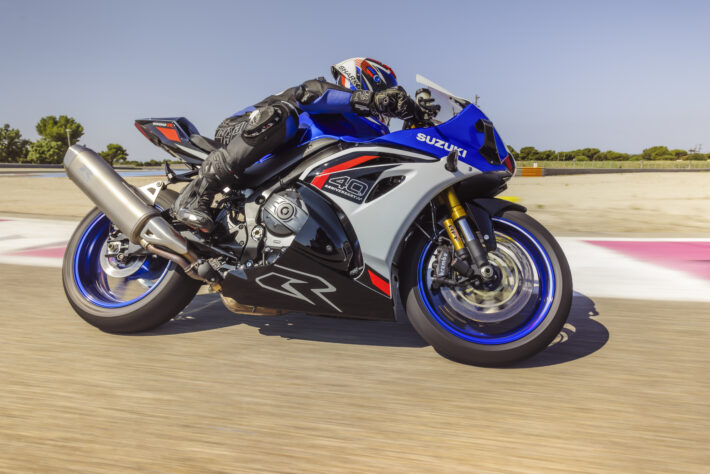
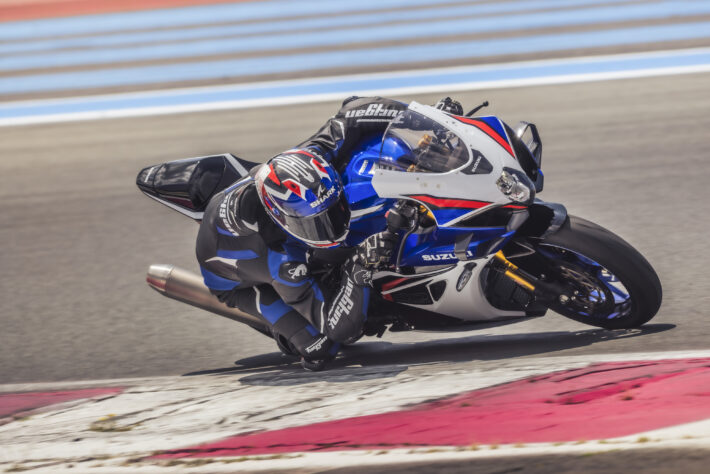
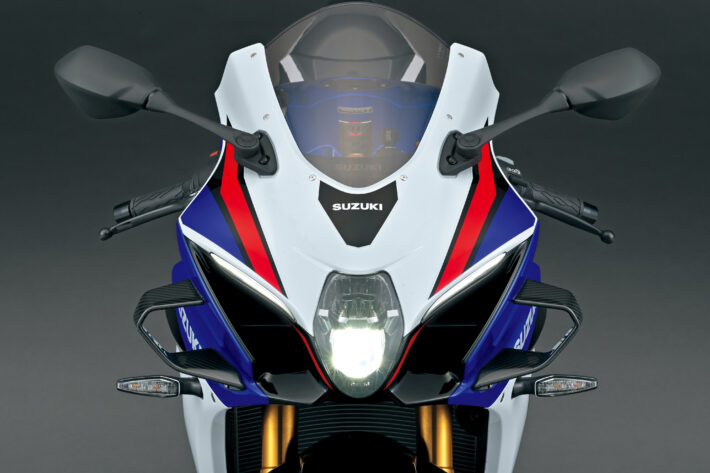
The foundation is the last generation GSX-R1000, first seen in 2017, which introduced a cunning mechanical variable valve timing setup, as used in MotoGP, and ride-by-wire fuel injection. That bike has been updated with a heap of engine changes, aimed at meeting those emissions regs, but also strengthening the bottom end and cutting internal friction. The electronics are tweaked, and it even has some sweet carbon fibre winglets on the front fairing.
Starting with the engine, there’s a slew of changes to the top and bottom end. A new cylinder head has revised inlet and exhaust ports, as well as bigger exhaust valves, up from 24mm to 25mm. Compression is up to 13.8:1 from 13.2:1, thanks to new forged pistons, and the VVT variable valve hardware has been revised.
Suzuki’s setup is a cunning mechanical setup rather than electronic or hydraulic systems as seen elsewhere: 12 steel balls sit in slanted grooves in the intake camshaft sprocket, and as the engine spins up, centrifugal forces push the balls outwards, and they rotate the sprocket forward and back, altering the timing of the intake valve opening.
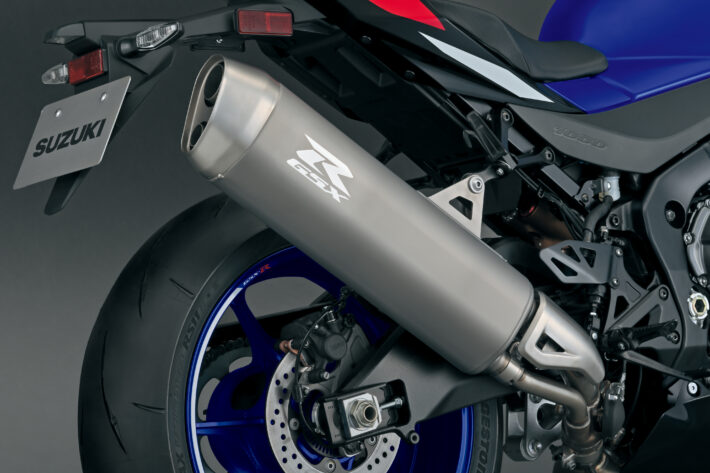
There are new camshafts, with less overlap but the same lift, to cut emissions, while the crankshaft has 2mm wider journals up to 37mm from 35mm, to handle greater loads. There’s also a modified crankcase design to suit the new crankshaft, and a new exhaust system.
The result of all this is indeed Euro 5+ compliance – but a little less in terms of claimed peak power and torque, which are down to 194bhp@13,200rpm from 202bhp and 110Nm from 117Nm. Suzuki says a lot of the changes are there to help race performance though, so we reckon that superbikes and even superstock machines will be able to unlock a solid chunk of power from exhaust and mapping changes.
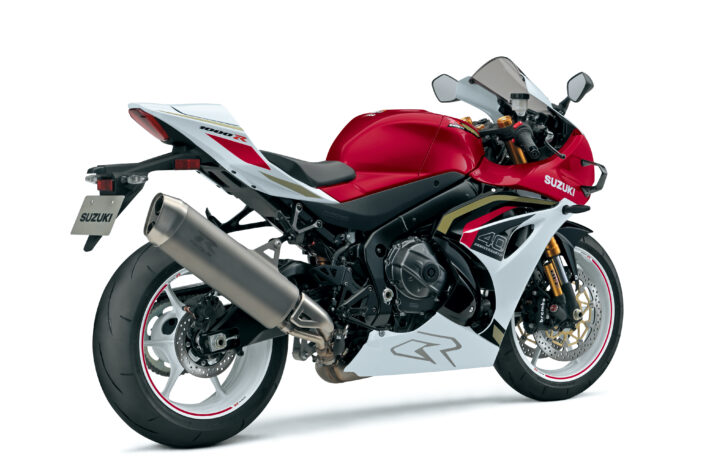
On the upside, there’s been a slew of weight loss mods – lithium battery, updated ABS unit and other detail changes, which means the new bike is only 1kg heavier than the 2017 machine.
There isn’t so much to talk about on the chassis side: the old bike was pretty sweet in terms of handling, and the frame and suspension are largely as you were, with the Showa BFF gas forks and BFF shock as before and Brembo monobloc calipers.
The 320mm discs are new though: they are a hybrid road/track design, with Brembo’s T-drive system on half the ten disc carrier mount points and conventional bobbins on the other half. That saves some weight, while reducing the noise of a pure T-drive disc mount system. There’s a new electronic steering damper, and the carbon fibre winglets claim to increase stability at speed, without affecting handling when cornering.
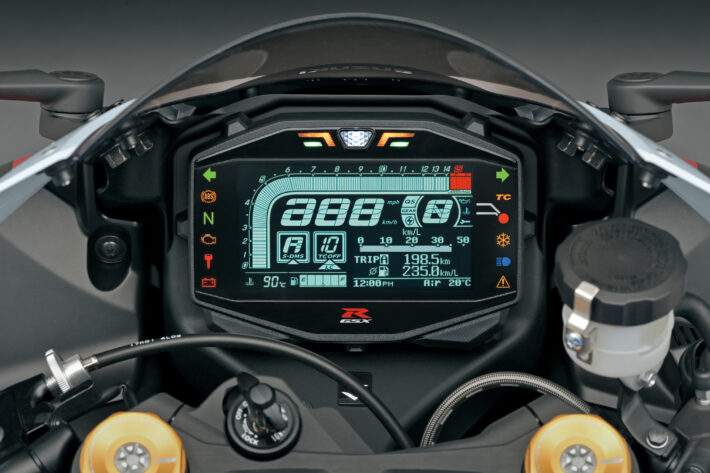
On the electronics side, the throttle bodies are 2mm wider, up to 48mm from 46mm, and Suzuki has updated the rider aids package too. There’s a ten-way traction control system with IMU assistance, and an updated launch control setup, as well as the usual up/down quickshifter, anti-wheelie and cornering ABS.
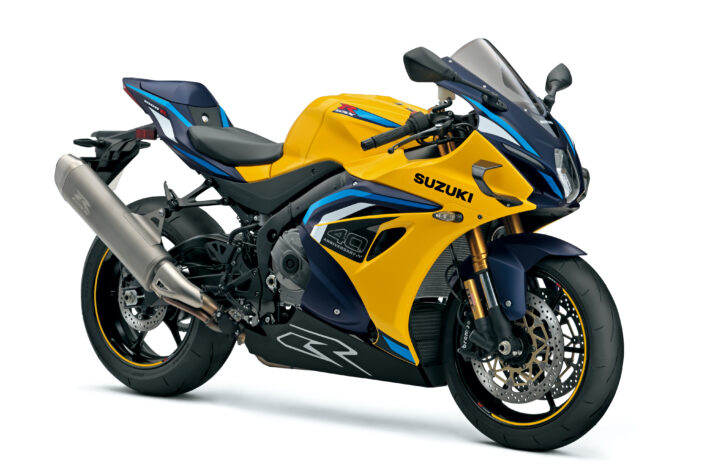
Add in new colours with special 40th anniversary graphics and you have a very impressive update, especially considering the decline in the 1000cc superbike sector. There’s no word on price or availability as yet – but we’d expect to see the first bikes soon to keep up with the 1985-2025 40th birthday theme. More, as ever, when we get it.
2025 SUZUKI GSX-R1000 TECH FEATURES
Engine
- High-performance 1,000cc, four-stroke, liquid-cooled, DOHC, inline-four cylinder engine.
- New crankshaft adopts thicker journals designed to accommodate higher loads, with new crankcases to accommodate updated design.
- Increased compression ratio from 13.2:1 to 13.8:1, with reshaped piston heads that also accommodate the increased exhaust valve diameter.
- Simple, compact, and light, the centrifugally operated Suzuki Racing Variable Valve Timing (SR-VVT) system is built into the intake cam sprocket and an adjacent guide plate, adding significantly to power at the high end.
- The Suzuki Racing finger follower valve train system improves valve control and allows higher rpm.
- In addition to the primary injectors that operate full-time in each throttle body, a secondary set of four Suzuki Top Feed Injectors (S-TFI) spray fuel from the top of the air box directly into the intake funnels at higher rpm. This results in enhanced combustion efficiency, throttle response and top-end power.
- The number of holes for the primary fuel injectors was changed from ten to eight holes.
- The cylinder head and both intake and exhaust ports have been modified to achieve higher efficiency.
- New head gasket, revised to improve durability.
- Each forged aluminium piston has short skirts, cutaway sides and a short, DLC coated gudgeon pin to reduce friction.
- A change to the rib shape on the underside of the piston heads reduces weight and contributes to durability.
- The piston circlips are new and improve durability.
- The introduction of a wider new cam chain helps reduce friction loss.
- A new single-stage funnel #1 and #4 design features a shape that contributes to improved output at high rpm.
- Camshaft lubrication now uses an intermittent lubrication scheme.
- The new exhaust system includes a slimmer new silencer design.
- The Suzuki Clutch Assist System (SCAS) contributes to smooth shifting and enables a light touch to clutch lever operation.
Chassis
- A compact, lightweight chassis provides quick response and agility. It is designed to increase the rider’s confidence.
- Compact, light, and rigid, the twin-spar aluminium frame is built to deliver agile handling and great road holding ability.
- The race-inspired aluminium swingarm is braced on both sides and rigidity is optimised to help improve racetrack handling.
- The bolt-on rear subframe is made of strong, light square aluminium tubing.
- New winglets on the front cowling generate downforce at high speeds to enhance stability.
- Lightweight, six-spoke, cast aluminium wheels contribute to agile handling.
- Bridgestone BATTLAX RACING STREET RS11 radial tyres provide high cornering performance, positive grip, and durability in a wide range of conditions.
- Dual four-piston, radially-mounted, monobloc Brembo front brake calipers paired with 320mm discs and a single-caliper rear brake with a 220mm disc provide sure braking power.
- The end of the front brake lever is slotted to reduce the chance of wind pressure causing brake drag at high speed.
Rider Aids
- Suzuki Drive Mode Selector (SDMS) allows the rider to pick from three available engine map settings that help better match power delivery characteristics to the riding conditions.
- Smart TLR Control integrates the Suzuki Traction Control System (STCS) with Lift Limiter and Roll Torque Control.
- Ride-by-wire Electronic Throttle System gives greater control over the engine output.
- Bi-directional quick shifter allows the rider to shift up and down smoothly and efficiently without using the clutch or blipping the throttle.
- By intervening to control brake pressure while braking through corners, the lean-angle sensitive ABS system Motion Track Brake System helps the rider better trace their intended line through the corner.
- Slope Dependent Control provides more stable braking by monitoring the bike’s posture and optimising ABS to match the grade and prevent rear wheel lift when travelling downhill.
- Suzuki Easy Start System starts the engine with just one quick press of the starter button, even without pulling in the clutch lever when the transmission is in neutral.
- Low RPM Assist helps ensure smoother starts when pulling away from a standing start or riding at low speeds.
Electronics
- The new Li-ion battery is lighter, more compact and provides more stable voltage under load.
- The simple multifunction instrument panel is laid out so the rider can quickly confirm the tachometer and speedometer readouts.
- The narrow and compact high-illumination LED headlight contributes to the sharp face design.
- The LED combination tail and brake light features a vertical layout that contributes to the tail’s sharp, slim design. It features sharp, clean, light and bright, LED turn signals.
Styling
- Sleek, narrow and compact bodywork with a small frontal projected area helps maximise aerodynamic efficiency.
- The top of the fuel tank is designed to allow the rider to tuck in easily on straights.
- Large Suzuki Ram Air Direct (SRAD) intake ducts are positioned close to the center of the fairing nose, where air pressure is highest.
- The shot-blasted titanium silencer enhances the new exhaust system’s appearance.
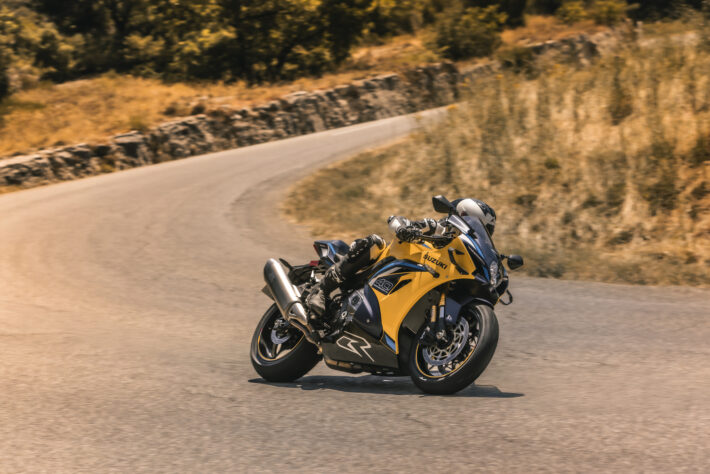
- The lineup of three available body colour schemes were carefully selected to maximise appeal and, in celebration of the GSX-R family’s 40th anniversary, pay homage to famous GSX-R liveries from previous generations.
- 40th anniversary logos combine with new graphics that hark back to the original GSX-R and stripes that add aggressive, sporty flair.
SPECIFICATIONS
| Overall length | 2,075 mm (81.7 in.) | |
| Overall width | 705 mm (27.8 in.) | |
| Overall height | 1,145 mm (45.1 in.) | |
| Wheelbase | 1,420 mm (55.9 in.) | |
| Ground clearance | 130 mm (5.1 in.) | |
| Seat height | 825 mm (32.5 in.) | |
| Kerb weight | 203kg (448 lbs.) | |
| Engine type | Four-stroke, four-cylinder, liquid-cooled, DOHC | |
| Bore x Stroke | 76.0 mm x 55.1 mm (3.0 in. x 2.2 in.) | |
| Engine displacement | 1000cc (61.0 cu. in.) | |
| Compression ratio | 13.8:1 | |
| Maximum power | 143.5kW (195PS)/13,200rpm | |
| Maximum torque | 110.0Nm/11,000rpm | |
| Fuel system | Fuel injection | |
| Starter system | Electric | |
| Lubrication system | Wet sump | |
| Transmission | Six-speed constant mesh | |
| Suspension | Front | Inverted telescopic, coil spring, oil damped |
| Rear | Link type, coil spring, oil damped | |
| Rake / Trail | 23°20’ / 95mm (3.7in) | |
| Brakes | Front | Disc, twin |
| Rear | Disc | |
| Tyres | Front | 120/70ZR17M/C (58W), tubeless |
| Rear | 190/55ZR17M/C (75W), tubeless | |
| Ignition system | Electronic ignition (transistorised) | |
| Fuel tank capacity | 16.0 L |
| Oil capacity (overhaul) | 4.0 L |
| Fuel consumption* | 41.54mpg (6.8 L/100km) in WMTC |
| CO2 emissions* | 158g/km in WMTC |