

Motorcycle dash cams have become an increasingly popular accessory for riders across the UK. Whether you want to record journeys, capture incidents on the road, or improve your confidence in the saddle, a motorcycle dash cam can serve a range of practical purposes, helping to offer you peace of mind on the road.
Choosing a suitable dash cam requires careful consideration, as riders have different requirements depending on how and where they ride. Weather resistance, video quality, storage capacity, and ease of installation are all worth considering before you commit to a purchase.
Why Do Motorcyclists Use Dash Cams?
Dash cams for motorcycles have grown in popularity for several reasons. According to the Department for Transport, motorcyclists accounted for 21% of all road fatalities in Great Britain in 2024, despite making up less than 1% of total traffic. Having a recording of what happens on the road can be a practical safeguard.
Common reasons riders choose to install a motorcycle dash cam include:
- Recording evidence in the event of an accident, where footage may help establish what happened.
- Capturing dangerous driving incidents, such as close passes or sudden lane changes.
- Supporting an insurance claim by providing a visual record of events.
- Improving your confidence, particularly on busy roads or motorways.
- Providing an extra layer of security when parked, with some cameras continuing to record in standby mode. You can read more about keeping your motorcycle secure in our dedicated guide.
Dash cam footage can provide a useful, independent record of events; for example, footage of a close pass or a rear-end collision may help clarify the sequence of events for an insurer or, in some cases, the police.
Motorcycle Dash Cam vs Helmet Camera: What’s the Difference?
Riders considering a recording system often weigh up two main options: a dedicated motorcycle dash cam or a helmet-mounted camera. Searches for the best motorcycle helmet camera are common, though it is worth understanding how helmet cameras and dash cams differ before deciding which suits your riding style. Both have their uses, and the suitable choice depends on how and where you ride.
| Feature | Motorcycle Dash Cam | Helmet Camera |
| Mounting location | Frame or handlebars | Helmet |
| Power source | Motorcycle battery or USB | Rechargeable battery |
| Recording duration | Continuously records when your motorcycle’s ignition is on | Limited by battery life |
| Weather resistance | Typically built-in | Varies by model |
| Ease of use | Fixed, minimal setup | Portable, requires charging |
| Video perspective | Fixed angle | Rider’s point of view |
Helmet cameras can provide a natural rider’s-eye view of the road ahead and are portable between bikes. However, they may require more frequent charging, which could be inconvenient for daily riders.
Motorcycle dash cams, by contrast, offer a fixed perspective and are designed for continuous use, meaning it will continually record your surroundings as soon as you turn your motorcycle’s ignition on, and stop recording when you turn it off. The recording loops itself, so once the memory card is full, it begins overwriting the oldest footage. It is therefore useful to take the memory card out, download the footage to an external device, and then reinsert it. Rest assured, no charging is needed as motorcycle dash cams draw power directly from your motorcycle’s battery.
Front and rear cameras for motorcycles are also available, providing wider coverage of events around the bike.
What Features Should You Look for in a Motorcycle Dash Cam?
Before purchasing, it is worth comparing features against your own riding needs and budget. A daily commuter, for instance, may prioritise low-light performance and ease of installation, while a touring rider covering long distances may place greater value on storage capacity and GPS functionality.
Not every rider will require the same specification, and paying for functions you are unlikely to use might not represent good value.
Key features to consider include:
- Video resolution: Higher resolution can improve the detail captured in footage.
- Frame rate: A higher frame rate can produce smoother recordings, which may be more useful in fast-moving situations.
- Low-light performance: Night-time recording quality varies between models.
- Weatherproof rating: Important for year-round riding in the UK.
- Storage capacity: Determines how much footage can be held before older clips are overwritten.
- GPS functionality: Some cameras record route and location data alongside video.
- Mobile app connectivity: Allows footage to be reviewed or transferred from a smartphone.
- Emergency recording: Some models lock footage automatically during sudden deceleration.
- Ease of installation: Particularly relevant if you plan to fit the camera yourself.
Is Video Quality Important?
Video quality is a key consideration when choosing a motorcycle dash cam. Higher resolutions can help identify details such as vehicle registration plates or road markings.
Frame rate affects recording smoothness. A camera recording at 60 frames per second (fps) should produce noticeably smoother footage than one recording at 30fps, which can matter when reviewing fast-moving events.
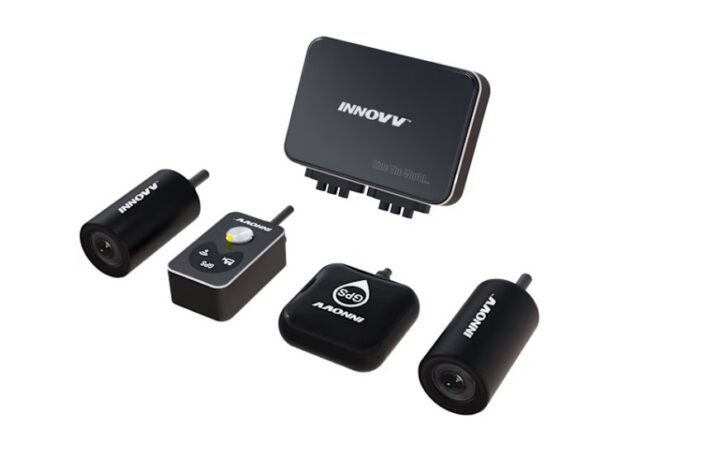
Image stabilisation is also worth considering. Road vibration on a motorcycle can affect footage quality, and a camera with built-in stabilisation may produce more usable recordings.
Riders who commute in the evenings or early mornings should pay particular attention to nighttime performance.
It is also worth bearing in mind that higher resolution footage takes up more storage space.
Footage quality can also vary depending on conditions, camera placement, and the model selected. Riders should consider dash cam footage as a useful supplementary record rather than a guaranteed resolution to any incident.
Should You Choose Front and Rear Cameras for a Motorcycle?
Front and rear cameras for motorcycle setups provide wider coverage of the road environment. Since incidents can occur from multiple directions, dual-camera systems can offer a more complete record of events.
Rear-facing footage can be particularly useful in certain scenarios, such as when a vehicle follows too closely or collides with the rear of a motorcycle, or where the behaviour of following traffic is relevant to understanding what happened.
That said, dual-camera systems tend to be more complex to install and may come at a higher cost. Riders should weigh up whether the wider coverage is suited to how and where they ride.
Understanding Weatherproofing Ratings
Motorcycles operate in a wide range of weather conditions, particularly in the UK. A dash cam that might not withstand rain or cold temperatures could leave riders without a recording when they need it most.
Weatherproofing is typically indicated by an IP (Ingress Protection) rating. The two numbers in an IP rating refer to protection against solid particles and liquids, respectively. Common ratings to look for include:
- IP65: Protected against low-pressure water jets and suitable for light rain.
- IP67: Can withstand submersion in up to one metre of water for up to 30 minutes.
- IP68: Withstands deeper or longer immersion, engineered for most riders in demanding conditions.
For most UK riders, an IP65 or IP67 rating should provide a practical level of protection. If you ride in particularly exposed conditions or off-road environments, a higher-rated camera may be worth considering.
Storage and Recording: What Should Riders Consider?
Reliable storage is an important part of any dash cam setup. Motorcycle dash cams typically work on a loop recording system, meaning once the storage is full, the oldest footage is automatically overwritten unless clips have been manually saved or locked. Points to consider include:
- Memory card compatibility: Check which card types and capacities the camera supports.
- Recording capacity: How many hours of footage can be stored before older clips are overwritten.
- Loop recording: Most dash cams use loop recording, which automatically overwrites the oldest footage when the card is full.
- Emergency clip locking: Some cameras can lock clips to prevent them from being overwritten during an incident.
- File management: How footage is organised and how easy it is to retrieve specific clips.
- Video retrieval methods: How easily you can access and save footage following a crash, ride using methods such as a memory card, USB, or mobile app.
For most riders, the reliability of the recording system is more important than raw storage size because, unlike in cards, motorcycle dash cams are exposed to severe weather conditions and extreme vibrations. If the motorcycle dash cam fails in these conditions, you may lose footage. Riders who use their camera daily or on longer routes may find they need greater capacity than those who ride occasionally.
Are GPS and Wi-Fi Features Worth Having in a Dash Cam?
GPS and Wi-Fi connectivity can be useful features in dash cams for motorcycles, though not every rider will find them essential.
GPS functionality allows a camera to record location data and route information alongside video footage. In some cases, speed data recorded by GPS may also be relevant. This can be useful if precise details of where an incident occurred are needed.
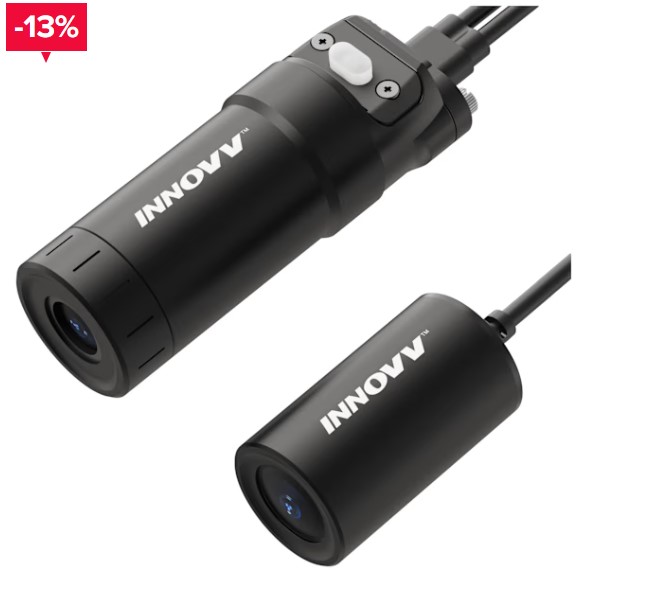
Wi-Fi connectivity can simplify the process of transferring and reviewing footage. Rather than removing the memory card, riders with a Wi-Fi-enabled camera may be able to access clips directly through a smartphone app, reducing the time needed to access and share footage with your insurer or the police.
If location data and app connectivity are not priorities for you, a more straightforward model might serve just as well.
Hardwired vs Battery-Powered Motorcycle Dash Cams
The two main power options for motorcycle dash cams are hardwired systems and battery-powered models.
| Feature | Hardwired | Battery-Powered |
| Installation complexity | Higher, typically requires professional fitting | Lower, easier DIY installation |
| Recording duration | Continuous while the engine runs | Limited by battery capacity |
| Maintenance | Minimal once fitted | Regular charging required |
| Reliability | Generally consistent | May run out of power on longer rides |
| Convenience | No need to charge or remove camera | Portable, can be moved between bikes |
Hardwired systems draw power directly from the motorcycle’s battery and can offer continuous recording for the duration of a ride. They may also support parking mode, allowing the camera to record when the bike is stationary.
Battery-powered cameras are often simpler to install and can be transferred between bikes more easily. However, riders should check the battery life carefully, as some cameras might not last a full day’s riding without needing a charge.
The type of riding you do and whether you are comfortable carrying out an electrical installation should all influence which power option you choose.
Where Should a Motorcycle Dash Cam Be Mounted?
Camera positioning is an important practical consideration as it needs to clearly capture your surroundings, but not block your view. In the UK, the Highway Code requires riders to have a clear view of the road, so any mounting position should be chosen carefully.
When deciding where to mount a motorcycle dash cam, riders should consider:
- Secure mounting points: The camera should be firmly attached and should not move or vibrate excessively.
- Protection from vibration: Road vibration can affect both footage quality and camera longevity.
- Usable footage angle: The camera should be positioned to capture a clear view of the road ahead.
- Clear sightlines for the rider: The camera should not obstruct instruments, mirrors, or the rider’s line of sight.
- Safe operation: Mounting should not interfere with any controls, cables, or the safe handling of the motorcycle.
There is no specific legislation banning dash cams on motorcycles, but the camera should not create a hazard or impair riding safety. If you are uncertain about positioning, consulting a qualified fitter before installation can help.
Can Motorcycle Dash Cam Footage Be Used for Insurance Claims?
Dash cam footage can, in some instances, play a role in supporting an insurance claim investigation.
It is important to understand that footage might not automatically determine liability or lead to a specific outcome. Claims are assessed on the circumstances of each case, and insurers will consider a range of factors when reaching a decision, including video footage, witness statements, and vehicle damage reports; footage does not automatically determine liability.
If you have concerns about how footage might relate to an existing or potential claim, speaking with your insurer directly is advisable. You can also read through our motorbike insurance claims guide for further guidance on the process.
Protect Yourself and Your Bike on the Road with Motorcycle Insurance from Devitt
A motorcycle dash cam can be a worthwhile investment, helping riders to record journeys and incidents on the road responsibly and with greater confidence. Choosing a suitable motorcycle dash cam involves weighing up video quality, weatherproofing, storage, power options, and mounting position against your own riding habits and budget.
At Devitt, we have been providing motorbike insurance for over 90 years. Visit our motorcycle insurance pages or call our UK-based team on 0345 872 3614 to discuss the cover options that may be available for you.
Disclaimer: the sole purpose of this article is to provide guidance on the issues covered. This article is not intended to give legal advice, and, accordingly, it should not be relied upon. It should not be regarded as a comprehensive statement of the law and/or market practice in this area. We make no claims as to the completeness or accuracy of the information contained herein or in the links which were live at the date of publication.
You should not act upon (or should refrain from acting upon) information in this publication without first seeking specific legal and/or specialist advice. Arthur J. Gallagher Insurance Brokers Limited trading as Devitt accepts no liability for any inaccuracy, omission or mistake in this publication, nor will we be responsible for any loss which may be suffered as a result of any person relying on the information contained herein.