Honda launches 1000cc Hornet-based retro roadster that harks back to the 1980s
Honda’s not really got into the spirit of the current retro trend – until now. Where firms like BMW, Yamaha, Kawasaki and Suzuki have been offering modern machinery with classic looks, Honda took a different path, with the odd ‘neo-retro’ design like the CB650R, CB1000R and CB125R.
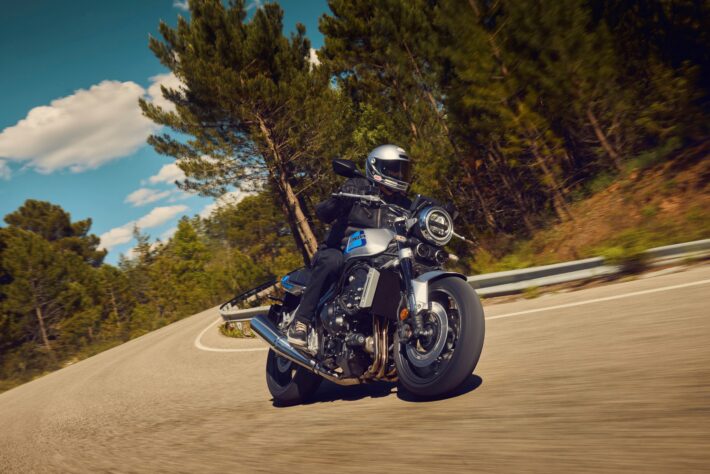
But it’s hit the jackpot with this one we reckon – a new CB1000F, based on the current Hornet roadster, with styling straight from the CB750/900 lineage of the early 1980s. Back then, fairings were still in their infancy, so a big sporty bike meant little in the way of plastic, perhaps a small nose cone, but a bruising motor, chunky fuel tank and big round headlamp.
Those 1980s air-cooled inline-fours from Honda weren’t classics: reliability woes including camchains and tensioners affected sales, and the firm moved away from inline-fours, and into V-4s for a while with the VF750 and VFR750.
Today though, the big H has some cracking straight fours, and it’s taken one of the best – the new Hornet 1000 – and made it into a cool 80s throwback. The new CB1000F takes the basic Hornet package, and tweaks it to suit. Now, part of that is a ‘retune’ of the engine, by which we mean ‘detune’.
Honda’s got a long history of doing this: it insists on taking perfectly good motors then dropping the compression, softening the cams and shrinking the throttles to give less peak power. It makes sense we guess: a naked retro bike probably doesn’t need a full 150bhp from the Hornet’s 2017 Fireblade-based engine.
And we’re sure the result will be an impressively civilised powerplant: Honda always outperforms its specs, and the ‘only’ 122bhp peak output on this bike will no doubt be very satisfying. But as with the old Hornet 900, we sort of wish they’d left the full power in there (or at least made it easier to gain more power in future).
At least the fuel consumption is better, with a claimed 51mpg, and you certainly won’t need to worry about the 190bhp-capable CBR1000RR bottom end coping with the reduced output…
Away from the slightly-strangled motor, the chassis is all good stuff. A basic steel frame is cheap and light enough for this class, while the suspension and brakes are solid spec. Nissin radial brakes and Showa BPF forks won’t win many cool points amongst the Öhlins and Brembo crew, but are top-drawer road-going gear.
There’s a thoroughly-modern set of electronics too: IMU-assisted cornering ABS and traction control, plus a 5” TFT LCD dash, which will peeve the purists but offers much more capability than an old-school pair of clockwork dials.
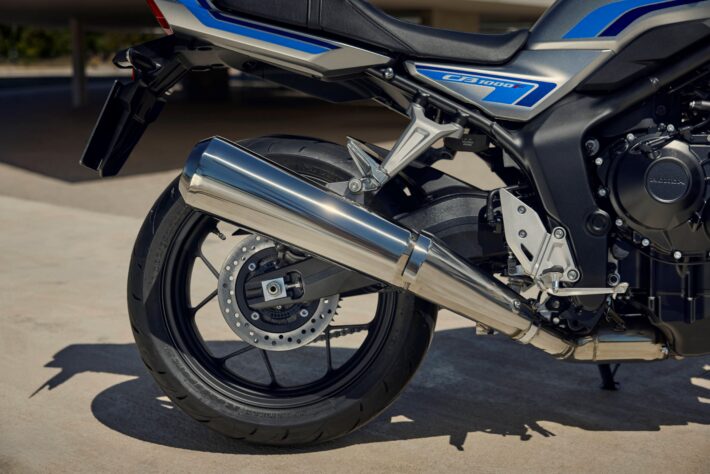
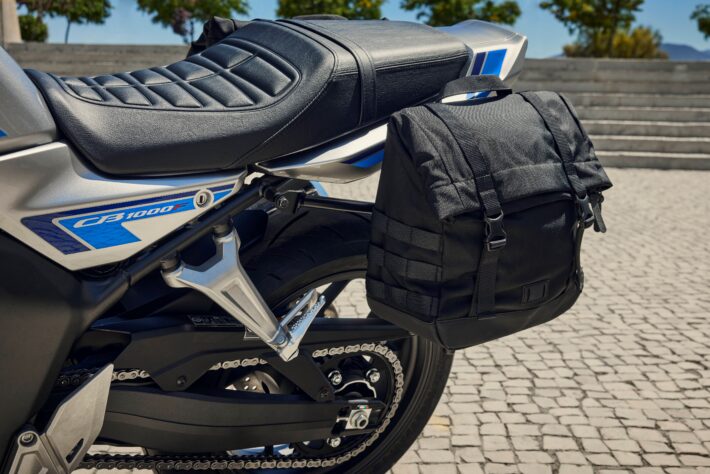
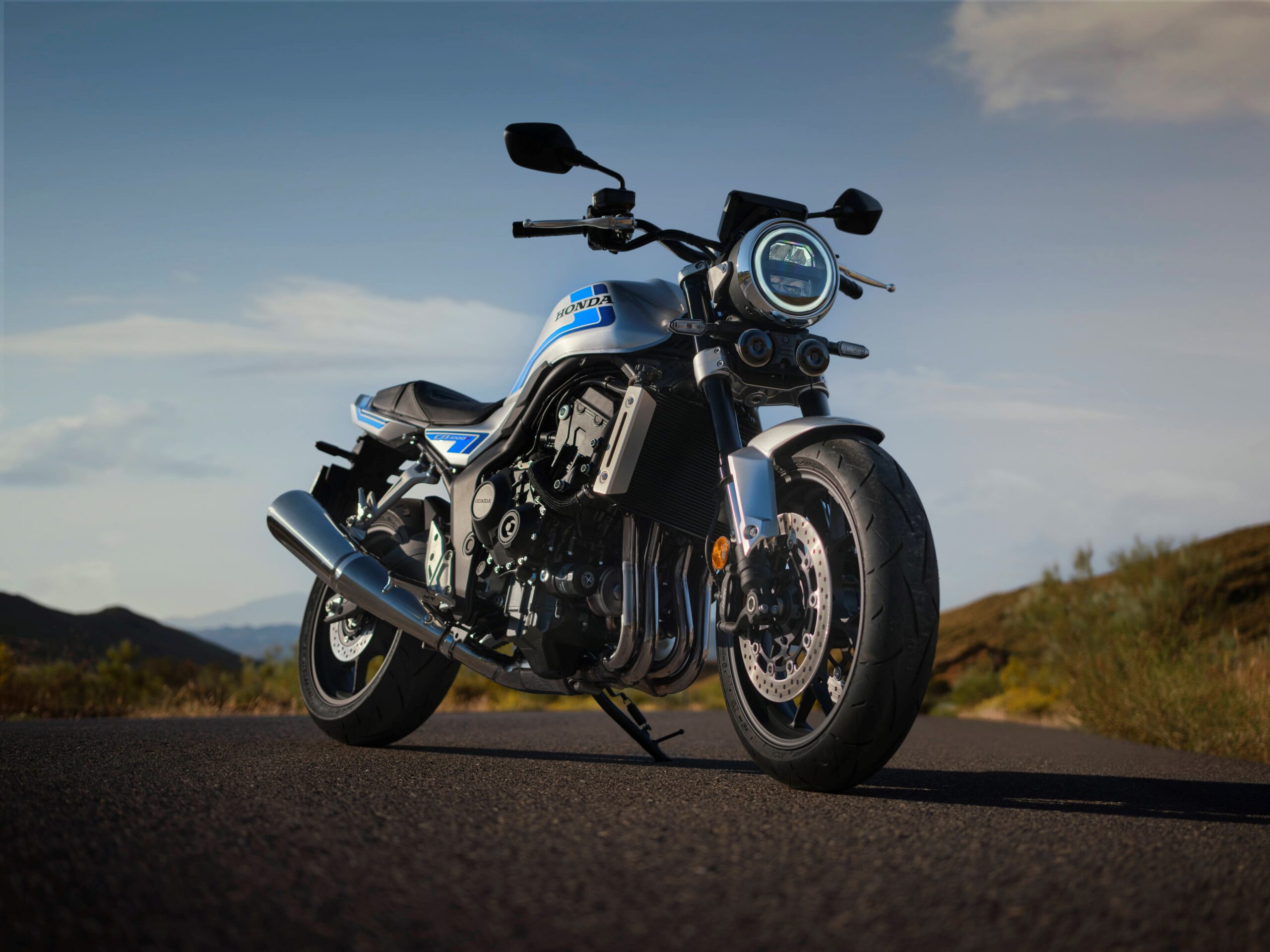
It’s the styling that makes this bike though. The fuel tank, paint scheme and tail unit perfectly echo the bikes of the 80s, underlined by the big chrome silencer and round LED headlamp.
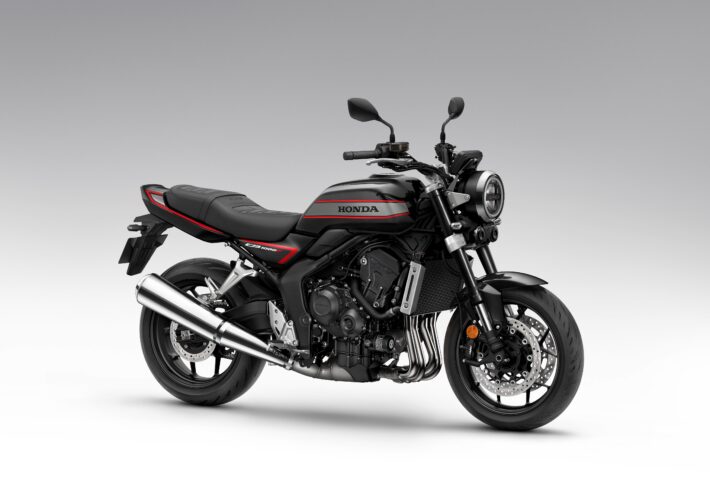
Okay, the water-cooled engine and diamond frame aren’t quite canon: Honda’s not even tried to hide the radiator with black surround, or added fake air-cooling fins to the barrels and cylinder head.
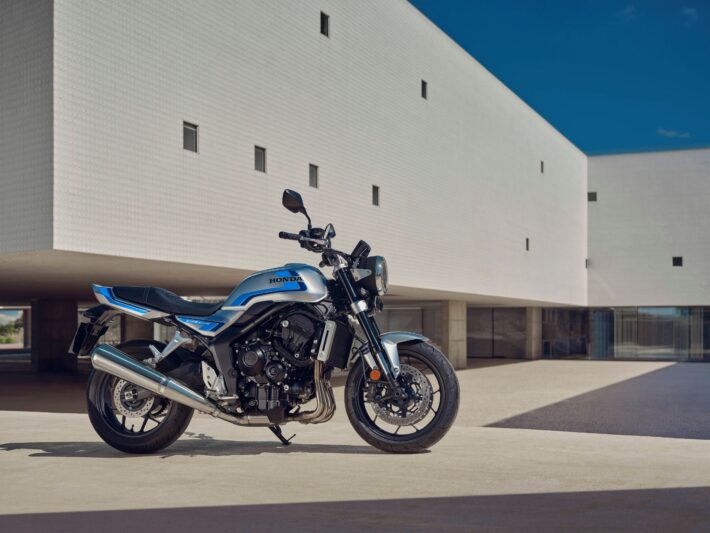
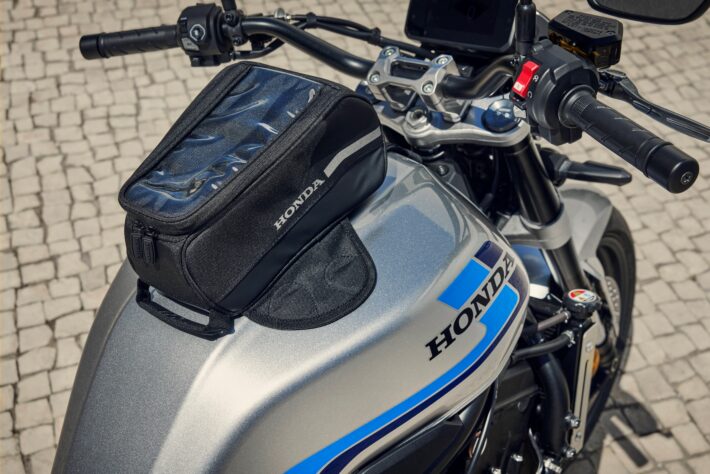
Nevertheless, it all works well we think, especially in the silver scheme. Add in the neat colour matched nosecone from the official accessory catalogue and you’ve got a proper sporty-looking 80s muscle bike, with all the luxuries of a 2025 machine.
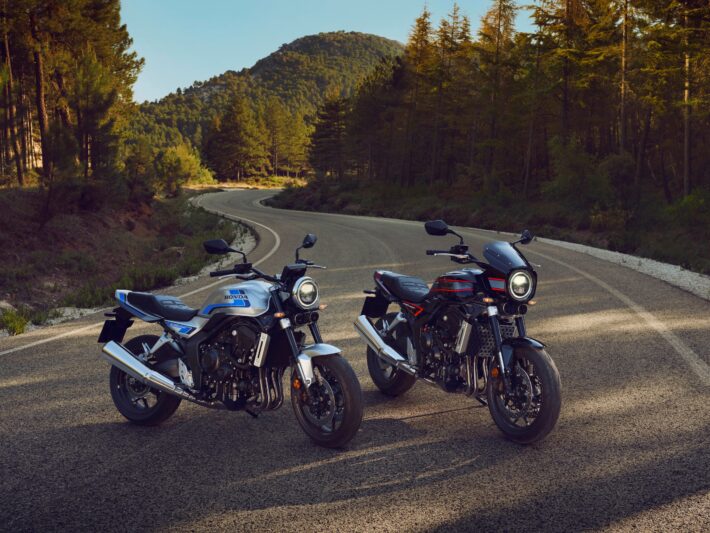
It’s well priced too: the new CB1000F starts at £10,599, and will be in dealers soon. More info from your dealer, or at www.honda.co.uk
TECH HIGHLIGHTS
ENGINE
Retuned for low to midrange response with lower compression (11.7:1)
Extensively tuned intake and cam timing deliver strong torque with ‘distinct, offbeat fourcylinder feel’
Lowered first and secont gear ratios chosen for excellent lowspeed acceleration, but higher ratios in other gears for more relaxed cruising
Assist/slipper clutch control
CHASSIS
Diamond frame with long subframe for rider and pillion comfort
Fully adjustable 41mm Showa SFFBP USD forks
New Showa ProLink rear shock with CB1000Fspecific linkage ratio Fourpiston, radialmount front brake calipers and 310mm floating discs Cornering ABS with IMU assistance
120/70ZR17 and 180/55ZR17 front and rear tyres
ELECTRONICS
Sixaxis Inertial Measurement Unit (IMU) management of all ride systems Throttle By Wire (TBW) control; three default rider modes plus two USER custom options
Three levels of Engine Power and Engine Brake
Three levels of Honda Selectable Torque Control (HSTC)
STYLING
Lines drawn from the CB750F and CB900F of the early 1980s
Full LED lighting plus twin, dual horns as per the originals Honda Smart Key convenience
Fiveinch TFT screen with full Honda RoadSync smartphone connectivity
Honda Emergency Stop Signal (ESS) integration
Preconsumer recycled polypropylene used in manufacture of some parts
2026 Honda CB1000F Specs
Engine: Inline-four 16v DOHC, liquid-cooled, 1000cc
Bore x stroke 76mm x 55.1mm
Compression ratio: 11.7:1
Fuel injection: PGM-FI ride-by-wire fuel injection system
Peak power: 122bhp (91kW)@9,000 rpm
Peak torque: 103Nm@8,000 rpm
Clutch: wet slipper/assist clutch.
Frame: steel diamond type frame
Front suspension: Showa 41mm Separate Function Fork Big Piston (SFFBP) fully-adjustable USD forks
Rear suspension: Preload/rebound adjustable Showa monoshock, Pro-Link aluminium swingarm
Wheels: cast aluminium five-spoke
Tyres: 120/70 17 180/55 17
Brakes: Dual 310mm floating discs, radially mounted Nissin four-piston calipers (front), single 240mm disc, NIssin single-piston caliper (rear). Cornering ABS.
Dash: Digital unit with 5″ TFT display
Kerb weight: 214kg
Seat height: 795mm
Wheelbase: 1,455mm
Rake/Trail: 25°/98mm
Fuel capacity: 16l