
New limited-edition Factory Custom version of Triumph’s sporty big twin café racer adds sweet chassis kit and slick styling
Up until now, the TFC (Triumph Factory Custom) programme at Triumph motorcycles in Hinckley has produced four premium limited-edition machines – variants of the Rocket 3, the Thruxton and (strangely) *two* Bobber models.
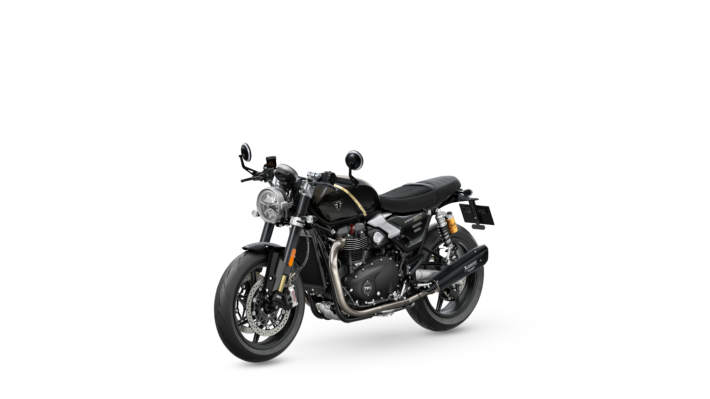
And now there’s a fifth – the 2027 Triumph Speed Twin 1200 TFC. It’s a high-end custom variant of the classy Speed Twin café racer, with some serious chassis upgrades, tasty carbon fibre bodywork enhancements plus smart details like Akrapovic silencers, unique badging and the usual premium finish on Triumph’s trickest special models.
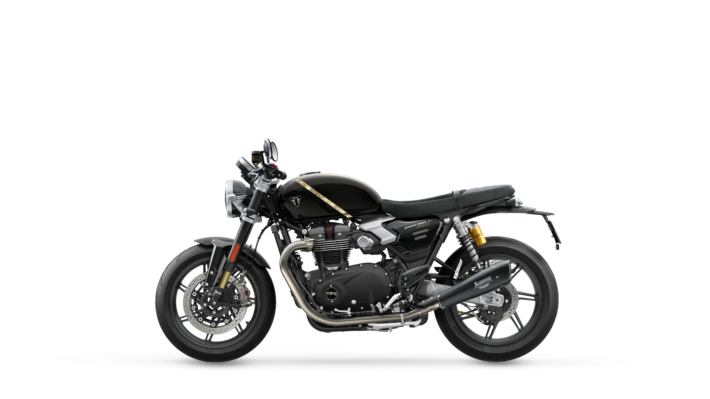
The basics are familiar enough: like the base Speed Twin, it’s powered by the 1200cc parallel twin motor from the current Bonneville range, in a high output tune. That’s all relative of course: you only get 103bhp peak power, but it’s very pleasing power from the modern liquid-cooled 8-valve SOHC unit, with plenty of low-down and midrange grunt.
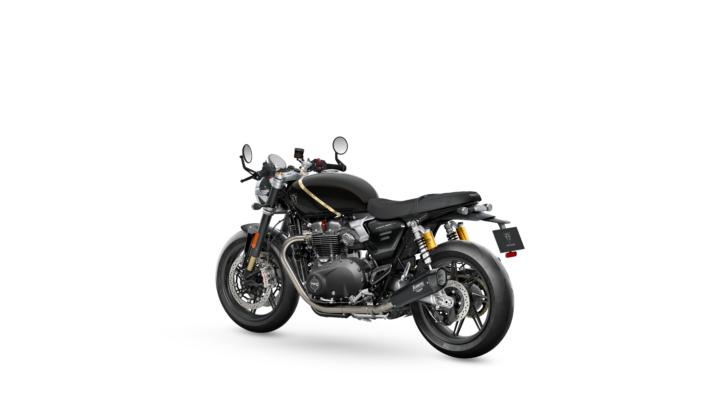
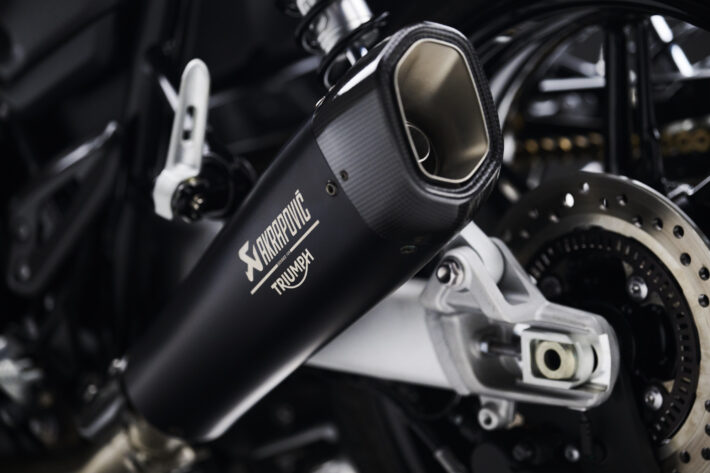
There’s no engine tweaks on the TFC models sadly (we’d love to see a higher compression piston or even a cheeky big-bore kit in there) but you do get slightly sportier pipes. Twin Akrapovič titanium megaphone silencers with black detailing and carbon fibre end caps are road legal of course, but save a bit of weight and offer a ‘deep distinctive note’ according to the firm.
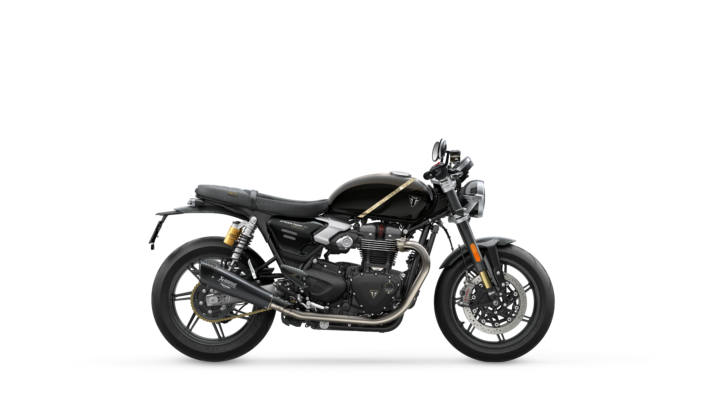
That classy motor is bolted into a tubular steel cradle main frame with a cast aluminium twin-shock swingarm, and classic café racer/retro roadster bodywork. The TFC treatment really starts in that chassis though, where the running gear has been upgraded with new more premium kit.
The rear twin shocks and 43mm USD front forks are by Öhlins, with full adjustability for preload, compression and rebound damping all round, and a subtle black/gold anodised finish on the hardware.
The brakes are also upgraded from the stock bike, with Brembo Stylema M4.30 radial calipers, paired with a Brembo radial master cylinder and 320mm floating discs up front, and they’re bolted to light cast aluminium seven-spoke wheels.
The tyre fitment is arguably overkill for such a moderate power output – Metzeler Racetec RR K3 rubber would do good work with a 205bhp machine on a race track never mind a 105bhp road bike – but then we’d never complain about *too much* grip on any bike.
And let’s be honest, the TFC Speed Twin isn’t likely to be putting in many 1,500 mile weeks to get the Metzelers worn down to the cords…
An impressive chassis setup then, and Triumph’s made a few more tweaks to make the most of it. Part of that is the riding position, and there are sporty clip-on bars instead of sit-up parts, to put more weight over the front end and give a more committed stance.
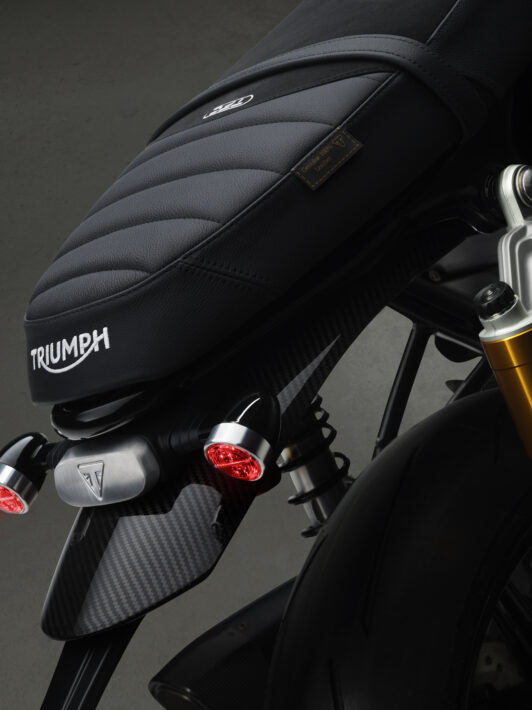
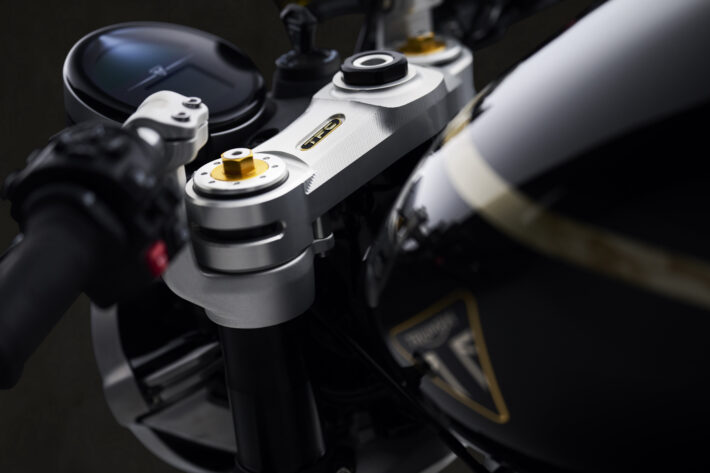
There’s also more rear-set footpegs, plus a new billet aluminium top yoke, while the sporty one-piece bench seat has a fancy leather/suede covering and tasteful ribbed stitching.
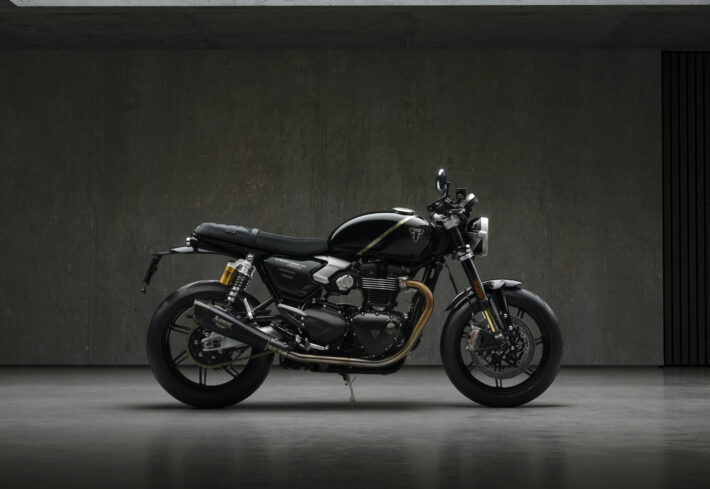
The cosmetics are a big part of the TFC project overall, and the Speed Twin is no exception. Triumph’s base level of finish and build quality has been a big focus in recent years, but the TFC bikes go an extra step.
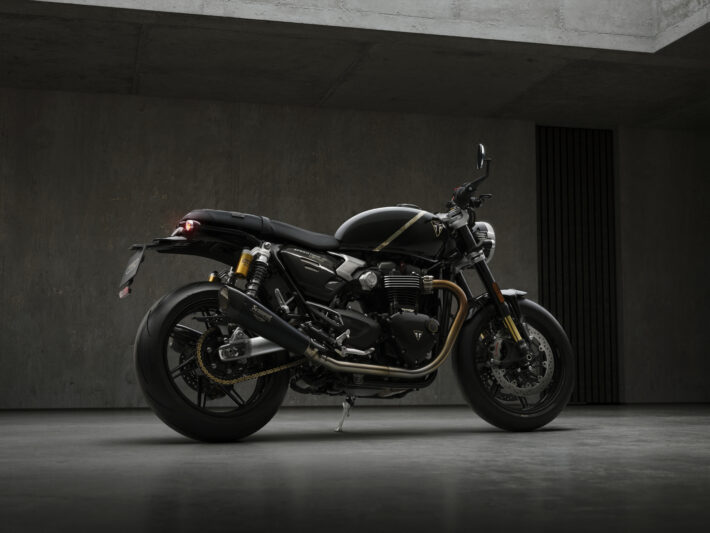
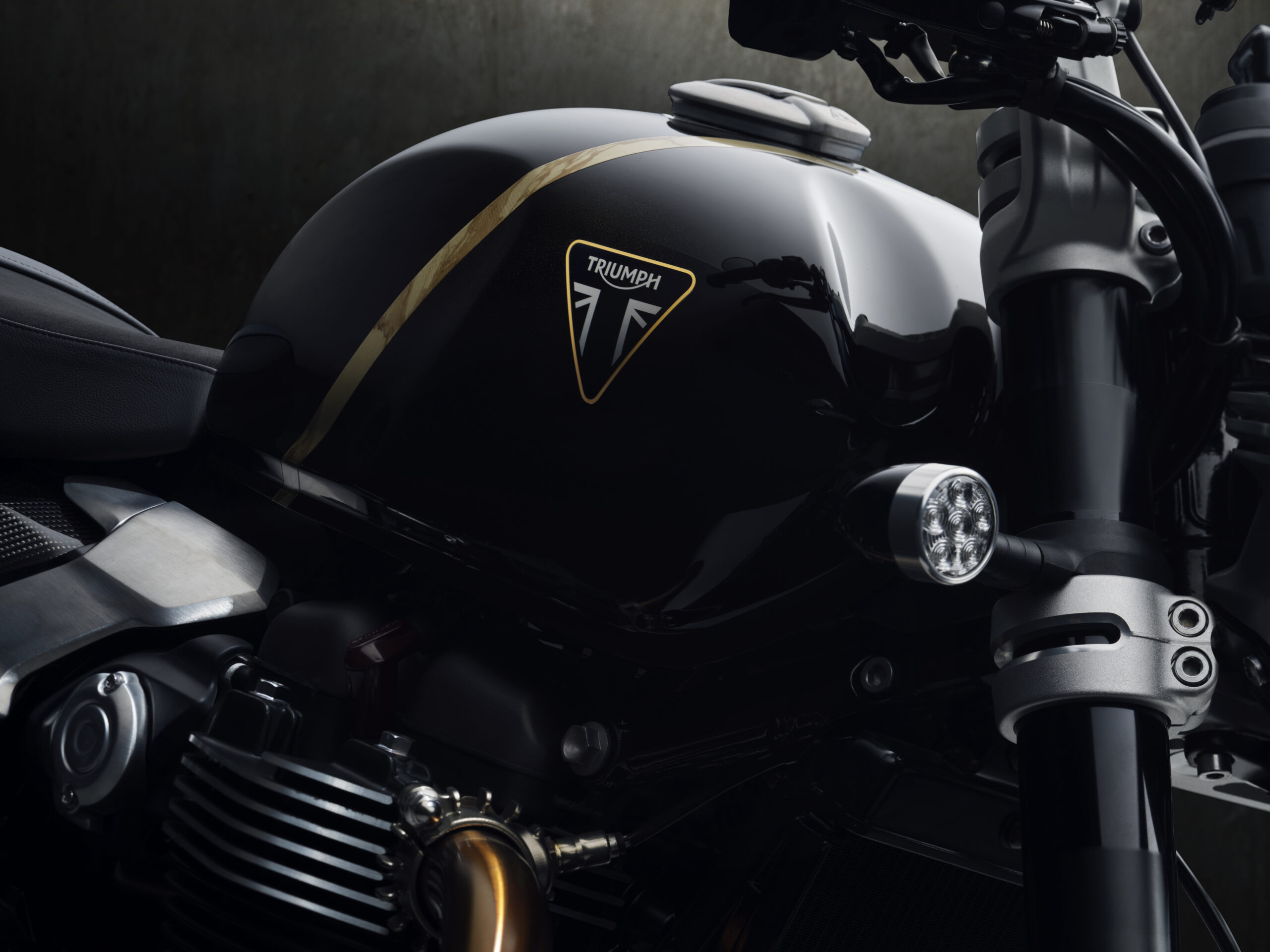
The Speed Twin gets carbon fibre bodywork with unique badging and a distinctive Obsidian Gold paint scheme. The black and gold theme is consistent with a gold chain and fork lowers, and blacked-out detailing on the engine and chassis. It’s a handsome, sophisticated look that matches the Speed Twin concept really well.
There’s plenty of sophistication in the technology as well, despite the retro looks of the bike. It has the full suite of rider aids from the standard Speed Twin, meaning you get IMU-assisted traction control and ABS, as well as up/down quickshifter and power modes, all controlled by a colour LCD dash.
Just 750 of the TFC Speed Twin version will be made, and it’s available to order now, priced from £18,495 on the road, with deliveries beginning in October 2026.
It thus sits above the Speed Twin RS version which comes with the Öhlins rear shocks and Brembo brakes but Marzocchi forks and standard pipes, and costs around £14,800. More info on the entire 1200 Speed Twin range at www.triumphmotorcycles.com.
2027 Triumph Speed Twin 1200 TFC Specs
| ENGINE AND TRANSMISSION | |
| Type | Liquid-cooled parallel twin, 8-valve, SOHC, 2700 crank order |
| Capacity | 1,200cc |
| Bore | 97.6mm |
| Stroke | 80.0mm |
| Compression | 12.1:1 |
| Maximum Power | 105PS/103.5bhp (77.2 kW) @7,750 rpm |
| Maximum Torque | 112 Nm@4,250rpm |
| Fuel System | Multipoint fuel injection with electronic throttle control. Three riding modes (Sport, Road, Rain). |
| Exhaust | Brushed stainless steel 2 into 2 exhaust system with twin Akrapovič silencers and carbon tips |
| Final Drive | X-ring chain |
| Clutch | Wet, multi-plate, slip & assist |
| Gearbox | 6-speed, Triumph Shift Assist |
| CHASSIS | |
| Frame | Tubular steel, with steel cradles |
| Swingarm | Twin sided, fabricated aluminium |
| Front Wheel | Cast aluminium alloy, 7-spoke, 17 x 3.5 in |
| Rear Wheel | Cast aluminium alloy, 7-spoke, 17 x 5.0 in |
| Front Tyre | 120/70 R17 |
| Rear Tyre | 160/60 R17 |
| Front Suspension | Öhlins Ø43mm upside down forks, adjustable for pre-load, compression and rebound damping. 120mm wheel travel |
| Rear Suspension | Öhlins twin RSUs with external reservoirs, adjustable for pre-load, compression and rebound damping. 123mm wheel travel |
| Front Brakes | Twin Ø320mm floating discs, Brembo Stylema M4.30 radial calipers, Brembo MCS lever, OCABS |
| Rear Brakes | Single Ø220mm fixed disc, Nissin 2-piston floating caliper, OCABS |
| Instruments | LCD multi-function instruments with integrated colour TFT screen |
| DIMENSIONS & WEIGHTS | |
| Length | 2073 mm |
| Width (Handlebars) | 795 mm |
| Height Without Mirrors | 1055 mm |
| Seat Height | 810 mm |
| Wheelbase | 1414 mm |
| Rake | 22.6° |
| Trail | 92 mm |
| Wet weight | 214 kg |
| Fuel Tank Capacity | 14.5 litres |
| SERVICE | |
| Service Interval | 10,000 miles (16,000km) / 12 months |
| CONSUMPTION AND EMISSIONS (EU) | |
| Fuel Consumption | 4.4 l/100km (64.2mpg) |
| Emissions | 104g/km
EURO 5+ |