
Just released, let’s take a look at the 2026 Triumph Tracker and Thruxton 400…
Older readers may remember that when Triumph relaunched as a bike firm in the early 1990s it didn’t do small bikes at all. The initial run of bikes from the Hinckley factory showed off at the Cologne bike show in 1990 were all big bruisers: the smallest was a 750 triple (soon dumped), and the majority of the new machinery used massive motors – 900cc triples, 1000cc fours and even a hefty 1200cc four.
Later on, the firm came up with the Bonneville 800 twins and then joined the 600cc class with the TT/Daytona/Speed Four lineup, but its heart seemed set on big bore bikes, as seen on the later 1200 Tiger range.
But we’re into the second half of the 2020s now, and thirty-odd years after its original beefy bike range appeared, Triumph is adapting to the new reality. Which is that small capacity bikes are back in vogue. A combination of factors – demographics (bikers are getting older, weaker, more sensible), economics (costs are up everywhere) and legal (speeding crackdowns) are all eating away at the appeal of massive mega-powered bikes, and cheaper, easier, lightweight machines are filling the gap.
The pioneers were the likes of the Royal Enfield 350 single range, alongside KTM’s 390, and BMW’s G310 – coincidentally (or not) all made in India. These bikes were solid sales hits, and the smart money has piled in to the sector: BSA, Honda, Hero – they’re all offering bikes in this class now, and Hinckley joined in a couple of years ago with its Speed and Scrambler 400 models (again, made in India with partner firm Bajaj).
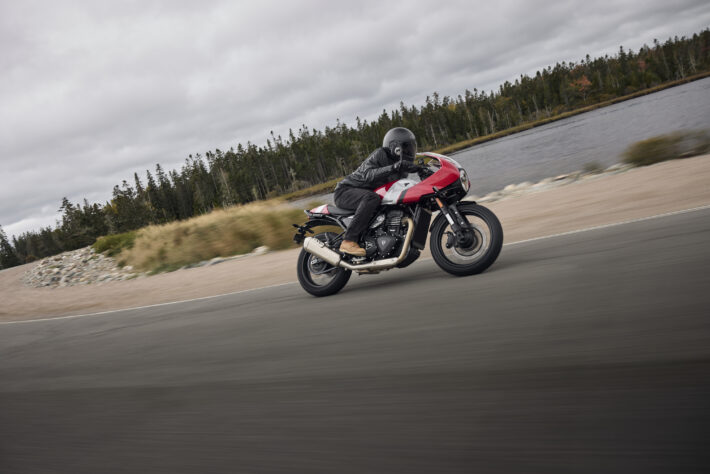
And now, Triumph’s extending the range even further, with two new lightweight 400 models, the Tracker and the Thruxton. We saw the Thruxton earlier this year: it was launched in India first, which might have come as a surprise to British fans of Triumph and its union-flag motifs. Now, the mini café-racer is coming to the rest of the world, including the UK, offering a sharp, premium, sporty-looking option in the sector.
The Thruxton 400 uses a 41.4bhp variant of the TR-series single cylinder engine from the Speed 400, with valve timing tweaks giving a bit more top end. The engine is fitted into a steel tube frame with preload-adjustable remote reservoir monoshock rear suspension, cast aluminium swingarm, and 43mm Big Piston USD front forks.
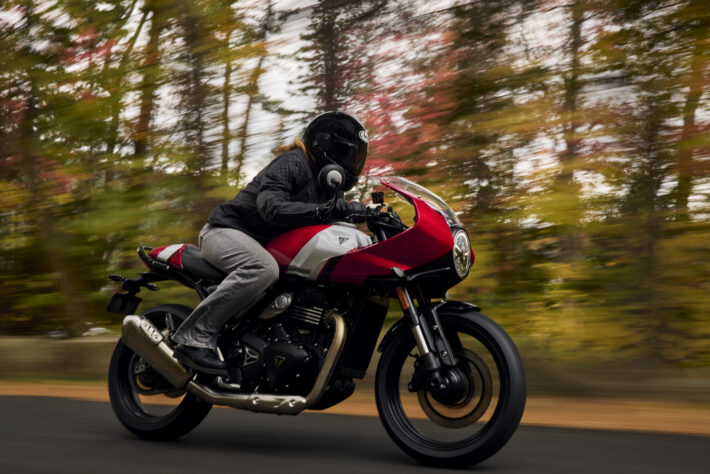
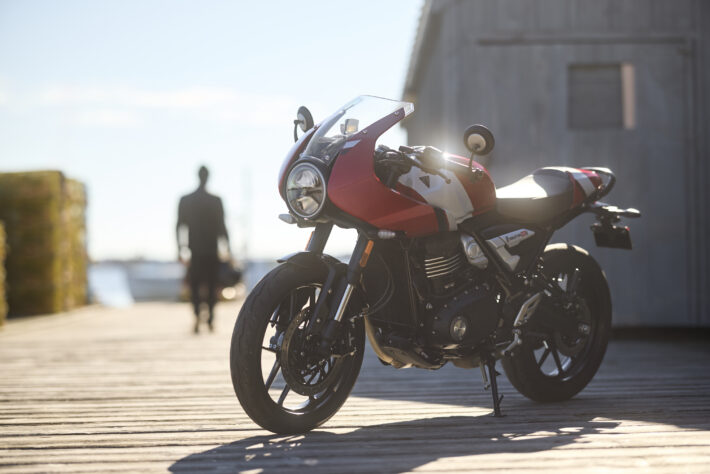
The cast aluminium wheels wear sporty Pirelli Diablo Rosso IV tyres, and there’s a proper disc brake both ends with a radial caliper and 300mm disc up front. The main feature is the neat half-fairing though, which adds a real dash of 1960s British bike style, together with the shapely fuel tank and Monza-style alloy fuel cap, rear seat cowl, clip-on bars, round headlamp and upswept exhaust silencer.
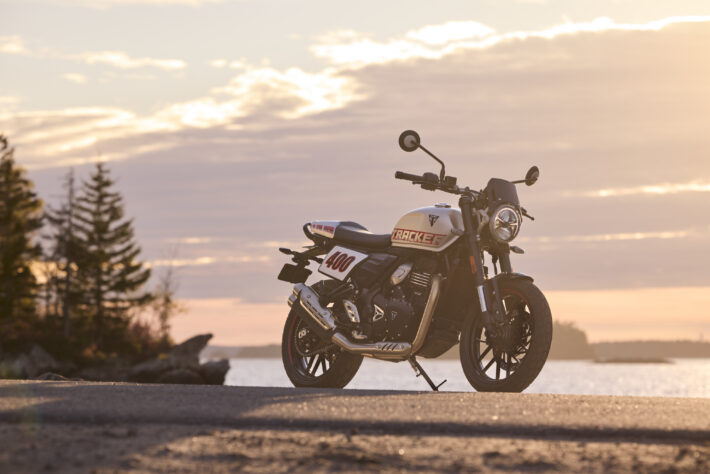
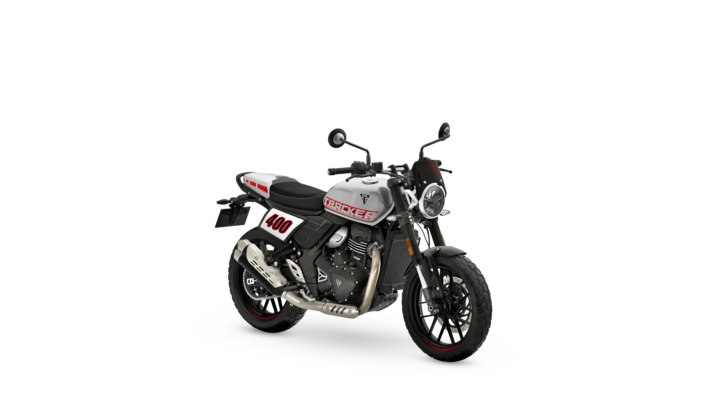
The Tracker is the real surprise though. Triumph’s come up with a slick-looking mini-flat tracker, which has the feel of something like the Ducati Scrambler Full Throttle model. The basics are the same as the rest of the 400 lineup: TR series engine making the higher 41.4bhp output, steel tube frame with cast aluminium monoshock swingarm, 43mm USD Big Piston forks, radial front brake caliper and cast aluminium wheels.
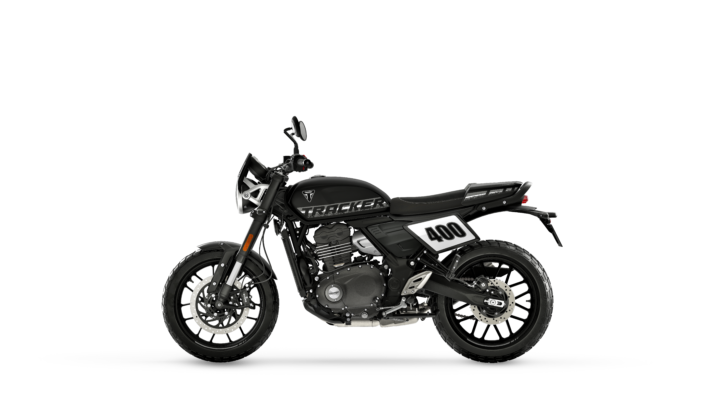
The differences come in the riding position, tyres and bodywork/styling, all of which are flat-tracker styled. The handlebars are wider and lower, plus the pegs are a bit higher and more rear-set than the Speed, giving a more committed riding position.
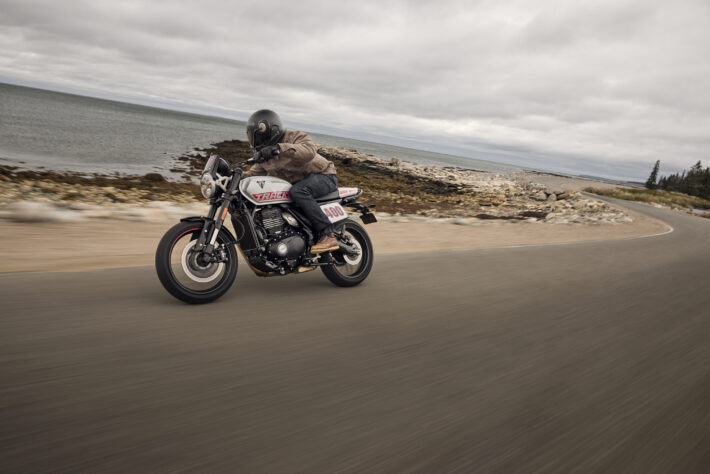
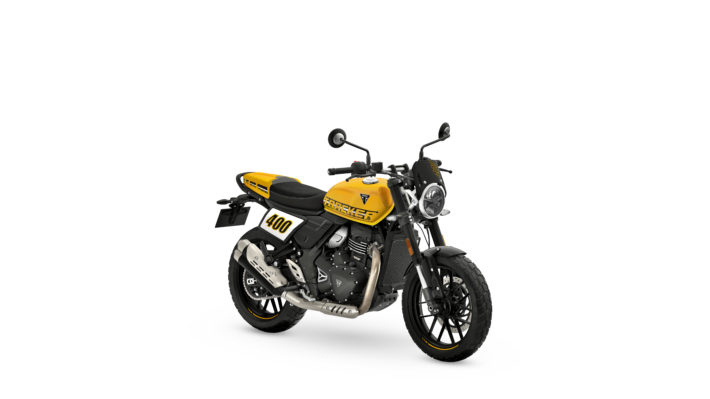
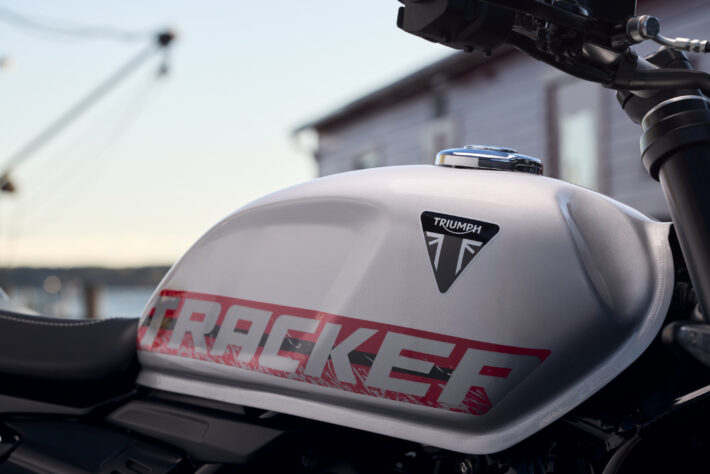
The tyres are premium Pirelli MT60 RS flat-track styled fitments, which are a sweet fitment on a small bike, and the bodywork includes a custom-designed seat cowl, number board, bespoke fuel tank and neat fly screen. The Tracker also comes in some sweet colourways: Racing Yellow, Phantom Black and Aluminium Silver Gloss.
Both bikes are out in the spring and are well priced, considering the premium design and sporty spec. The Tracker 400 will be in dealers from April 2026 priced at £5,745, while the Thruxton 400 will be available in March 2026, priced from £5,995. More details: www.triumphmotorcycles.co.uk.
SPECIFICATION – TRACKER 400
| ENGINE AND TRANSMISSION | |
| Type | Liquid-cooled, single-cylinder, 4 valve, DOHC |
| Capacity | 398 cc |
| Bore | 89.0 mm |
| Stroke | 64.0 mm |
| Compression | 12:1 |
| Maximum Power | 42 PS / 41.4 bhp (30.89 kW) @ 9,000 rpm |
| Maximum Torque | 37.5 Nm @ 7,500 rpm |
| Fuel System | Bosch electronic fuel injection with electronic throttle control |
| Exhaust | Stainless twin-skin header system with stainless steel silencer |
| Final Drive | X-ring chain |
| Clutch | Wet, multi-plate, slip & assist |
| Gearbox | 6 speed |
| CHASSIS | |
| Frame | Hybrid spine/perimeter, tubular steel, bolt-on rear subframe |
| Swingarm | Twin-sided, cast aluminium alloy |
| Front Wheel | Cast aluminium alloy, 17 x 3.0 in |
| Rear Wheel | Cast aluminium alloy, 17 x 4.0 in |
| Front Tyre | 110/70 R17 |
| Rear Tyre | 150/60 R17 |
| Front Suspension | 43mm upside down Big Piston forks. 140mm wheel travel |
| Rear Suspension | Gas monoshock RSU with external reservoir and pre-load adjustment. 130mm wheel travel |
| Front Brakes | Single 300mm fixed disc, four-piston radial caliper, ABS |
| Rear Brakes | Single 230mm fixed disc, single piston floating caliper, ABS |
| Instruments | Analogue speedometer with integrated multi-function LCD screen |
| DIMENSIONS & WEIGHTS | |
| Length | 2033 mm |
| Width (Handlebars) | 857 mm |
| Height Without Mirrors | 1050 mm |
| Seat Height | 805 mm |
| Wheelbase | 1371 mm |
| Rake | 24.4° |
| Trail | 107.6 mm |
| Wet weight | 173kg |
| Fuel Tank Capacity | 13 litres |
| SERVICE | |
| Service Interval | 10,000 miles (16,000 km) / 12 months (whichever comes first) |
| CONSUMPTION AND EMISSIONS (EU) | |
| Fuel Consumption | 3.6 litres / 100 km |